PART 3
Apparently, Daniel’s finances were none of my business when I asked questions, but they were my responsibility whenever my parents needed me to accept less than he received.
“So let me understand,” I said quietly. “You told everyone there would be no presents. Then you bought expensive gifts for Daniel’s children because he was having a difficult year.
Why couldn’t you have given Michael and Sophie something small, too? Or simply waited until another day to give Daniel’s children their presents privately?”
Mom looked away. “We didn’t want to disappoint them.”
“And you didn’t mind disappointing mine?”
She immediately raised her eyes.
“That is not what happened.”
“Then what did happen?”
For several seconds, she said nothing.
From the living room, I could hear Sophie laughing at something on television. Michael was explaining a video game to his sister. Their ordinary happiness made the conversation at the front door feel even more painful.
Mom glanced inside again.
“Can we talk somewhere privately?”
“We are talking privately.”
“Paul, please. I didn’t come here to fight.”
“Neither did I. I wrote you a letter because I wanted you to understand what happened. You came here because you didn’t like what I wrote.”
Her expression changed.
For the first time since she arrived, she looked less offended than uncomfortable.
“I thought you understood our family,” she said.
There it was.
The familiar sentence.
The one that had followed me through childhood, adulthood, birthdays, holidays, and every family gathering where Daniel received something I didn’t.
You understand.
I folded my arms.
“I understand more than you think.”
Mom sighed dramatically.
“Your brother has always needed more help than you. You were the responsible one. You always managed to figure things out. Daniel needed us to give him a little extra support.”
“I was eleven when Dad told me I was too old to need help with my homework. Daniel was thirteen when you hired a tutor because he didn’t want to study by himself. I was seventeen when I worked weekends to buy my first car. Daniel was twenty-one when Dad gave him money for a car because he didn’t like taking the bus.”
Mom blinked.
“I don’t remember every little thing that happened when you were children.”
“I do.”
My voice wasn’t loud, but something in it made her stop.
“I remember all of it.”
She tightened her grip on her purse.
“You’re making this about the past.”
“No. I’m telling you that Christmas wasn’t the first time. It was just the first time I watched you do it to my children.”
Mom’s eyes filled with tears, but I had lived long enough to know that tears didn’t automatically mean someone understood the pain they had caused.
“Daniel’s children are teenagers,” she said. “They understand these things differently. Michael and Sophie are still young. They have plenty of Christmases ahead of them.”
I felt something inside me go very still.
“So because my children have more Christmases ahead of them, it doesn’t matter if you hurt them this year?”
“That isn’t what I said.”
“Then tell me what you meant.”
She opened her mouth, then closed it.
Finally, she said, “Your father thought it would be better if we gave Daniel’s children their gifts at Christmas dinner. He said you wouldn’t mind.”
I stared at her.
“Dad said I wouldn’t mind?”
“He said you were doing well. You have a good job, a nice house, and a wonderful family. You and your wife can afford to give your children whatever they need. Daniel isn’t in the same position.”
I couldn’t believe what I was hearing.
My parents had looked at the life I had built through years of work, saving, and careful decisions, then decided that my stability meant my children deserved less consideration.
Because I had managed my responsibilities, I had somehow lost the right to expect fairness.
“Did Dad say anything about how Michael and Sophie might feel?” I asked.
Mom didn’t answer.
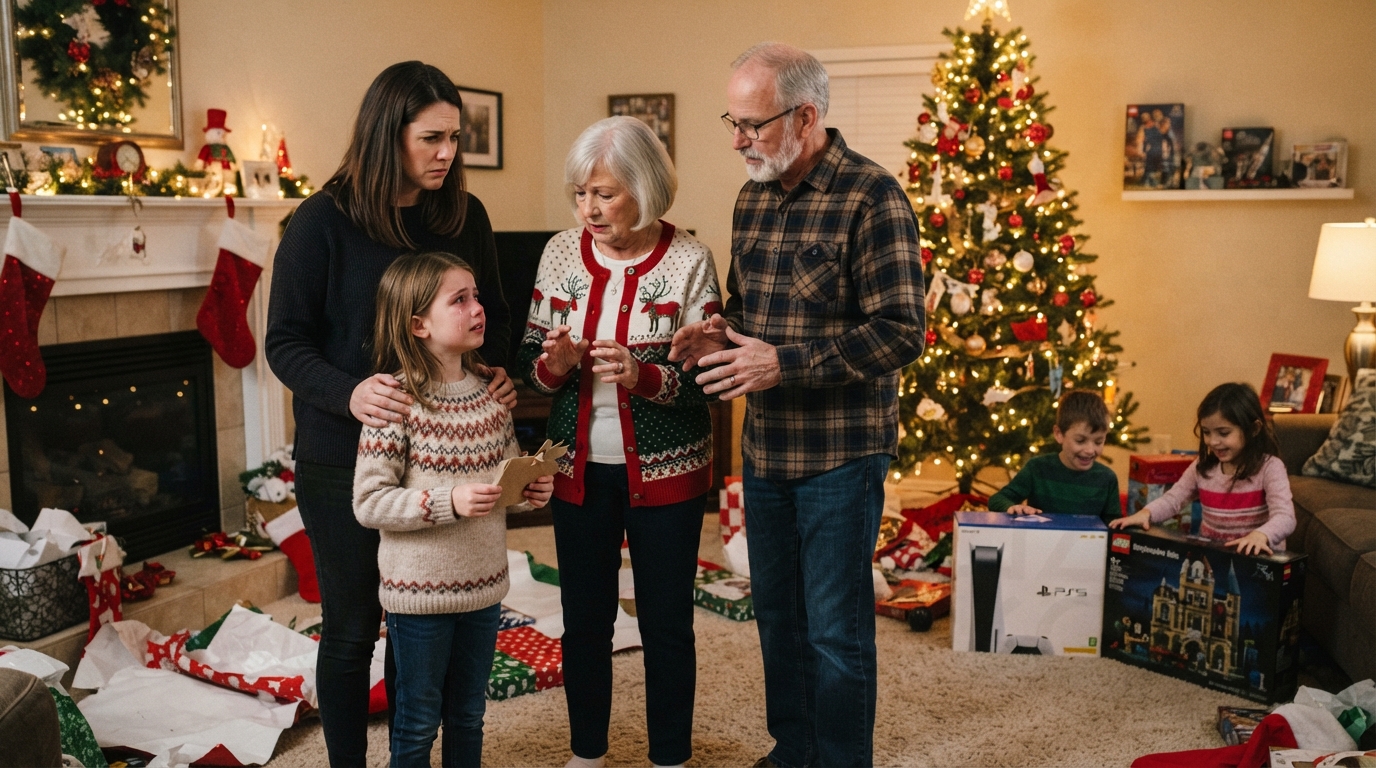
“Did either of you think about what would happen when Sophie saw her cousins opening MacBooks and designer handbags while she sat there wondering why Santa had forgotten her?”
“Paul, we didn’t think she would take it that way.”
“She is eight years old, Mom. What other way was she supposed to take it?”
Mom looked toward the living room again.
Then she said something that made the entire conversation feel even worse.
“Your father thinks you should have explained to the children that their cousins had earned those presents.”
I actually stepped back.
“Earned them?”
“Yes. Daniel’s children have been doing very well in school. They have extracurricular activities, and they’ve worked hard. Your father wanted to reward them.”
I looked at her for a long moment.
“Michael won his school’s mathematics competition this year. Sophie spent two months collecting food for a local shelter. She even donated some of her allowance because she wanted other children to have something special for Christmas. Did you know that?”
Mom’s face changed slightly.
“No.”
“Of course you didn’t.”
I felt the sting of those words as soon as I said them, but I didn’t take them back.
“You didn’t ask about their grades. You didn’t ask about their activities. You didn’t even look at the drawing Sophie made for you. You put it aside before the ink was dry.”
Mom looked down at her purse.
“I was busy preparing dinner.”
“You had time to buy designer handbags.”
She flinched.
For the first time, I saw something other than indignation on her face.
She looked embarrassed.
But embarrassment wasn’t an apology.
“Paul,” she whispered, “you have to understand that your father and I love all our grandchildren.”
“I hope you do.”
“We would never intentionally hurt them.”
“Then why are you defending what happened instead of apologizing for it?”
She didn’t answer.
I waited.
The silence stretched between us.
Finally, Mom wiped her cheek and said, “I suppose I could have handled it differently.”
I wanted those words to be enough.
For a moment, I even considered accepting them simply because I was tired. Tired of arguing. Tired of trying to explain things that should have been obvious. Tired of feeling like the difficult son whenever I asked to be treated with the same consideration as my brother.
But then I remembered Sophie sitting beneath that Christmas tree.
I remembered Michael pretending not to care.
And I realized that accepting another half-apology would teach my children the same lesson I had spent my entire life trying to unlearn.
“Could have handled it differently?” I repeated.
Mom looked at me.
“Paul, what do you want me to say?”
“The truth.”
“I’ve told you the truth.”
“No. You’ve told me why you think what you did was reasonable. I’m asking you to acknowledge what it did to my children.”
Her eyes hardened again.
“I cannot believe you’re demanding an apology over Christmas presents.”
“I’m not demanding an apology over presents.”
I stepped away from the doorway, leaving the entrance open but making no move to invite her inside.
“I’m asking you to understand why two children who followed your rules ended up feeling less loved than their cousins.”
Mom stood perfectly still.
Then, from the living room, Sophie called out.
“Dad? Who’s at the door?”
Mom’s expression changed immediately.
She straightened her coat and forced a small smile.
“It’s Grandma, sweetheart!”
Sophie appeared around the corner.
She was wearing the pink sweater she had received that morning, and one of her new books was tucked under her arm.
When she saw my mother, her face brightened.
“Grandma!”
She hurried toward the doorway.
For one hopeful second, I thought Mom might finally do something simple and kind. I thought she might kneel down, hug her granddaughter, and tell her that she was sorry Christmas had hurt her feelings.
Instead, Mom patted Sophie’s head and said, “Hello, darling. Have you been a good girl?”
Sophie nodded.
“I think so.”
Mom smiled.
“Good girls don’t worry about presents, you know. Christmas is about being grateful for what you have.”
Sophie looked down at the book in her hands.
“I am grateful,” she said softly. “Daddy and Mommy gave me nice presents.”
“That’s wonderful.”
“But I still don’t understand why you said there wouldn’t be any presents, and then Cousin Emily got so many.”
Mom’s smile froze.
I felt my stomach tighten.
Sophie wasn’t being disrespectful. She wasn’t demanding anything. She was simply asking the question that no adult in our family seemed willing to answer honestly.
Mom glanced at me.
“Your father and I had a special reason.”
“What reason?”
“Sophie,” I interrupted gently, “Grandma and I are having a conversation right now.”
She looked at me, then at her grandmother.
“Okay.”
She walked back toward the living room, but before she disappeared around the corner, she turned once more.
“Grandma?”
“Yes, sweetheart?”
“Next Christmas, will Santa come to Grandma’s house for me, too?”
Mom’s lips parted.
Nothing came out.
Sophie waited for a moment, then quietly returned to her book.
I looked at my mother.
“You should go home, Mom.”
She stared at me as though I had slapped her.
“You’re asking me to leave?”
“Yes.”
“After everything we’ve done for you?”
I closed my eyes briefly.
There it was again.
Not concern for Sophie.
Not regret over Michael.
Not even an attempt to make things right.
Just a reminder that I owed them something.
“I didn’t ask you to buy me presents,” I said. “I didn’t ask you for money. I didn’t ask you to do anything for me. I asked you to treat my children with basic kindness.”
Mom’s chin trembled.
“You’ve changed, Paul.”
“No,” I said quietly. “I think I’m finally changing the things I used to accept.”
She stood there for another moment, apparently waiting for me to reconsider.
When I didn’t, she turned and walked down the front steps.
I watched her reach her car before closing the door.
My wife appeared beside me.
“Are you okay?”
I shook my head.
“No. But I think I needed to do that.”
She slipped her hand into mine.
“You did.”
We stood together in the hallway for a while.
Then she leaned against my shoulder and whispered, “You know what hurts the most?”
“What?”
“Michael and Sophie weren’t asking for expensive things. They weren’t even expecting presents at your parents’ house. They were expecting to be included.”
I looked toward the living room.
Michael was helping Sophie arrange her new books on the coffee table. He was pretending to be interested in the television, but I knew him well enough to recognize when he was trying to keep his feelings hidden.
“I know,” I whispered.
And for the first time in my life, I understood that protecting my children might mean disappointing my parents.
I wasn’t sure I was ready for what would come next.
But I knew I couldn’t go back to pretending nothing had happened.
The next three days were strangely quiet.
My mother didn’t call.
My father didn’t leave any more voicemails.
Daniel sent a photograph of his children standing beside their new Christmas gifts, accompanied by a message that read:
The kids are loving their presents. Hope Michael and Sophie enjoyed theirs, too.
I stared at the message for a long time.
There was no acknowledgment of what had happened.
No apology.
Not even a hint that he understood why I might still be upset.
I put my phone down without responding.
That evening, my wife and I sat at the kitchen table after the children had gone to bed.
The Christmas tree lights reflected in the window, and the house was quiet except for the hum of the refrigerator.
“I think you should decide what kind of relationship you want with your parents going forward,” she said.
I rubbed my forehead.
“I don’t want to cut them out of our lives.”
“Then don’t make that decision just because you’re angry.”
She reached across the table and took my hand.
“But don’t keep bringing the children into situations where they have to wonder why Grandma and Grandpa treat them differently.”
I looked at her.
“What if my parents never admit they did anything wrong?”
“Then you’ll have to decide whether you can have a healthy relationship with them without that admission.”
I thought about it.
My parents had never been particularly good at apologizing. They preferred to explain, justify, redirect, or remind me of everything they had done for me.
When I was younger, I had believed that if I explained myself clearly enough, they would eventually understand.
As an adult, I had learned that some people could understand your pain perfectly well and still refuse to accept responsibility for causing it.
“I want them in the children’s lives,” I said.
“Then they need to show the children that they belong there.”
I nodded slowly.
That night, I wrote down three simple boundaries in a notebook.
First, I would no longer agree to family arrangements that depended on vague promises or unspoken expectations.
Second, I would not ask my children to ignore unequal treatment simply to keep the peace.
Third, if my parents wanted a relationship with their grandchildren, they would have to treat all of them with respect, regardless of how much money they spent or how successful their parents appeared to be.
I wasn’t planning to send the list to anyone.
It was for me.
A reminder that love didn’t require me to keep accepting the same hurtful behavior.
For the first time in years, I felt a little lighter.
Then, on the afternoon of December 30, my phone rang.
It was my father.
I almost let it go to voicemail.
Instead, I answered.
“Hello?”
“Your mother tells me you asked her to leave your house.”
His voice was cold and controlled.
“I did.”
“Do you have any idea how upset she was?”
“I imagine she was upset.”
“She went over there to make peace, and you humiliated her.”
I leaned back in my chair.
“Dad, she came over to explain why you bought expensive presents for Daniel’s children after telling everyone there would be no gifts. She didn’t apologize to Michael or Sophie. She told Sophie to be grateful.”
“She was trying to teach her a lesson.”
“What lesson?”
“That life isn’t always fair.”
I stared at the wall.
For a moment, I couldn’t speak.
Then I said, “You taught me that lesson when I was a child. I don’t need you to teach it to my children.”
Dad made a frustrated sound.
“You’re thirty-six years old, Paul. You have a wife, a house, a good job. You should be mature enough to understand that families have different needs.”
“Why do Daniel’s needs always come first?”
“Because he needs more help.”
“Does he?”
“Yes.”
“Then why did you give his children MacBooks and designer handbags?”
Dad went silent.
I waited.
Finally, he said, “That is not the point.”
“Then what is the point?”
“The point is that your mother and I have spent our entire lives trying to keep this family together, and now you’re threatening to tear it apart over one Christmas dinner.”
I looked at the framed photograph on the bookshelf across from me.
It showed our family at the beach two summers earlier. Michael and Sophie were standing in front of us, grinning at the camera. Daniel’s family stood on the other side of my parents.
Everyone was smiling.
I remembered taking that photograph.
I also remembered that Dad had spent most of that trip discussing Daniel’s business plans while barely asking me about my job.
I had dismissed it then.
I had dismissed so many things.
“I’m not tearing the family apart,” I said. “I’m refusing to pretend that nothing happened.”
Dad sighed.
“You’ve always been too sensitive.”
I closed my eyes.
For years, that phrase had made me question myself.
Maybe I was too sensitive.
Maybe I remembered things incorrectly.
Maybe I expected too much.
Maybe being a good son meant swallowing every disappointment and smiling through every family gathering.
But I wasn’t a child anymore.
And my children weren’t responsible for protecting my parents from the consequences of their own decisions.
“I have to go, Dad.”
“Paul—”
“I love you. But I’m not discussing this anymore unless you’re willing to talk about what happened to Michael and Sophie.”
I ended the call.
My hands were shaking slightly.
Not because I regretted what I had said.
Because I couldn’t remember the last time I had spoken to my father without immediately trying to make him happy afterward.
That evening, Michael came into the kitchen while I was washing dishes.
“Dad?”
I turned off the faucet.
“What’s up, buddy?”
He hesitated.
“Are Grandma and Grandpa mad at us?”
The question hit harder than anything my father had said.
“Why would you think that?”
“Because we left their house early. And now Grandma hasn’t called.”
I dried my hands and crouched so we were at eye level.
“No, buddy. You didn’t do anything wrong.”
“Then why didn’t they give us presents?”
I had prepared myself for this conversation a dozen times, but none of those imagined versions had made the real moment easier.
“Sometimes adults make decisions that aren’t fair,” I said. “And sometimes they make mistakes that hurt people they love.”
Michael studied my face.
“Did Grandma and Grandpa make a mistake?”
I took a breath.
“I think they made a decision without thinking enough about how it would affect you and Sophie.”
He looked down at the floor.
“Maybe they forgot us.”
I felt my chest tighten.
“No, Michael. They didn’t forget you. They knew you were there.”
His eyes filled with tears.
“Then why did they only give presents to Emily and Noah?”
I pulled him into a hug.
“I don’t know, buddy. I wish I had a better answer.”
He wrapped his arms around my neck and held on.
For a long time, neither of us spoke.
Then he whispered, “I told Sophie that Santa probably got confused.”
I closed my eyes.
“Oh, buddy.”
“I didn’t want her to feel bad.”
I hugged him more tightly.
At eleven years old, my son had tried to protect his younger sister from the same hurt I had spent decades pretending didn’t exist.
And that was when I made a promise to myself.
My children would never have to earn the right to feel loved in our family.
They would never be told to stay quiet because someone else’s feelings mattered more.
And they would never be expected to accept humiliation simply because the people hurting them were relatives.
I kissed the top of Michael’s head.
“You don’t have to make excuses for grown-ups, okay? That’s not your job.”
He nodded against my shoulder.
After a moment, he pulled away and wiped his eyes.
“Can we still visit Grandma and Grandpa someday?”
I looked at him carefully.
“If they treat you and Sophie kindly, yes. But we won’t go somewhere just to pretend everything is okay when it isn’t.”
He thought about that.
Then he nodded again.
“Okay, Dad.”
He went back to the living room.
I stayed in the kitchen for several minutes, staring at the sink.
That was the moment I stopped thinking of boundaries as a punishment.
They weren’t a way to make my parents suffer.
They were a way to make sure my children didn’t have to carry the same pain I had carried for years.
And I was determined to keep that promise.
On December 31, Daniel finally called.
I was in the garage, putting away the Christmas decorations, when his name appeared on my phone.
I answered with a simple greeting.
“Hey.”
“Hey, man. You got a minute?”
“Sure.”
He sounded unusually hesitant.
“Mom says things got pretty bad when she came over.”
I put the box of ornaments on the shelf.
“What did she tell you?”
“That you accused her of treating your kids badly. That you told her to leave.”
“That’s accurate.”
He sighed.
“Paul, look, I don’t want this to become a huge family thing.”
“Neither do I.”
“Then can we just move on?”
I leaned against the workbench.
“Move on to what, Daniel?”
“To normal. You know what I mean.”
“No, I don’t.”
He was quiet for a moment.
Then he said, “Look, I get that the Christmas thing looked bad. But Mom and Dad have helped me a lot this year. They wanted to do something nice for the kids. I didn’t ask them to make a big announcement or anything.”
“Did you know they were buying the gifts?”
Another pause.
“Yeah.”
“Did you know Mom had told everyone there would be no presents?”
“Of course.”
I waited.
Daniel exhaled.
“Paul, I didn’t think it would turn into this.”
“Why didn’t you suggest giving the presents to your children privately?”
“I don’t know. I didn’t think about it.”
“Did you think about Michael and Sophie sitting there?”
He didn’t answer immediately.
Then he said, “They’re your kids, man. You could have taken them home if they were upset.”
For a moment, I couldn’t believe what I had heard.
I had taken them home.
I had done exactly that.
But Daniel spoke as though the problem had been my reaction rather than the decision that had hurt them.
“I did take them home,” I said. “Because I wasn’t going to make them sit there and watch it continue.”
“See? So they’re fine now.”
I gripped the edge of the workbench.
“No, Daniel. They’re not fine just because I brought them home and gave them their own presents. Michael thought our parents had forgotten him. Sophie asked why Santa didn’t come for her. Those are things children shouldn’t have to worry about because adults couldn’t be bothered to think about how their actions might affect them.”
Daniel was silent.
For a moment, I thought he might finally understand.
Then he said, “You’re making me feel like I did something terrible.”
I stared at the concrete floor.
“I didn’t call you to make you feel anything. I’m telling you what happened.”
“Well, I can’t change what happened now.”
“No. But you can acknowledge it.”
He sighed.
“Fine. I’m sorry your kids felt bad.”
The words were so carefully arranged that they barely resembled an apology.
I didn’t argue.
I simply said, “I hope you think about what happened.”
Then I ended the call.
I went back to the decorations, but my mind remained on the conversation.
For years, Daniel and I had occupied different roles in the same family.
He was the one who needed help.
I was the one who could manage.
He was the one whose mistakes required understanding.
I was the one whose objections required correction.
And whenever I tried to change those roles, the entire family acted as though I had broken some unspoken agreement.
But I had never agreed to be the son who deserved less.
I had simply been too young to know that I could refuse.
On New Year’s Day, we visited a small park near our house.
The children played on the swings while my wife and I sat on a bench with coffee.
The sky was clear, and the air was cold enough that we could see our breath.
For the first time since Christmas, the four of us were together without the weight of my parents’ disappointment hanging over us.
Sophie came running toward us with a handful of small stones.
“Look, Mommy! I found a heart!”
She held up a gray stone that vaguely resembled one.
My wife smiled.
“That’s beautiful, sweetheart.”
Sophie placed it in her coat pocket.
“I’m going to keep it.”
Michael approached more slowly, his hands tucked into his hoodie.
“Dad?”
“Yeah?”
“Can we do Christmas at home next year?”
I looked at him.
“Of course we can.”
“Even if Grandma and Grandpa invite us?”
“Even then. We’ll decide what’s best for our family.”
He nodded, seeming relieved.
Then he asked, “Does that mean we won’t see them anymore?”
“No, buddy. It just means we won’t put ourselves in a situation where we feel hurt and then pretend it didn’t happen.”
He considered that answer.
“Okay.”
Sophie climbed onto the bench beside her mother.
“I think next Christmas we should make cookies for the neighbors,” she announced.
My wife smiled.
“That’s a wonderful idea.”
“And we can give some to the people at the hospital. Some people have to work on Christmas, right?”
“That’s right,” I said.
Sophie nodded solemnly.
“Then they should get cookies, too.”
Michael laughed.
“Can I help make them?”
“Of course,” she said. “But you have to help clean up.”
He groaned.
Sophie giggled.
And just like that, the conversation moved on.
They were children.
They deserved to spend their time thinking about cookies, games, school, and all the small things that made life exciting.
They shouldn’t have been burdened with trying to understand why their grandparents seemed to value them differently from their cousins.
Watching them run toward the playground, I realized that the best thing I could give my children wasn’t an explanation for every unfair thing that happened.
It was the knowledge that when something hurt them, they could come to me.
They wouldn’t have to convince me that their feelings mattered.
They wouldn’t have to prove they were good enough.
And they wouldn’t have to stay somewhere painful just because leaving might upset someone else.
I took my wife’s hand.
“Thank you,” I whispered.
She looked at me.
“For what?”
“For helping me see that I don’t have to keep doing things the way my parents expect.”
She squeezed my hand.
“You don’t.”
For the first time, I believed her completely.
But I still hadn’t heard the last of my parents.
On January 3, a message appeared in our family group chat.
It was from my father.
Your mother and I have decided that we need to have a family meeting. There are things that need to be discussed before this gets any worse.
I stared at the screen.
A few seconds later, Daniel responded.
Agreed. We should all sit down and clear the air.
Then Mom sent a message.
Sunday afternoon. Everyone at our house. No excuses, please.
I put the phone down.
My wife looked over from the couch.
“What is it?”
I showed her the messages.
She read them, then looked at me.
“Do you want to go?”
I thought about it.
Part of me wanted to refuse immediately. I could already imagine my father explaining why I was wrong, my mother crying, and Daniel insisting that everyone should move on.
But another part of me wanted to hear what they had to say.
Not because I expected them to change.
Because I wanted to know whether there was any possibility of building a different relationship with them.
“I’ll go,” I said. “But I’m not bringing the kids.”
My wife nodded.
“That’s probably best.”
I typed a short response.
I’ll come on Sunday. I want us to have an honest conversation about what happened, and I don’t want the children involved in an argument.
Dad responded almost immediately.
Fine. Sunday at two.
I put my phone away.
For the first time, I wasn’t going to the family meeting to defend myself or persuade anyone that I deserved equal treatment.
I was going because I had finally learned that I could tell the truth without asking permission.
And whatever happened on Sunday, I was no longer willing to sacrifice my children’s peace to protect my parents’ pride.
PART 4
On Sunday afternoon, I arrived at my parents’ house ten minutes before two.
I had spent the entire drive reminding myself of one thing: I wasn’t there to win an argument. I was there to find out whether my family could acknowledge the truth.
When I walked into the living room, Dad was sitting in his usual armchair. Mom sat beside him with a box of tissues on the coffee table. Daniel was on the couch, scrolling through his phone.
Nobody offered me coffee.
Nobody asked how Michael and Sophie were doing.
Dad simply pointed toward the empty chair across from him.
“Sit down, Paul. We need to get this sorted out.”
I sat.
Mom immediately began speaking.
“Your father and I have been very upset about how Christmas turned out. We never intended for anyone to feel excluded.”
I nodded.
“Then I hope we can talk honestly about why it happened.”
Dad leaned forward.
“We’ve already explained why. Daniel’s family needed extra help this year, and we wanted to make Christmas special for his children.”
I looked at Daniel.
“Did you need extra help buying presents for your children?”
He shifted uncomfortably.
“No. Mom and Dad offered.”
“Did you know they were buying the gifts after Mom told everyone there wouldn’t be any?”
“Yes.”
“Did you suggest giving the presents privately so my children wouldn’t feel excluded?”
Daniel rubbed his forehead.
“No, Paul. I didn’t think about it.”
I nodded slowly.
“That’s what I wanted to understand.”
Dad interrupted.
“Enough with the interrogation. Daniel has admitted that he could have handled things differently. What more do you want?”
I looked directly at him.
“I want you to understand that the problem wasn’t the price of the presents. It was the decision to make one set of grandchildren feel special by making the other set feel forgotten.”
Mom reached for a tissue.
“We never wanted Sophie to think Santa had forgotten her.”
“But she did.”
Mom lowered her eyes.
“And Michael thought you had forgotten him, too,” I continued. “They weren’t expecting anything from you. They were following the rules you gave us. They brought cookies and a card. Sophie made a picture of our entire family because she wanted you to have something from her.”
I paused, remembering the drawing sitting on the side table.
“You didn’t even look at it.”
Mom began crying.
Dad shook his head.
“This is exactly what I mean. Every little thing becomes a tragedy with you.”
I felt the familiar urge to defend myself, to list every example from my childhood, to prove that this wasn’t just one incident.
But then I realized I didn’t need to convince him that I had been hurt.
He had heard me.
He simply didn’t want to accept what I was saying.
“Dad,” I said quietly, “I’m not asking you to agree with every feeling I have. I’m asking you to consider the feelings of two children who love you.”
He folded his arms.
“They’ll get over it.”
Those four words settled over the room.
Daniel stopped looking at his phone.
Mom’s crying slowed.
And I finally understood something I had struggled with for most of my life.
My father believed that because pain eventually faded, the person who caused it had no responsibility to address it.
I stood up.
“I think we’re finished here.”
Mom immediately reached for my arm.
“Paul, please sit down. We haven’t even discussed what we’re going to do about this.”
I looked at her hand, then gently stepped away.
“What do you mean?”
Dad exchanged a glance with Mom.
Then he said, “We think you should bring the children over next weekend. We’ll give them some presents, and everyone can move on.”
For a moment, I was tempted.
Not because I wanted gifts for my children, but because I wanted them to have happy memories with their grandparents. I wanted Sophie to stop wondering whether she was less important. I wanted Michael to feel comfortable enough to laugh around them again.
But I couldn’t pretend that a few wrapped boxes would repair what had happened.
“Will you apologize to them?” I asked.
Dad looked offended.
“For what?”
“For making them feel excluded.”
Mom wiped her cheeks.
“We can tell them there was a misunderstanding.”
“No,” I said. “There wasn’t a misunderstanding. You told us there would be no gifts. Then you gave gifts to Daniel’s children in front of everyone.”
Dad’s face reddened.
“Are you seriously going to keep holding this over our heads?”
“No. I’m going to stop pretending it didn’t happen.”
I picked up my coat.
“If you want a relationship with Michael and Sophie, you need to acknowledge their feelings. You don’t have to buy them anything. You don’t have to spend the same amount of money on every grandchild. But you cannot deliberately exclude them from a family celebration and then tell them to be grateful for whatever they have.”
Daniel finally spoke.
“Paul, come on. They’re our parents.”
I turned toward him.
“And Michael and Sophie are your niece and nephew. Did you think about that when your children were opening their presents?”