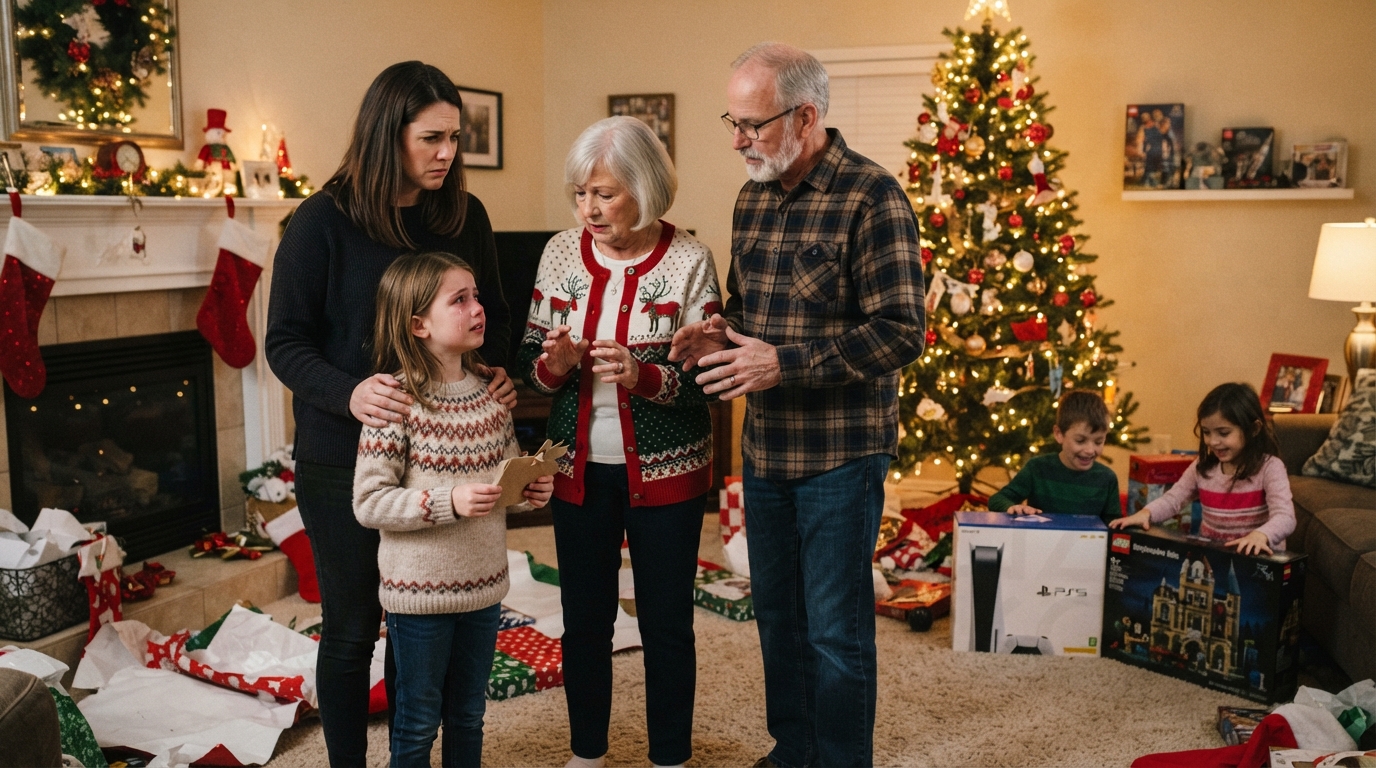
He looked down.
For once, he didn’t have an answer.
I continued.
“I love you, Daniel. I love Mom and Dad. But I’m not going to teach my children that being part of a family means accepting whatever treatment they receive.”
Then I walked out.
No shouting.
No dramatic argument.
No final insult.
Just a quiet decision to stop participating in a pattern that had hurt me for years.
As I drove home, I felt a mixture of sadness and relief.
I knew my parents were angry.
I knew they would probably tell relatives that I was being unreasonable.
But I also knew that when Michael and Sophie grew up, I wanted them to remember that their father stood beside them when it mattered.
Not that he demanded expensive gifts.
Not that he won an argument.
That he listened.
That he believed them.
And that he loved them enough to say no when something wasn’t right.
The Phone Call I Never Expected
For the next two weeks, I kept my distance from my parents.
We didn’t argue. We didn’t exchange angry messages. I simply stopped initiating contact.
Life continued.
I went to work. My wife helped the children with their schoolwork. We made pancakes on Saturday mornings and watched movies together on Friday nights.
Slowly, Christmas became a memory rather than an open wound.
Then, on a Thursday evening, my phone rang.
It was Daniel.
I answered cautiously.
“Hey.”
“Hey, Paul.”
His voice sounded different.
“Are you busy?”
“Not really. What’s up?”
He was quiet for a few seconds.
“Emily asked me something last night.”
I waited.
“She asked why Michael and Sophie hadn’t been over to Grandma and Grandpa’s house since Christmas.”
I leaned back on the couch.
“What did you tell her?”
“I told her you were upset about what happened.”
“And what did she say?”
Daniel exhaled.
“She asked whether her grandparents had given her and Noah all those presents because they loved them more than Michael and Sophie.”
I closed my eyes.
There was a long silence between us.
“Paul, I didn’t know what to say.”
I looked toward the kitchen, where my wife was helping Sophie prepare her school bag.
“What did you tell her?”
“I told her no. I told her that Grandma and Grandpa love all four of them.”
I didn’t interrupt.
“But then she asked why they had made such a big deal about giving them presents in front of everyone when they knew you weren’t expecting any.”
Daniel’s voice grew quieter.
“She said it made her feel uncomfortable, too.”
For the first time, I heard something in my brother’s voice that I hadn’t heard before.
Not defensiveness.
Not irritation.
Regret.
“I should have said something that night,” he admitted. “When I saw Michael sitting there, I knew something was wrong. I just didn’t want to make Mom and Dad angry.”
I stared at the ceiling.
“Why are you telling me this now?”
“Because I think I finally understand what you were trying to say.”
He paused.
“I’ve spent my entire life getting used to our parents helping me. I never really thought about what it looked like from your side. Whenever you did well, everyone assumed you didn’t need anything. Whenever I struggled, they rushed in to help.”
I said nothing.
“I thought that was normal,” he continued. “I thought you were fine because you never asked for help.”
“I stopped asking because I learned what happened when I did.”
Daniel breathed out slowly.
“I know.”
Those two words meant more to me than all his earlier explanations.
For once, he wasn’t telling me that I was too sensitive.
He wasn’t asking me to move on.
He was listening.
“I’m sorry, Paul,” he said. “Not just because the kids were hurt. I’m sorry I stood there and let it happen when I knew it wasn’t fair.”
I leaned forward, resting my elbows on my knees.
“Thank you.”
“I don’t expect you to forgive me immediately.”
“I appreciate that.”
“And I want to apologize to Michael and Sophie, too. Not with gifts. I want to tell them I should have done better.”
I thought about it for a moment.
“I’ll talk to them first. They’re still hurt, and I don’t want them to feel pressured to make you feel better.”
“That’s fair.”
Before ending the call, Daniel said something else.
“You know what Emily told me?”
“What?”
“She said she wished we’d all opened our presents at home instead. She said she didn’t like seeing Sophie look sad.”
I felt my throat tighten.
Daniel continued.
“I think our kids understand more than we give them credit for.”
After we hung up, I sat quietly for several minutes.
My brother wasn’t suddenly a different person. One conversation couldn’t undo years of unequal treatment.
But it was a beginning.
And for the first time, I felt there might be a way forward that didn’t require me to pretend the past hadn’t happened.
The Apology That Finally Reached the Children
That weekend, I spoke with Michael and Sophie.
I told them Daniel wanted to apologize for what happened at Christmas.
Michael looked thoughtful.
“Does that mean Uncle Daniel is mad at Grandma and Grandpa?”
“I don’t know how he feels about them, buddy. But he knows that what happened hurt you.”
Sophie hugged her stuffed rabbit.
“Is he going to give us presents?”
“No, sweetheart. He wants to talk to you and tell you he’s sorry.”
She considered that for a moment.
“Okay. Can we see Emily and Noah, too?”
“Of course.”
We arranged to meet Daniel and his family at a neighborhood park the following Saturday.
When we arrived, Emily and Noah ran toward Michael and Sophie. Within minutes, the four children were chasing each other across the grass, laughing as though no time had passed.
Daniel approached me.
“Thanks for coming.”
I nodded.
He looked genuinely nervous.
“I don’t know how to do this without making it awkward.”
“Just tell them the truth.”
He took a breath and walked over to the children.
“Hey, guys. Can I talk to you for a minute?”
They gathered around him.
Daniel crouched so he was at their level.
“I owe you both an apology,” he began. “At Christmas, Grandma and Grandpa gave Emily and Noah presents even though they had told everyone there wouldn’t be any. I knew about the presents, and I didn’t think enough about how that would make you feel.”
Michael looked down.
Sophie held her rabbit against her chest.
Daniel continued.
“I should have said something. I should have made sure you weren’t left out like that. I’m sorry I didn’t.”
He paused.
“You didn’t do anything wrong. You weren’t forgotten because you weren’t good enough. And you didn’t deserve to feel that way.”
Sophie’s eyes filled with tears.
“Why didn’t you tell Grandma and Grandpa?”
Daniel swallowed.
“Because I was afraid of upsetting them. That was wrong, and it wasn’t fair to you.”
Michael studied his uncle for a moment.
“Are you going to do it again?”
Daniel shook his head.
“I can’t promise that nobody in the family will ever make a mistake. But I can promise that I’ll try to do better. And if I see something unfair happening, I won’t pretend I didn’t notice.”
Michael nodded slowly.
“Okay.”
Sophie stepped forward and hugged Daniel.
“It’s okay, Uncle Daniel.”
He closed his eyes and hugged her back.
“But you still need to tell Grandma,” she added.
Daniel gave a small, sad laugh.
“Yes, sweetheart. I do.”
Afterward, the children ran back toward the playground.
Daniel and I stood beside the bench, watching them.
“I should have done that a long time ago,” he said.
“Yes,” I replied.
He nodded.
“I know.”
I didn’t tell him that everything was forgiven.
I didn’t need to.
His apology mattered because he had finally acknowledged the harm, not because it erased it.
And for the first time, my children had heard an adult admit that they had been treated unfairly without making them feel guilty for saying so.
That was a beginning worth protecting.
The Letter My Mother Read Twice
A week later, my mother sent me a text.
Could we meet? Just the two of us. I want to talk.
I stared at the message for a while before replying.
We can talk at a coffee shop on Saturday.
She agreed.
When I arrived, she was already seated near the window. A cup of tea sat untouched in front of her.
She looked older than I remembered.
Not physically, exactly.
More like someone who had spent several weeks arguing with herself and hadn’t found a comfortable answer.
I sat across from her.
“Hi, Mom.”
“Hi, Paul.”
For a moment, neither of us spoke.
Then she reached into her purse and pulled out a folded sheet of paper.
It was my letter.
The one I had mailed after Christmas.
“I’ve read this several times,” she said.
I looked at the paper.
“What do you think of it?”
She ran her fingers along the fold.
“At first, I thought you were being unfair. I thought you were trying to make your father and me feel guilty for doing something nice for Daniel’s children.”
I waited.
“But I read it again a few days later. And then I read it again.”
Her voice trembled.
“I kept thinking about the way you described Sophie asking why Santa hadn’t come for her.”
She looked up at me.
“I couldn’t stop imagining her sitting there, looking at all those presents.”
My throat tightened.
Mom continued.
“I remembered being eight years old myself. I remembered how important Christmas felt when I was little. And I realized that if someone had made me feel the way Sophie felt, I would have been heartbroken.”
She wiped her eyes.
“I didn’t want to admit that because it meant I had hurt her.”
I looked down at the table.
For years, I had imagined what it might feel like to hear my mother acknowledge the favoritism. I had imagined the relief, the validation, the sudden release of every old disappointment.
But sitting across from her now, I didn’t feel triumphant.
I felt sad.
Sad that it had taken a letter, an argument, and the hurt of two children for us to reach this moment.
Mom took a shaky breath.
“Paul, I am sorry.”
I looked at her.
“I’m sorry I told everyone there wouldn’t be presents and then made an exception for Daniel’s children. I’m sorry I let your father convince me that you wouldn’t mind. I’m sorry I put Daniel’s needs ahead of yours for so many years because I assumed you were strong enough to handle it.”
Her eyes filled.
“And I’m sorry I made you feel that your children had to accept less because you had learned to manage without asking for help.”
I couldn’t speak for a moment.
Mom reached across the table, but stopped before touching my hand.
“I know I can’t change what happened when you were a child. I know I can’t undo Christmas. But I don’t want to keep making the same mistakes.”
I took a breath.
“Why did you always treat us differently?”
She looked down at her hands.
“Your father and I used to worry about Daniel constantly. He struggled in school, and he made decisions that frightened us. We thought if we didn’t help him, he might fail.”
She paused.
“You were always so responsible. You did your homework. You got good grades. You found a job. You made plans. Every time we saw you handling something, we told ourselves you didn’t need us to worry about you.”
She looked up again.
“But somewhere along the way, we started confusing your independence with not needing love or support.”
I felt something tighten in my chest.
“Mom, I needed you, too.”
She nodded, tears running down her cheeks.
“I know that now.”
“No,” I said gently. “I needed you then.”
She closed her eyes.
For a long moment, she didn’t speak.
Then she whispered, “I’m sorry I didn’t see it.”
I looked at the woman sitting across from me.
She was my mother.
She had loved me in many ways. She had cooked my favorite meals, helped me with school projects when I was young, and held my hand when I was sick.
But she had also allowed a pattern to develop that left me feeling like the child who needed the least was the child who deserved the least.
Both things were true.
I didn’t have to erase the good memories to acknowledge the painful ones.
And I didn’t have to deny the painful ones to love her.
“I appreciate your apology,” I said.
She let out a shaky breath.
“Does that mean you’ll bring Michael and Sophie over?”
I paused.
“I want them to have a relationship with you. But I need to see that things will be different.”
She nodded.
“What do you need from me?”
“Don’t promise things you won’t do. Don’t compare the children. Don’t make them feel guilty for asking questions. And if you make a mistake, acknowledge it instead of telling them they’re too sensitive.”
Mom listened without interrupting.
“And I need you to understand that I’m not going to keep the peace by asking my children to ignore things that hurt them.”
She nodded again.
“I understand.”
I studied her face.
“Do you?”
She took a breath.
“I think I’m beginning to.”
It wasn’t a perfect answer.
But it was more honest than anything she had said on my doorstep.
Before we left, she asked whether she could see the children sometime soon.
I told her we could arrange a short visit, provided the children were comfortable.
She agreed.
Then, as I stood to leave, she said, “Paul?”
I turned.
“Your father’s not ready to apologize. He’s still angry.”
I nodded.
“I’m sorry to hear that.”
“Will you talk to him?”
“When he’s ready to have an honest conversation, I’ll listen.”
Mom looked disappointed, but she didn’t argue.
For once, she didn’t ask me to make everything easier for my father.
She simply said goodbye.
And I walked out of the coffee shop knowing that an apology couldn’t change the past, but it could open a door to something better.
Whether my parents chose to walk through it was up to them.
My Father’s Unexpected Visit
My father remained silent for another month.
He didn’t call on my birthday, although he sent a short text that read, Happy birthday. Hope you have a good day.
I thanked him.
I didn’t use the message as an opportunity to restart the argument.
I was learning that not every silence needed to be filled, and not every relationship could be repaired by one person trying harder.
Then, one Saturday morning in February, someone knocked on our front door.
When I opened it, my father stood on the porch holding a small paper bag.
“Can I come in?”
I stepped aside.
He walked into the living room, looking around as though he hadn’t been there in months.
In a way, he hadn’t.
My wife greeted him politely, then went to check on the children.
Dad sat on the couch.
I took the chair opposite him.
For a while, he talked about ordinary things. The weather. A problem with his car. A neighbor who had recently retired.
Then he placed the paper bag on the coffee table.
“I brought something for the kids.”
I looked inside.
There were two small books, one for Michael and one for Sophie.
Nothing expensive.
Nothing extravagant.
Just thoughtful little gifts.
“I saw them at the bookstore,” Dad said. “I thought Michael might like the one about space. And Sophie likes animals, doesn’t she?”
I nodded.
“She does.”
Dad looked at the books.
“I don’t know how to fix this.”
His voice was so quiet that I almost didn’t recognize it.
I sat back.
“Fix what?”
He rubbed his palms together.
“The situation with you. With the kids. With your mother.”
He looked toward the hallway.
“Your mother told me what she said to you at the coffee shop. She told me about your letter.”
I waited.
“She thinks I should apologize.”
“And what do you think?”
He sighed.
“I think I owe you one.”
Those words seemed to cost him something.
Dad had spent most of his life believing that authority meant being right. He had rarely admitted mistakes, especially to his children.
For him to say those words was not a small thing.
But I needed to know whether he understood what he was apologizing for.
“Why?” I asked.
He looked at me.
“Because I treated you differently.”
I remained silent.
He continued.
“I always thought you were strong. I thought you could handle things on your own, so I focused on Daniel because he seemed to need more help.”
He looked down.
“I told myself I was being practical. I told myself that because you had a good job and a stable family, you didn’t need as much from us.”
His jaw tightened.
“But I never asked whether that was true.”
I felt my throat grow tight.
Dad took a slow breath.
“And at Christmas, I thought you would understand because you had always understood before.”
He shook his head.
“I didn’t stop to think about what I was asking you to accept. Or what I was asking your children to accept.”
For the first time, I saw my father without the certainty that had defined him for so long.
He looked like a man who had finally begun to understand that being a parent didn’t mean he had always been right.
“I’m sorry, Paul,” he said. “I’m sorry I made you feel like you mattered less because you were better at managing your life. And I’m sorry I let Michael and Sophie feel the same way.”
I stared at him.
I had waited years to hear something like that.
But now that it had finally arrived, I didn’t know what to do with it.
Dad glanced toward the hallway.
“Can I tell them I’m sorry, too?”
I considered the question.
“They’re home. But I want you to understand something first.”
He nodded.
“If you apologize, don’t expect them to make you feel better. Don’t tell them to forget about it. And don’t use the presents as proof that everything is fixed.”
Dad looked down at the paper bag.
“Okay.”
I called the children into the living room.
Michael appeared first, followed by Sophie, who was carrying her stuffed rabbit.
When they saw their grandfather, both of them stopped.
Dad stood up.
“Hello, you two.”
“Hi, Grandpa,” Michael said cautiously.
Dad crouched in front of them.
“I brought you something small. But before you look at it, I want to say something.”
The children watched him.
“I’m sorry about Christmas. I told myself that because your dad was doing well and you had your own presents at home, what happened at Grandma and Grandpa’s house wouldn’t matter very much.”
He swallowed.
“I was wrong. You deserved to feel welcome and included. And I should never have made you feel that you were less important than your cousins.”
Sophie’s fingers tightened around her rabbit.
“Did we do something bad?”
Dad’s face crumpled slightly.
“No, sweetheart. You didn’t do anything bad.”
“Then why didn’t you give us presents?”
Dad took a breath.
“Because I made a selfish decision. I thought more about what I wanted to do for your cousins than about how it would affect you. That was my mistake, not yours.”
Michael looked at him for a long moment.
“Are you going to do it again?”
Dad shook his head.
“I will try very hard not to. And if I make a mistake, I hope you’ll tell me. I promise to listen.”
Sophie looked at Michael.
Michael gave a small nod.
Then Sophie stepped forward and hugged her grandfather.
Dad closed his eyes and held her carefully.
Michael joined them a moment later.
I turned toward the window because I didn’t want the children to see the tears gathering in my eyes.
My father wasn’t suddenly perfect.
Neither was my mother.
Neither was I.
But that morning, something had changed.
For the first time, my father had admitted that his decisions could hurt people, even when he believed he had good reasons.
And for the first time, my children had heard him take responsibility without making them feel that they were asking for too much.
When the children opened their books, Dad sat beside them and listened while Michael explained three facts about space that he had learned at school.
Sophie showed him the pictures in her animal book.
He didn’t look at his phone.
He didn’t interrupt them to talk about Daniel.
He simply listened.
And for that morning, it was enough.
The Christmas We Chose for Ourselves
By the time December came around again, our family had changed.
Not everything was perfect.
There were still awkward conversations, and my father occasionally slipped into old habits. My mother sometimes became defensive when she felt criticized.
But there was a difference now.
When something hurt, we talked about it.
When someone made a mistake, we tried to acknowledge it.
And when my parents invited us to family gatherings, I no longer felt obligated to say yes simply because refusing might disappoint them.
We made plans that worked for our family.
We spent time with Daniel and his children, and the cousins gradually grew closer again. Daniel continued trying to be more thoughtful, and I stopped expecting one apology to erase everything that had come before it.
Our relationship wasn’t perfect, but it was becoming more honest.
Then Christmas approached.
In early December, Mom sent a message to the family group chat.
Your father and I would love to have everyone over for Christmas dinner this year. We want all the children to feel welcome. Please let us know if you can come.
I read the message twice.
A year earlier, I would have immediately agreed.
This time, I discussed it with my wife.
“What do you think?” I asked.
She considered it.
“I think we should ask what the plan is.”
So I replied to Mom.
We’d be happy to discuss Christmas plans. We want to make sure everyone understands the arrangements in advance, especially the children.
Mom responded a few minutes later.
Of course. We won’t be doing a gift exchange at dinner. If anyone wants to exchange presents privately, that’s fine, but we won’t make it part of the gathering.
I appreciated the clarity.
I also appreciated that she hadn’t treated my question as an accusation.
We decided to attend Christmas dinner, but we made a plan of our own.
We would open presents at home in the morning.
We would bring cookies for everyone.
And if anything happened that made the children uncomfortable, we would leave without an argument.
When I told Michael and Sophie we would be visiting their grandparents, Sophie looked thoughtful.
“Will Grandma and Grandpa be nice this year?”
I knelt beside her.
“I hope so, sweetheart. And if something makes you uncomfortable, you can tell me.”
She nodded.
“Okay.”
Michael asked whether Emily and Noah would be there.
“Yes.”
“Good,” he said. “I want to show Noah my new science book.”
That was all.
No anxiety about presents.
No wondering whether Santa would remember them.
No fear that their cousins would be celebrated while they sat quietly in the corner.
For the first time, Christmas felt like Christmas again.
On Christmas morning, our house was filled with laughter.
Sophie opened her presents in her pajamas, while Michael carefully unwrapped a telescope he had been hoping for all year.
My wife made pancakes, and I burned the first batch because I was too busy helping the children assemble their new toys.
We laughed about it.
Later, we packed the cookies and drove to my parents’ house.
When we arrived, Mom met us at the door.
She hugged the children and asked about their schoolwork. Dad came out of the kitchen and greeted us.
The house smelled like roasted turkey, cinnamon, and fresh bread.
Daniel and his family arrived shortly afterward.
Emily and Noah immediately ran to show Michael and Sophie a board game they had brought.
For a while, everything felt ordinary.
And ordinary was wonderful.
After dinner, Mom stood up.
“I want to say something before we have dessert.”
The room grew quiet.
She looked at all four children, then at Daniel and me.
“Last Christmas, I made a decision that hurt people I love. I told everyone there wouldn’t be presents, then gave gifts to only some of the grandchildren. I thought I was doing something nice, but I didn’t think enough about how it would affect everyone else.”
She took a breath.
“I was wrong. I’m sorry to all four of you for making Christmas about something other than being together.”
Her eyes moved to Michael and Sophie.
“And I’m especially sorry to you two. You deserved to feel welcome and loved. You didn’t do anything wrong.”
Sophie looked at me.
I gave her a small nod.
She turned back to her grandmother.
“Thank you for saying sorry, Grandma.”
Mom’s eyes filled with tears.
Dad stood up next.
“I also owe everyone an apology,” he said. “I made excuses for what happened because I thought I knew what was best. I didn’t listen when Paul tried to explain why it hurt his children.”
He looked at me.
“I was wrong about that.”
I nodded.
Dad continued.
“From now on, we’ll be clearer about family plans, and we’ll try to treat the children with the same respect. That doesn’t mean every gift will always be identical or every situation will be exactly the same. But nobody should be made to feel less important.”
Daniel spoke next.
“And I should have said something last year. I knew what was happening, and I stayed quiet because I didn’t want to upset Mom and Dad. I’m sorry for that, too.”
For a moment, nobody spoke.
Then Noah raised his hand.
“Can we eat dessert now?”
Everyone laughed.
The tension broke, and Mom wiped her cheeks.
“Yes, sweetheart. We can eat dessert.”
The children hurried into the kitchen to help bring out the pie.
I watched them go.
Michael was teasing Noah about his terrible drawing skills. Emily was asking Sophie whether she wanted to make friendship bracelets after dinner.
They weren’t thinking about who had received the most expensive gift.
They were thinking about each other.
And I realized that this was what I had wanted all along.
Not equal prices.
Not equal boxes.
Not proof that I had won an argument.
Just a family where no child had to wonder whether they mattered.
Later that evening, as we prepared to leave, Dad walked me to the front door.
“Paul?”
I turned.
“Yeah?”
“Thank you for not giving up on us.”
I thought about the question for a moment.
“I didn’t stop loving you, Dad. I just had to stop pretending everything was okay.”
He nodded slowly.
“I understand.”
I hoped he did.
Then he hugged me.
It wasn’t the kind of embrace that erased thirty-six years of complicated memories.
It was simply a father hugging his son, trying to do better than he had before.
And I hugged him back.
The Lesson I Finally Learned
On the drive home, Sophie fell asleep in her seat.
Michael was awake, looking out the window at the Christmas lights passing by.
After a while, he turned toward me.
“Dad?”
“Yeah, buddy?”
“Christmas was better this year.”
I glanced at him in the rearview mirror.
“I’m glad you think so.”
He hesitated.
“Grandpa said he was sorry.”
“He did.”
“Do you forgive him?”
I thought carefully before answering.
“I think forgiveness can happen slowly. It doesn’t mean we pretend nothing happened. It means we decide whether we want to give someone a chance to do better.”
Michael considered that.
“So we can love someone and still tell them when they’re wrong?”
I smiled faintly.
“Absolutely.”
He nodded, apparently satisfied.
Then he turned back toward the window.
A few minutes later, he said, “I’m glad we went.”
“So am I.”
I watched the road ahead, feeling a peace I hadn’t experienced in a long time.
For years, I had believed that being a good son meant being the easiest person in the family to disappoint.
I had convinced myself that because I could support myself, I shouldn’t ask for much.
Because I was responsible, I should be understanding.
Because Daniel needed more help, I should accept less.
And because my parents loved me, I should never question their decisions.
But love doesn’t make every decision fair.
And being strong doesn’t mean a person doesn’t need kindness.
That was the lesson I wanted my children to learn.
They could be generous without allowing others to take advantage of them.
They could forgive without pretending that nothing had happened.
They could love their family without sacrificing their dignity.
Most importantly, they could always come home knowing they belonged.
When we arrived, my wife carried Sophie inside while I helped Michael gather the gifts and books he had brought home.
The Christmas tree was still glowing in the living room.
Michael placed his science book beneath it and ran upstairs to get ready for bed.
I stood for a moment, looking at the tree.
I remembered last Christmas, when Sophie had sat beside me and whispered, “Dad, why didn’t Santa bring us anything?”
I had no answer then.
But I had one now.
Santa hadn’t forgotten my children.
Their worth had never depended on how many presents their grandparents placed beneath a tree.
And neither had mine.
The next morning, I found a small envelope on the kitchen counter.
Sophie had drawn a picture of our family again.
This time, there were six people in the picture: my wife, Michael, Sophie, Daniel, Emily, and Noah.
She had drawn our parents standing behind us.
Above everyone’s heads, she had written in uneven blue letters:
“FAMILY MEANS EVERYONE BELONGS.”
I held the picture for a long time.
Then I placed it on the refrigerator, right beside a photograph of our family laughing together at the park.
Not because everything had been perfect.
But because we were learning.
My parents were learning that love wasn’t measured by what they could give one child or withhold from another.
Daniel was learning that staying silent could hurt people just as much as making the wrong decision.
And I was learning that setting boundaries didn’t have to mean closing the door forever.
Sometimes, it meant leaving the door open only when everyone was willing to treat one another with respect.
I couldn’t change the childhood I had experienced.
I couldn’t recover every moment when I had felt overlooked or every occasion when I had swallowed my disappointment to keep the peace.
But I could change what happened next.
I could raise my children to know that they were loved without conditions.
I could teach them that family was not an excuse for cruelty.
And I could show them that the strongest people weren’t always the ones who endured the most pain in silence.
Sometimes, the strongest people were the ones who finally said, This stops with me.
That Christmas, I didn’t receive a gift from my parents that could compare with the MacBooks or designer handbags from the year before.
I received something far more meaningful.
I watched my children laugh without worrying whether they were less important.
I watched my brother apologize without making excuses.
And I watched my parents begin to understand that the love they claimed to have for their family needed to be visible in the way they treated us.
It wasn’t a perfect ending.
Real families rarely have perfect endings.
But it was a better beginning.
And as I stood in the kitchen, looking at Sophie’s drawing, I finally understood something I wished I had learned years earlier.
You don’t have to stop loving your family to stop accepting the things that hurt you.
Sometimes, protecting the people you love begins with refusing to let the same pain pass from one generation to the next.
And sometimes, the most important gift you can give your children isn’t something wrapped beneath a Christmas tree.
It’s the knowledge that they will never have to earn their place in your heart.