I never told my wife about Margaret. Not because I didn’t love my wife. I did.
Forty-two good years. Two children. Five grandchildren. A house full of Christmas mornings,
school concerts, Sunday dinners, and ordinary Tuesdays that became precious only after she passed in 2019. More article below👇
My wife, Helen, was a good woman. Kind. Patient. Steady in the way a lighthouse is steady.
She knew when to speak and when to let silence sit beside you like a friend. I loved her.
I built a life with her. But Margaret belonged to a room in my heart I had locked before I was old enough to understand what locking it would cost me.
Summer of 1962, I was eighteen years old and thought the world was simple.
Margaret worked at the ice cream shop on Lake Street.
She wore a blue apron, tied her hair with a white ribbon, and laughed every time I ordered vanilla, even though she knew I hated vanilla.
“You don’t have to keep pretending,” she said one afternoon.
“Pretending what?” “That you like vanilla.” I shrugged. “Maybe I come here for the company.”
Her cheeks turned pink.That was how it began. Small things.A walk by the lake after her shift.
A shared soda with two straws.
A Saturday night dance at the community hall where my hands shook the first time I touched her waist.
We were eighteen, stupid with hope, and certain the world would wait for us.
That fall, I enlisted.
I still remember the last night before I left.
Margaret and I sat on the wooden dock behind Lake Street while the sun disappeared behind the water.
She tried to be brave.
So did I.
“I’ll write,” I promised.
“You better.”
“Every week.”
“Every day,” she corrected.
I laughed.
Then she took a folded photograph from her purse and pressed it into my hand.
It was her senior picture.
Blue eyes.
Soft smile.
A little crease near the corner where she had held it too tightly.
“So you don’t forget me,” she whispered.
“As if I could.”
I kissed her goodbye beneath a sky full of stars and believed with my whole foolish heart that love, if it was true enough, could survive anything.
From overseas, I wrote her fourteen letters.
Fourteen.
I counted them because counting was all I had.
I wrote from barracks with metal bunks and dust on the windows.
I wrote under dim lights while other boys played cards and pretended not to miss home.
I wrote about the heat, the food, the strange loneliness of being surrounded by people and still feeling completely alone.
Mostly, I wrote about coming home.
About the little house we would buy.
About the kitchen she wanted with yellow curtains.
About the children we had not yet had but already imagined.
Every letter came back unopened.
At first, I thought it was a mistake.
Then the second came back.
Then the third.
By the seventh, I stopped sleeping well.
By the fourteenth, I stopped believing.
The final envelope was stamped RETURNED in red ink across my name.
I sat on my bunk holding it for a long time.
A boy named Miller asked if I was all right.
I said yes.
That was the first adult lie I ever told.
When I came home, Margaret was gone.
Her family had moved.
Nobody seemed to know where.
Or maybe nobody wanted to tell me.
My mother said, “Some girls don’t wait, Robert. Better you learned now.”
I believed her.
Because she was my mother.
Because I was hurt.
Because sometimes when your heart is broken, you accept the nearest explanation just to stop asking questions.
Years passed.
Life moved on because life is cruel that way.
I married Helen when I was twenty-five.
She knew I had been hurt before.
She never asked too much.
Maybe she understood that some griefs cannot be explained without sounding ungrateful for the life you have.
We had a good marriage.
I will never say otherwise.
Helen loved me through job losses, my father’s funeral, raising teenagers, bad knees, and the slow quiet of retirement.
When she got sick in 2018, I sat beside her bed every night and read to her from mystery novels she had already guessed the ending to.
Before she died, she took my hand and said, “Don’t disappear after I’m gone.”
I promised I wouldn’t.
Then I did.
Not at first.
There were arrangements to make.
People to call.
Papers to sign.
Food kept arriving in foil pans from neighbors whose names I sometimes forgot.
But after the funeral flowers wilted and the casseroles stopped, the house became too quiet.
I ate toast for dinner.
Watched the weather channel without listening.
Kept Helen’s robe on the chair beside the bed for almost a year.
My granddaughter Emily worried about me most.
She was twenty-three, stubborn, and entirely too much like Helen.
“Pop, you need to get out of the house,” she kept saying.
“I get out.”
“To the mailbox?”
“That counts.”
“It does not.”
Last month, she dragged me to bingo at the senior center.
“Five dollars a card,” she said, like she was offering me a cruise.
“I don’t play bingo.”
“You do today.”
“I’m eighty-two.”
“Exactly. You’re the target audience.”
I complained the whole drive.
She ignored me.
The senior center smelled like coffee, floor polish, and lemon cookies.
People sat around folding tables with colored daubers lined up like weapons.
Emily bought me three cards and pushed me toward an empty chair.
“Be social,” she whispered.
“I was social in 1974.”
“Try again.”
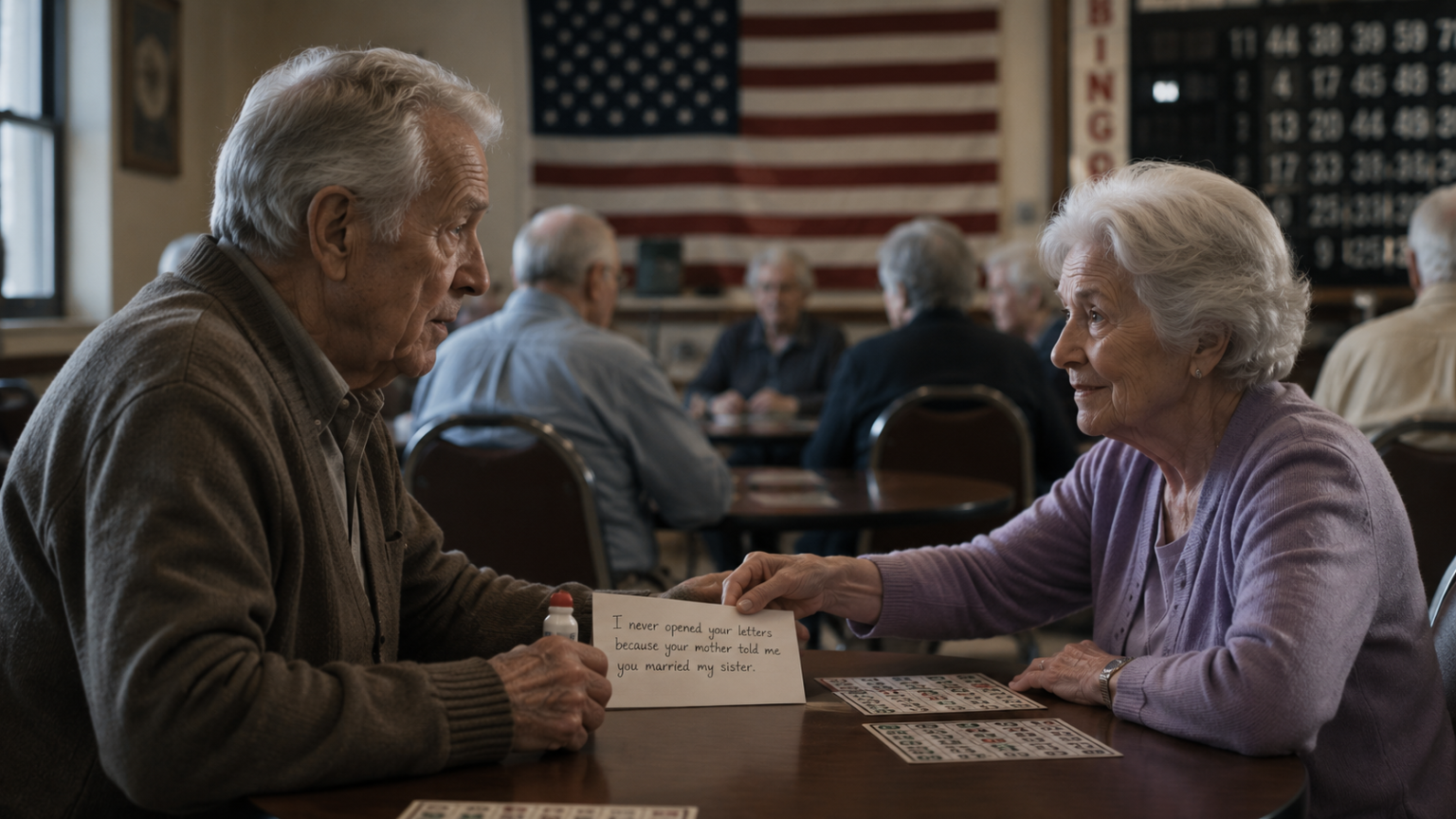
I sat down, annoyed, until the woman across from me looked up.
White hair.
Blue eyes.
My heart stopped.
Sixty-three years disappeared.
The room blurred at the edges.
The bingo caller’s voice became distant.
She stared at me as if she had been waiting and dreading this exact moment for half a lifetime.
“Hello, Robert.”
I could not speak.
My hand tightened around the dauber.
“Margaret?”
Her name came out like a prayer I had forgotten I knew.
She smiled sadly.
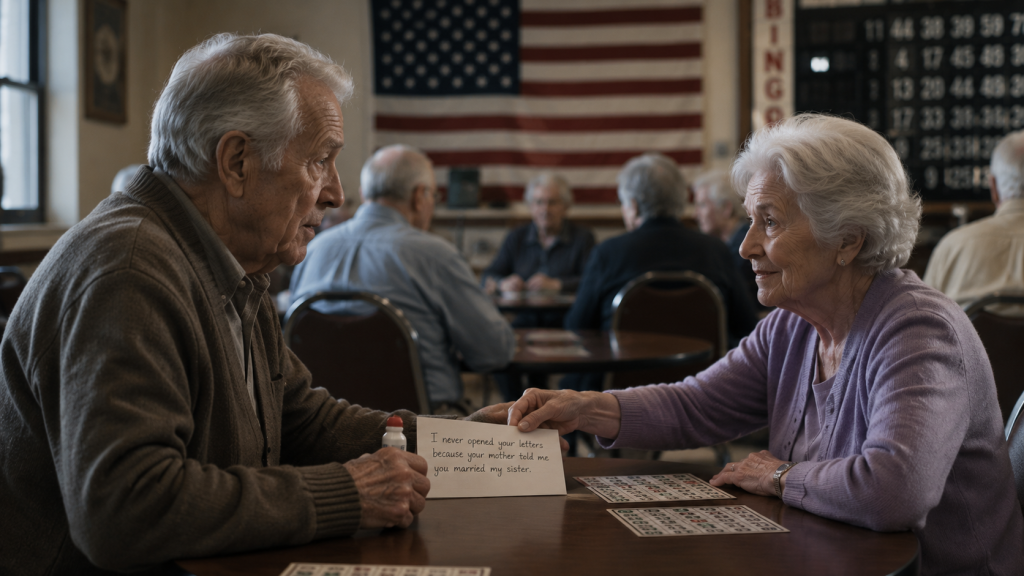
Then she slid her bingo card across the table.
On the back was a phone number.
And one sentence.
I never opened your letters because your mother told me you married my sister.
I read it once.
Then again.
The words did not make sense.
My mother.
Married my sister.
Margaret’s sister was Carol.
A pretty girl with dark hair who used to flirt with every boy at the lake.
I had never courted her.
Never held her hand.
Never kissed her.
I looked up, but Margaret was already standing.
“Call me,” she said softly.
Then she walked away.
Emily leaned over my shoulder.
“Pop? Are you okay?”
No.
I was not okay.
But I nodded because old habits are hard to kill.
That night, I sat in my kitchen with the bingo card in front of me.
Helen’s chair was empty across the table.
For the first time since she died, I felt ashamed of the silence I had kept.
Not because I had loved Margaret once.
But because I had buried the truth before I ever knew what the truth was.
I called the number at 8:03.
Margaret answered on the second ring.
Neither of us spoke for a moment.
Then she said, “I wondered if you would call.”
“I almost didn’t.”
“I know.”
My voice shook.
“Margaret, what did my mother tell you?”
She breathed in slowly.
“That you came home on leave and married Carol because she was pregnant.”
I closed my eyes.
“No.”
“She said you didn’t want to hurt me, so you asked her to explain.”
“No.”
My hand trembled against the receiver.
“I wrote you.”
“I know that now.”
“How?”
“After my mother died, I found a box in her closet. Your letters were inside. All fourteen.”
I could not breathe.
“She kept them?”
“She said your mother brought them over and begged her not to let me read them. Said it would ruin three families.”
My mother had been dead for twenty years.
Still, I felt the old fear of disappointing her rise in my chest.
Then anger followed.
Late.
Useless.
But real.
“Why would she do that?” I whispered.
Margaret was quiet.
“Because Carol wanted you.”
The answer was so simple, so ugly, that I almost laughed.
“My mother always liked Carol.”
“I know.”
“She said Carol came from a better family. She said you were…” I stopped.
“Too poor?” Margaret asked.
I swallowed.
“Yes.”
She gave a soft, bitter laugh.
“My father worked two jobs. Your mother thought that made us beneath her.”
I pressed my fingers to my eyes.
“I didn’t know.”
“I didn’t either.”
For a long while, we said nothing.
There was too much between us.
Not just lost love.
Lost years.
Lost choices.
Lost versions of ourselves.
Finally, Margaret said, “I was angry at you for forty years.”
“I don’t blame you.”
“I married too.”
“I know.”
“His name was Thomas. He was kind.”
“I’m glad.”
“He died in 2016.”
“I’m sorry.”
“I’m sorry about Helen.”
Hearing my wife’s name from Margaret’s mouth did something strange to my heart.
It reminded me that life had not been only loss.
We had both lived.
We had both loved.
But something had been stolen all the same.
Two days later, we met at a small diner near Lake Street.
Neither of us chose the ice cream shop.
It had been replaced by a pharmacy years ago.
Margaret arrived wearing a pale blue sweater.
Her hair was white now, her hands thinner, but her eyes were the same.
I stood too quickly and nearly knocked over my coffee.
She smiled.
“Still nervous?”
“Apparently.”
We sat across from each other like teenagers pretending to be strangers.
She had brought a box.
My letters.
Fourteen envelopes.
All yellowed with age.
All unopened.
Except one.
“I opened the first after I found them,” she said. “I couldn’t open the rest alone.”
I touched the top envelope with two fingers.
My handwriting stared back at me from another lifetime.
“I don’t know if I can read them.”
“You don’t have to.”
But I did.
Not all at once.
Just the first.
Dear Margaret,
It is hotter here than any July back home, and I would give almost anything for one vanilla cone from Lake Street, even though you know perfectly well I hate vanilla…
My voice broke on the second line.
Margaret reached across the table and covered my hand with hers.
For a second, we were eighteen again.
Then we were eighty-two.
Both things were true.
We read three letters that day.
Then we cried quietly into paper napkins while the waitress pretended not to notice.
After that, we began meeting every Thursday.
Sometimes we read letters.
Sometimes we talked about our spouses.
Our children.
The lives we had lived because the life we wanted had been taken from us.
Emily found out on the third week.
She saw Margaret’s name on my phone and smiled like a detective.
“Pop, who is Margaret?”
I told her.
Not everything.
Enough.
She listened carefully.
When I finished, she reached across the table and squeezed my hand.
“Helen would want you to have a friend.”
I nodded.
“I know.”
“And maybe more than a friend.”
“Emily.”
“What? You’re eighty-two, not dead.”
I laughed for the first time in days.
The hardest part came when Margaret and I visited my mother’s grave.
I had not been there in years.
We stood side by side in the cemetery under a sky the color of old pewter.
For most of my life, I had remembered my mother as difficult but loving.
Strict.
Proud.
Controlling, yes.
But never cruel enough to steal a whole future.
Now I did not know what to call her.
Margaret placed one of my returned envelopes on the grass.
Not as an offering.
As evidence.
“I hated you because of her,” she said quietly.
I looked at the stone.
“I obeyed her because I trusted her.”
Margaret turned to me.
“And now?”
I took a long breath.
“Now I think love without honesty can do terrible things.”
She nodded.
We left the letter there.
Rain came that night.
By morning, it was probably ruined.
That felt right.
A month after bingo, Margaret invited me to the lake.
The dock was gone, replaced by a metal railing and a walking path.
We sat on a bench watching children throw bread to ducks despite the sign telling them not to.
She had brought the last letter.
The fourteenth.
The one I wrote after understanding she would never answer.
“I’m afraid of this one,” she said.
“So am I.”
She opened it carefully.
My younger self had written only one page.
Dear Margaret,
I don’t know what I did wrong. I don’t know why you won’t answer. I keep thinking if I write the right words, you’ll come back to me on paper at least. Maybe silence is your answer. If it is, I will try to respect it. But I need you to know this: I loved you honestly. I would have waited. I would have come home. I would have chosen you.
Always,
Robert
Margaret pressed the letter to her chest and wept.
I put my arm around her.
Not with the hunger of young love.
With the tenderness of old grief.
“I would have chosen you too,” she whispered.
“I know.”
And somehow, after sixty-three years, knowing was both everything and not enough.
We did not talk about marriage.
We did not talk about making up for lost time as if time were a debt that could be repaid.
We simply kept meeting.
Thursday coffee.
Sunday walks.
Bingo, where Emily watched us from across the room with the smug satisfaction of someone who believed she had personally defeated loneliness.
One afternoon, Margaret brought vanilla ice cream in two paper cups.
“I still hate vanilla,” I said.
“I know.”
She handed me a spoon.
“But you came back every day for it.”
I smiled.
“That was never about the ice cream.”
She smiled too.
For the first time, without sadness.
Last week, I took Helen’s robe from the chair beside my bed and folded it carefully into a cedar chest.
I did not put her away.
You cannot put away forty-two years of love.
But I made room for the living.
That night, I dreamed of the dock in 1962.
Margaret was there in her blue apron.
Helen was there too, sitting on the edge with her shoes off, smiling at me like she knew something I didn’t.
When I woke, the house did not feel empty.
Just quiet.
There is a difference.
Tomorrow is Thursday.
Margaret and I are going to the diner again.
There are still five letters left to reread, though we both know the words now.
Maybe that is what life gives you if you are lucky enough to last this long.
Not a chance to go back.
But a chance to understand.
A chance to forgive what can be forgiven.
A chance to grieve what was stolen.
And sometimes, across a bingo table under fluorescent lights, a chance to hear your name spoken by the person you thought time had swallowed.
“Hello, Robert.”
Two words.
And sixty-three years came back.
THE END! THANKS FOR READING!
READ TREADING ARTITLE 👉 HERE