4,568 views
PART 3
She asked me to hold while she transferred me to the events manager. I spent the next twenty minutes listening to explanations about deposits, deadlines, and cancellation clauses.
Fortunately, I’d kept every agreement in my name. I had also paid most of the deposits directly.
When the manager explained that several vendors had not yet received their final payments, I asked her to place an immediate hold on all additional charges. “Please send me written confirmation before proceeding with anything else.”
She agreed. Then I called the catering company. Then the florist. Then the photographer.
By lunchtime, I had contacted every major vendor.
I wasn’t trying to ruin my son’s wedding.
I was simply refusing to finance a celebration where my presence had become an inconvenience.
But I wasn’t finished.
I called my bank and requested that the shared wedding account be frozen against further withdrawals while the ownership and transaction history were reviewed. I also revoked the access I’d personally authorized for Ben and Sloane.
The bank representative asked whether I was certain.
“I’m absolutely certain.”
After that, I called a locksmith.
I’d provided Sloane with a spare key because I trusted her. That trust had been repaid with unauthorized visitors, moved furniture, and the disappearance of my privacy.
By three o’clock, every exterior lock had been replaced.
I collected the decorations from my guest bedroom, carefully packed them into boxes, and arranged for Ben to collect his belongings.
I didn’t throw anything away.
I wasn’t interested in revenge.
I wanted my home back.
At approximately 5:40 p.m., my phone began ringing.
Ben.
I let it ring.
Then came a message.
Ben: Mom, the venue just called. They said you canceled everything. What is going on?
I didn’t respond.
Another message arrived.
Ben: Mom, Sloane is crying. You can’t do this to us.
Then another.
Ben: You need to fix this immediately. We have guests flying in.
I placed my phone facedown.
For the first time in months, the house was quiet.
I made myself a cup of tea and sat in Arthur’s favorite chair. The photograph from Lake Louise was still on the shelf.
I looked at it for a long time.
“I hope you would understand,” I whispered.
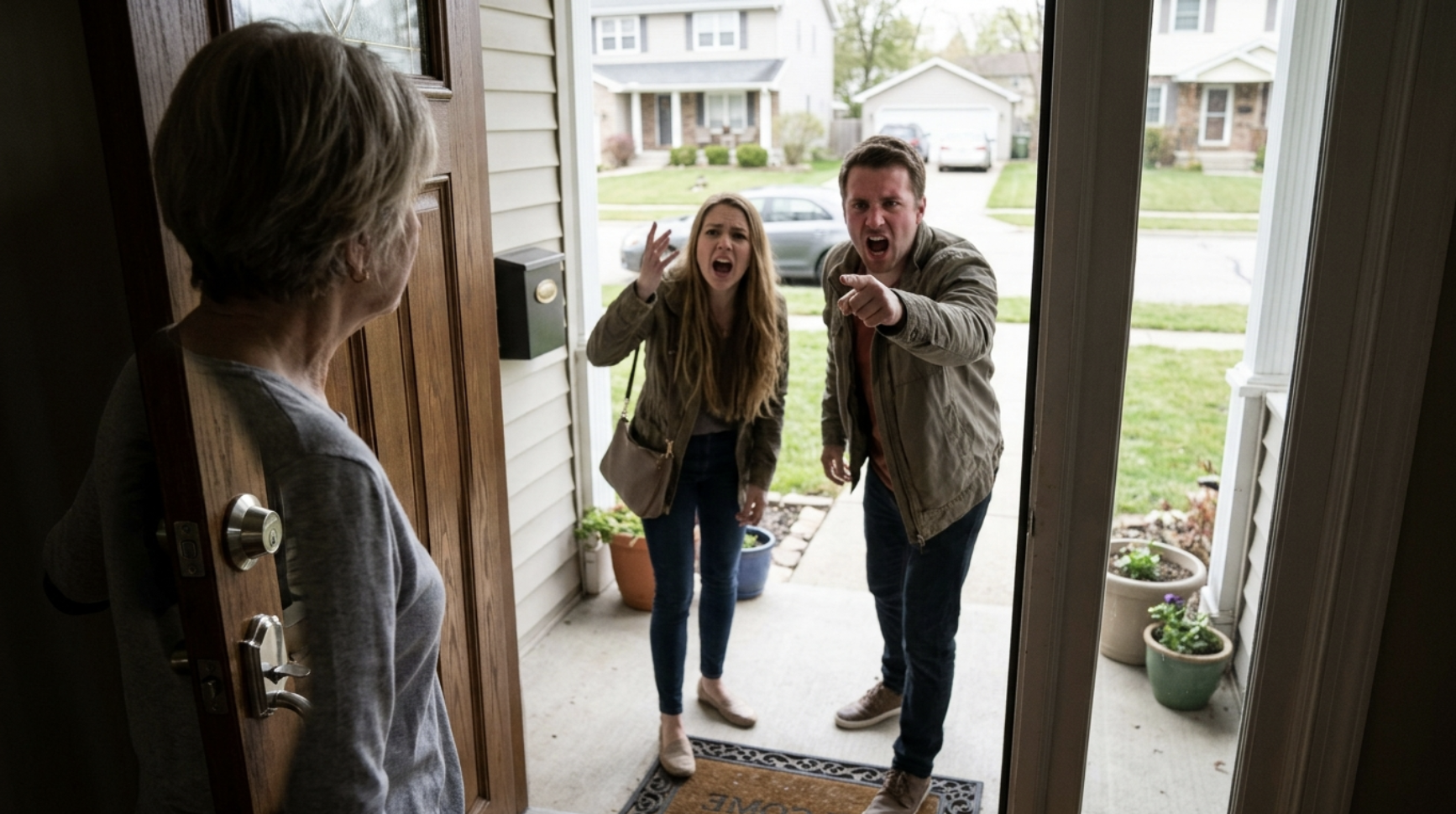
At 6:15 p.m., someone began pounding on my front door.
I looked through the window.
Ben stood on the front step, his face red with anger. Sloane was beside him, holding her phone and gesturing wildly.
I opened the door but kept the security chain attached.
“What have you done?” Ben shouted.
“Good evening, Ben.”
“Don’t good-evening me! The venue canceled our wedding!”
“I know. I made the call.”
Sloane stepped forward.
“You had absolutely no right!”
I looked at her.
“Actually, I did. I signed the contracts, paid the deposits, and agreed to finance the event. I also have the right to stop paying for something I no longer wish to fund.”
“You’re embarrassing us!” she snapped.
I almost laughed.
For months, she’d criticized my home, my furniture, my cooking, and even the memories displayed on my walls.
But apparently, I was the one embarrassing her.
Ben pushed his hands against the door.
“Mom, open this door. We need to talk.”
“No. You need to lower your voice.”
“I’m your son!”
“And I’m your mother. Yet somehow, that didn’t stop you from telling me that I either accepted everything or lost you.”
His expression changed.
“That’s not what I meant.”
“Those were your exact words, Ben.”
Sloane interrupted.
“This is ridiculous. We can discuss the money later. Just transfer the remaining amount so we can secure another venue.”
I stared at her.
“Transfer what money?”
“The wedding money, Margaret. We still need approximately $38,000.”
I slowly shook my head.
“You’re not getting another dollar from me.”
Ben looked genuinely stunned.
“You can’t just abandon us like this!”
I finally unhooked the security chain enough to speak more clearly.
“Ben, I deposited $16,000 into an account specifically for your wedding. When I checked it yesterday, only $942 remained. Do you want to explain where the other money went?”
Silence.
Sloane glanced at Ben.
He looked away.
“Mom, we were going to explain.”
“Then explain.”
“It was temporary,” he muttered. “We had some expenses.”
“Spa treatments?”
Neither answered.
“Designer clothing? Hotel charges? A gym membership?”
Sloane folded her arms.
“I don’t see why you’re monitoring every little expense.”
“Because it was my money.”
She rolled her eyes.
“You offered to help us!”
“I offered to pay for a wedding. I didn’t offer to finance your lifestyle.”
Ben rubbed his forehead.
“Can we please do this inside?”
“No.”
That single word seemed to offend him more than anything I’d said.
He stared at me as though he were looking at a stranger.
“Fine. If you want to make this difficult, we’ll remember it.”
I nodded.
“That’s entirely your choice.”
Then I closed the door.
For several minutes, I could hear them arguing on the front step. Eventually, their car engine started and disappeared down the street.
I thought that would be the end of it.
I was wrong.
The following morning, I received an email from Ben’s future father-in-law, Richard.
His message was short.
Margaret, I think you and I need to talk. There are things about the wedding expenses that you should know. Please don’t make any more decisions until we’ve spoken.
I read it twice.
Richard had always been polite but distant. He rarely involved himself in the wedding arrangements, and Sloane frequently joked that her father was too old-fashioned to understand modern celebrations.
I called him immediately.
“Richard, what’s happening?”
He sighed.
“Margaret, I wish I’d contacted you earlier.”
“Earlier about what?”
“About the money.”
I sat down.
“What money?”
He paused before answering.
“Sloane told us that you had agreed to give her and Ben $150,000. She said the $94,000 wedding was only the beginning. According to her, you were also planning to help them purchase a house.”
My hand tightened around the telephone.
“That’s completely false.”
“I suspected something was wrong. But yesterday, after hearing about the cancellation, I checked something.”
“What did you find?”
Richard lowered his voice.
“My daughter sent us a financial proposal several months ago. It included a statement showing that you had already promised to provide the down payment for their house.”
I felt cold.
“Richard, I never promised them a house.”
“I know that now.”
He took another breath.
“There’s something else. She told us you were becoming forgetful and that Ben was handling your finances because you couldn’t manage everything yourself.”
For a moment, I couldn’t speak.
It wasn’t just the money.
They had apparently been telling people that I was incapable of managing my own life.
And suddenly, I understood why Sloane had been so comfortable making decisions about my house.
She hadn’t simply expected me to pay for everything.
She had begun treating my independence as something she could take away.
“Richard,” I finally said, “would you be willing to meet me?”
“Of course.”
“Bring whatever documents you have.”
“I will.”
We arranged to meet at a quiet restaurant the following afternoon.
When I arrived, Richard was already sitting in a corner booth with a thick envelope beside him.
He stood when he saw me.
“Margaret, I’m sorry.”
I sat down.
“Let’s see what you have.”
He opened the envelope and slid several printed pages across the table.
The first document was a financial proposal.
The second was a budget for a future house.
But the third document made my stomach turn.
It was a draft email from Sloane to a real estate agent.
At the bottom was a sentence that made me read it three times.
Once Margaret understands that Ben and I are her only family, she’ll eventually agree to transfer the house. We just need to get everything arranged before she changes her mind.
I slowly placed the paper on the table.
Richard looked devastated.
“I had no idea she was thinking this way.”
I stared through the restaurant window.
For thirty years, I’d worked, saved, sacrificed, and protected the home Arthur and I had built.
I’d believed that one day Ben would bring someone into our family who would love him as much as we did.
Instead, I was beginning to wonder whether the wedding had never really been about celebrating their marriage.
And then Richard reached into the envelope again.
“Margaret,” he said quietly, “there’s one more thing you need to see.”
He placed a printed bank transfer record in front of me.
It showed a payment made from the wedding account.
The recipient wasn’t a wedding vendor.
It was a real estate brokerage.
And the payment description contained three words:
Whitfield property assessment.
I looked up at him.
“Richard, what exactly did they plan to do with my house?”
He didn’t answer immediately.
Instead, he pushed another document toward me.
It was a property valuation request.
My name was written at the top.
But I had never signed it.
And the signature at the bottom looked disturbingly similar to mine.
I felt my entire body go still.
Someone had apparently been preparing paperwork involving my home without my knowledge.
I carefully folded the document and placed it in my handbag.
“Richard,” I said, “I think this wedding cancellation is going to be the smallest problem they have.”
Because now I wasn’t just dealing with an ungrateful son and a demanding future daughter-in-law.
I was dealing with something much more serious.
And I intended to find out exactly how far they had gone.
PART 4
I didn’t sleep much that night.
The document Richard had shown me kept appearing in my thoughts. Someone had requested a valuation of my property using my name, and I had never authorized it.
At seven the following morning, I called my solicitor, Helen Crawford.
Helen had handled Arthur’s estate twelve years earlier. She was a sharp woman in her late fifties who believed in asking questions before making assumptions.
I explained everything.
The wedding account. The missing money. The false claims about the house. The property valuation request.
She listened without interrupting.
When I finished, she said something that immediately caught my attention.
“Margaret, don’t contact Ben or Sloane about that document yet. Bring everything to my office. We need to establish exactly what happened.”
I arrived at her office an hour later carrying a folder containing bank statements, wedding contracts, emails, and Richard’s documents.
Helen examined everything carefully.
After nearly forty minutes, she looked up.
“Have you ever signed a power of attorney giving Ben authority over your financial or property matters?”
“Never.”
“Have you given him permission to act on your behalf with a real estate agent?”
“Absolutely not.”
She nodded.
“Then we need to notify the relevant parties that you dispute this authorization and have the documents investigated. We should also protect your property records and review your financial accounts.”
I agreed.
Helen helped me contact the real estate brokerage named on the valuation request.
The agent, a man named Peter Lawson, agreed to speak with us.
When we arrived, he looked uncomfortable.
“Mrs. Whitfield, I genuinely believed everything was authorized.”
“Who contacted you?”
“Your son and his fiancée.”
“What exactly did they tell you?”
Peter opened his computer.
“They said you were considering downsizing and wanted an assessment before putting the property on the market.”
I stared at him.
“I have never considered selling my home.”
He nodded nervously.
“They also mentioned that you were planning to move into a smaller retirement property.”
I felt my stomach tighten.
Retirement property?
I was sixty-three, perfectly capable of managing my home, and had no intention of moving anywhere.
“Did you receive written authorization?”
Peter hesitated.
“Yes. An email containing a signed authorization form.”
Helen leaned forward.
“Can we have a copy?”
Peter agreed to provide the records through the appropriate process.
Before leaving, he mentioned something else.
“Your son also asked whether the property could be transferred directly to him after the valuation.”
I looked at Helen.
She didn’t say anything, but I could see her expression changing.
We left the office with more questions than answers.
That afternoon, Helen arranged for a formal notice to be sent to the brokerage and advised me on protecting my property.
I also changed my banking passwords, reviewed my credit reports, and instructed the bank to flag any unusual requests involving my accounts.
I thought I had done enough.
Then my phone rang.
It was Ben.
I almost ignored it, but Helen had advised me to keep a record of any relevant communications.
I answered.
“Hello, Ben.”
“Mom, we need to talk.”
“About what?”
“About the wedding.”
“There’s nothing left to discuss.”
He sighed dramatically.
“Look, Sloane and I have been under a lot of pressure. You know how expensive everything is. We made some mistakes with the account, but you didn’t have to destroy our entire wedding.”
“Where did the money go, Ben?”
He went quiet.
“Mom, not everything is about money.”
“Then explain the property valuation.”
Silence.
It lasted so long that I checked whether the call had disconnected.
Finally, he spoke.
“Who told you about that?”
I closed my eyes.
There it was.
Not denial.
Not confusion.
Just a question about who had exposed them.
“I know someone requested a valuation of my house using my name.”
“Mom, we were only exploring possibilities.”
“Possibilities for what?”
“You’re getting older. The house is too big for one person. We thought it might make sense to sell it and help us get established.”
I couldn’t believe what I was hearing.
“You thought?”
“Yes. We were trying to plan for the future.”
“Whose future, Ben?”
He became irritated.
“You always make everything sound terrible.”
“No, Ben. I am simply asking why you were making plans involving my property without asking me.”
He lowered his voice.
“Sloane thought you’d eventually understand.”
I nearly laughed.
“Your fiancée thought I would eventually understand that my own home belonged in your financial plans?”
“That’s not what I said.”
“Then tell me what you said.”
He ended the call.
I sat at the kitchen table for a long time.
The same table where I’d helped him with homework, celebrated his graduation, and listened to him talk about becoming a man who would always protect his family.
I wondered when that little boy had disappeared.
Or whether I had simply refused to see the man he had become.
Three days later, I received an unexpected visitor.
Sloane’s mother, Patricia.
She arrived carrying a small handbag and wearing an expression that suggested she was coming to settle a disagreement between children.
I invited her inside.
She glanced around my living room.
“Margaret, I think this situation has gone too far.”
I didn’t offer her tea.
“What situation?”
“The wedding. Ben is devastated. Sloane hasn’t stopped crying.”
I looked at her calmly.
“I’m sorry they’re upset.”
Patricia seemed surprised by my answer.
“Then perhaps you can reconsider.”
“Reconsider what?”
“Paying for the wedding. You know how important this is to them.”
I sat down.
“Patricia, may I ask you something?”
“Of course.”
“Did Sloane tell you that I had agreed to give them $150,000?”
Her expression changed.
“She mentioned that you were helping them.”
“I helped them with a $94,000 wedding. I never promised a house deposit.”
Patricia looked down at her handbag.
“And did she tell you that someone requested a valuation of my home without my permission?”
Patricia’s eyes widened.
“I don’t know anything about that.”
“Did she tell you that the shared wedding account had been used for personal expenses?”
Patricia didn’t answer.
I leaned forward.
“Patricia, I am not asking you to defend your daughter. I’m asking whether you know what has been happening.”
She remained silent for several seconds.
Then she said something I wasn’t expecting.
“Margaret, Sloane told us you had become increasingly difficult to deal with. She said Ben was worried about your memory and that he was trying to help you manage your affairs.”
I felt my throat tighten.
“Did you believe her?”
“I didn’t know what to believe.”
I looked at her.
“Then perhaps you should look at the evidence before deciding who is telling the truth.”
I showed her the bank statements and the property valuation request.
She read them slowly.
By the time she finished, her hands were trembling.
“Oh, my goodness.”
“What is it?”
She looked at me.
“There’s something I think you should know.”
She opened her handbag and removed her phone.
“Last month, Sloane asked her father and me to contribute $20,000 toward the wedding. We refused because we couldn’t afford it. But she told us not to worry because you had already agreed to cover everything.”