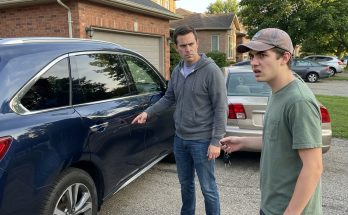
He also advised me to keep communication with my family in writing where possible and to avoid making threats or promises about the legal outcome.
I followed his advice. I didn’t post the video online. I didn’t call Mitch’s employer.
I didn’t contact his friends to tell them what he had done.
I simply stopped paying his insurance and other expenses, after confirming the necessary arrangements with my insurer, and made sure any cancellation or transfer was handled correctly.
The silence that followed was almost more difficult than the confrontation itself.
For the first few days, I kept expecting someone to call and ask how I was doing.
Instead, I received messages about Mitch.
His missed shifts.
His mounting bills.
His anger.
His belief that I was being cruel.
No one asked whether the damage to my SUV had been repaired.
No one asked whether I was worried about the cost.
No one asked whether I had been sleeping.
Then, on the ninth day, I received a message from my aunt.
She was the woman who had given me the leather key fob when I was nineteen.
Aunt: Your mother called me. She says things are bad between you and your brother. I don’t want to interfere, but I do want to know what happened from your side. Are you okay?
I stared at the message.
My aunt had always been different.
She never assumed that the loudest person was the most truthful. She listened before forming an opinion. When she offered help, she didn’t attach a debt of gratitude to it.
I called her immediately.
For nearly an hour, I explained everything.
The request for fifteen thousand dollars.
The scratch.
The footage.
The sedan.
The flatbed.
My father’s reaction.
When I finished, she was silent for a long moment.
Then she asked, “Cass, do you remember what I told you when I gave you that keychain?”
I glanced toward my keys on the counter.
“Anything I bought with my own money was mine.”
“Not exactly.”
I waited.
“I told you that owning something means you have to take responsibility for it. That includes protecting it. And sometimes, that means disappointing people who think they should be allowed to use it.”
I swallowed.
“I think I forgot that.”
“No,” she said gently. “I think you spent too long believing that being a good daughter meant being the easiest person in the family to take advantage of.”
My eyes filled with tears.
She continued.
“You can forgive your brother someday if you want to. You can have a relationship with your parents if you decide it’s healthy. But you don’t have to hand over your security just to prove you love them.”
I pressed my hand against my mouth.
For the first time since the incident, someone had spoken about my pain without immediately redirecting the conversation toward Mitch’s problems.
My aunt didn’t tell me to calm down.
She didn’t tell me to compromise.
She didn’t tell me that family was family.
She simply listened.
Before we hung up, she said one more thing.
“Your mother told me you were always the responsible one when you were children. I remember it differently.”
“How?”
“You weren’t born responsible, Cassandra. You were a child who learned that if you didn’t take care of things, nobody else would.”
I sat very still.
Then she added, “You don’t have to keep being that child.”
After the call, I took the leather key fob from my keys.
The word was worn around the edges.
Yours.
I ran my thumb over the letters.
For the first time in years, I understood that the message wasn’t about possessions alone.
It was about my life.
My time.
My future.
My right to decide what I could give and what I needed to keep.
And I was finally ready to defend all of it.
The next unexpected development came on a Tuesday afternoon.
I was leaving the hospital after a long assignment when Ramsay called.
“Cassandra, I wanted to update you on the vehicle matter.”
I stepped aside from the crowded corridor.
“All right.”
“We’ve received a response to the demand letter.”
“From Mitch?”
“Yes.”
I closed my eyes.
“What does it say?”
“He disputes your characterization of the arrangement. He claims you intended to transfer the vehicle to him and that you’ve allowed him to treat it as his own for two years.”
I wasn’t surprised.
“He never paid for it.”
“That is one of the issues we’re documenting. He also says he has incurred expenses maintaining the vehicle.”
“He paid for gas and one oil change.”
“Then we’ll distinguish those expenses from the purchase price, insurance, and other costs. Keep your records organized.”
“Is he threatening to sue me?”
“He has indicated that he may challenge your recovery of the vehicle. Whether he actually files anything remains to be seen.”
I took a slow breath.
“Can he make me give it back?”
“That depends on the law, the documents, and the facts. I don’t want to promise an outcome before we’ve reviewed everything. For now, don’t release the vehicle or sign anything transferring ownership without advice from me.”
“Understood.”
He paused.
“There is another point. He is asking to negotiate.”
I almost laughed.
“Negotiate what?”
“His proposal is that you return the sedan to him, withdraw your demand for compensation related to the SUV, and agree not to pursue the matter further.”
I stared through the hospital’s glass doors at the afternoon traffic.
“So he wants his car back, and he wants me to forget that he damaged mine.”
“That’s how the proposal reads.”
“What happens if I refuse?”
“We continue through the appropriate process. You should know that pursuing a claim can take time and involve costs, so we’ll discuss the practical options before making decisions.”
I thanked him and ended the call.
Then I stood outside for several minutes.
I was tired.
I wanted the SUV repaired.
I wanted my savings to stop feeling vulnerable.
Most of all, I wanted my family to stop acting as if my refusal to surrender was the real offense.
But I also knew something I hadn’t known a week earlier.
I didn’t have to decide anything simply because Mitch was impatient.
I could take my time.
I could ask questions.
I could make a decision based on evidence rather than guilt.
That evening, I told Ramsay to reject the proposed exchange as written and to continue advising me on the appropriate next steps.
I wasn’t demanding that Mitch lose everything.
I was simply refusing to surrender my rights in exchange for his promise to stop making my life difficult.
There was a difference.
And I intended to hold on to it.
Three days later, Mitch showed up at my apartment again.
This time, he brought a folder.
I opened the door but didn’t invite him inside.
“What do you want?”
He held up the folder.
“I brought the paperwork.”
“What paperwork?”
“Proof that I’ve been paying for the car.”
I looked at the folder.
“Please send it to my attorney.”
His expression hardened.
“Can you stop acting like I’m some criminal?”
“I’m not discussing the vehicle without my attorney.”
“I’m trying to fix this!”
“Then communicate through him.”
He shook his head.
“You really think you’re better than everyone now.”
“No, Mitch.”
“Then let me talk.”
I hesitated.
He looked exhausted. His shirt was wrinkled, and there were dark circles beneath his eyes. For the first time, he seemed less interested in shouting than in making me listen.
I remained at the doorway.
“You have five minutes.”
He glanced down at the folder.
“I’ve been driving that car for two years. Everybody knows it’s mine.”
“Everyone knows you’ve been driving it.”
“What’s the difference?”
“The title.”
He rolled his eyes.
“You know what I mean.”
“Yes. I know what you mean. You believe that because you’ve had access to something for a long time, it belongs to you.”
He looked at me sharply.
“That’s not fair.”
“Isn’t it?”
He opened the folder and pulled out a stack of receipts.
“Look. I paid for gas. I bought tires once. I paid for an oil change.”
I examined the receipts without taking them from him.
“Those expenses don’t change the name on the title.”
“You make it sound like I never contributed anything.”
“I didn’t say that.”
“You’re acting like you did everything.”
“I paid for the car. I paid for the insurance. I paid for the major repairs. I allowed you to use it because I wanted you to succeed.”
He looked away.
For a moment, I thought he might finally acknowledge what I had done for him.
Instead, he said, “You always bring up money.”
I felt the old frustration rise, but I kept my voice steady.
“Because money is what you asked me for, Mitch. Fifteen thousand dollars. When I refused, you damaged my SUV.”
He rubbed his forehead.
“I already said I was angry.”
“You haven’t apologized.”
“I said I was angry!”
“That explains how you felt. It doesn’t make what you did acceptable.”
He stared at me.
Then he lowered his voice.
“What do you want me to do? Get on my knees?”
“No.”
“Then what?”
“Take responsibility.”
He looked at the floor.
I continued.
“Tell the truth about what happened. Stop claiming I owe you the sedan. Work with the insurance process. Address the damage you caused. And stop telling our parents that I’m destroying the family because I won’t give you what you want.”
His eyes lifted.
“I can’t afford eight thousand dollars.”
“I didn’t ask you to produce eight thousand dollars today.”
“Then what are you asking?”
“For you to stop acting as though the consequences of your decisions are my fault.”
He was silent.
For several seconds, neither of us spoke.
Then he said something I hadn’t expected.
“You know Dad says you were always his favorite.”
I blinked.
“What?”
“He says you were the one who could do no wrong. You got good grades. You got a good job. You bought your own car. Everybody was proud of you.”
I stared at him.
“Mitch, that’s not true.”
“Of course you’d say that.”
“I spent years helping you.”
“And you never let me forget it.”
The words struck harder than I expected.
I had never thought of my help as a way to make him feel inferior. I had helped because I wanted him to have opportunities I could see slipping away.
But perhaps he had experienced my help differently.
Perhaps every payment reminded him that he hadn’t achieved what he wanted.
Perhaps every time our parents praised me for being responsible, he felt the comparison.
I couldn’t know for certain.
And even if that was how he felt, it still didn’t excuse what he had done.
“Mitch,” I said carefully, “if you’ve felt that way, I wish you’d talked to me about it. I would have listened.”
He gave a bitter laugh.
“You wouldn’t understand.”
“Maybe not. But I would have tried.”
He looked at me for a long moment.
Then he said, “I need that car.”
“I understand.”
“No, you don’t. If I lose my job, I won’t be able to pay rent. If I can’t pay rent, I’ll have nowhere to go.”
I felt a familiar pull inside me.
The old instinct.
The urge to fix the problem before it became worse.
I could almost hear the solution forming in my mind. I could help him rent a vehicle. I could pay for a few weeks of transportation. I could ask my aunt whether she knew someone who needed delivery help.
I could do all of those things.
But before I could even consider them, Mitch added, “So just give it back. You don’t need it as much as I do.”
The urge disappeared.
I looked at him.
“That’s exactly the problem.”
He frowned.
“What?”
“You believe that because your need is greater, my ownership matters less.”
He said nothing.
“I hope you find a way to keep your job. I really do. But I can’t keep solving your problems by sacrificing my own security.”
His face hardened again.
“So that’s it?”
“For now, yes.”
He shoved the folder against his chest.
“You’re going to regret this.”
“Maybe.”
I stepped back.
“But I’m not changing my answer because you’re angry.”
Then I closed the door.
I stood behind it, listening to his footsteps retreat down the hallway.
My hands were shaking.
My heart was pounding.
But I didn’t open the door again.
For once, I allowed a difficult conversation to end without trying to make the other person feel better about the boundary I had set.
And that was progress.
That weekend, I took my SUV to the repair shop for a more detailed assessment.
The technician walked me along the driver’s side, pointing out the areas where the paint had been cut deeply enough to require extensive refinishing.
He explained that the final cost could change once the work began, depending on what they found beneath the damaged surface.
I signed the necessary paperwork and arranged transportation while the repairs were pending.
When I returned home, I found an envelope tucked beneath my apartment door.
My name was written across the front in my mother’s handwriting.
Inside was a single sheet of paper.
Cassie,
Your father and I want you to come to dinner on Sunday. Mitch will be there. We think it’s time for everyone to sit down and talk.
We don’t want this to destroy our family.
Love, Mom.
I read it twice.
Part of me wanted to refuse immediately.
I could already imagine the conversation. Dad would explain why Mitch had acted out. Mom would ask everyone to calm down. Mitch would complain about his lost vehicle. Eventually, someone would suggest that I return the sedan and forgive the damage because that was the easiest way to restore peace.
But another part of me wondered whether there might still be a way forward.
Not a return to the old arrangement.
A new one.
One where I could love my family without being expected to finance every crisis.
I called my aunt.
She listened while I explained the invitation.
“What do you want to happen at this dinner?” she asked.
“I want them to understand that I’m not going to keep doing this.”
“Then go only if you can say that without needing them to agree.”
I thought about it.
“Why does that matter?”
“Because they may never agree, Cassie. You can explain yourself perfectly and still have someone decide that you’re wrong. Your boundary doesn’t become real only when they approve it.”
I looked at the leather key fob lying on my kitchen counter.
Yours.
She was right.
I didn’t need my father’s permission to protect my savings.
I didn’t need my mother’s approval to expect respect.
And I didn’t need Mitch to admit that he had been wrong before I could decide what I was willing to accept.
“I’ll go,” I said.
“Then go because you want to speak, not because you’re hoping they’ll give you permission to leave.”
I smiled faintly.
“You’re very good at this.”
“I’ve had practice.”
We laughed, and for the first time in days, the sound came easily.
I confirmed the dinner with Mom.
Then I spent the rest of the evening doing something I hadn’t done in a long time.
I made plans for myself.
I booked a short weekend trip for the following month. Nothing extravagant. Just two nights in a quiet coastal town, with a hotel room overlooking the water and no responsibilities beyond choosing where to eat.
I had postponed that trip twice because Mitch needed help.
I had canceled another vacation the year before because Dad’s truck needed repairs.
This time, I made the reservation and put it on my calendar.
The money was mine.
The time was mine.
And I was allowed to enjoy both.
I didn’t know what would happen at Sunday’s dinner.
I only knew that I would no longer walk into my parents’ house believing I had to earn the right to be treated fairly.
For the first time, I was prepared to let them be disappointed.
Because their disappointment was not proof that I had done something wrong.
And the next time Mitch looked at me and expected me to solve his problems, he would have to confront a truth he had spent years avoiding:
I could love my brother without being the person who rescued him.
PART 4
On Sunday evening, I returned to my father’s house for dinner, carrying no gifts, no checkbook, and no intention of apologizing for protecting myself.
Mitch was already sitting at the table. Dad looked serious, and Mom had prepared the pot roast we used to eat on Sundays when life felt simpler.
Before anyone touched their food, Dad cleared his throat.
“We need to put this family back together,” he said. “Cassandra, if you return Mitch’s car and drop the claim for your SUV, we can finally move on.”
I looked at my father, then at my brother.
“Has Mitch apologized for what he did?”
Nobody answered.
I turned to Mitch. “I’m not asking you to be perfect. I’m asking you to take responsibility.”
For the first time, he didn’t argue immediately.
He stared at his plate before whispering, “I was angry. I thought if I made you feel bad enough, you’d give me the money. I didn’t think you’d actually take the car.”
My heart sank.
“So you knew exactly what you were doing.”
He nodded, his eyes filling with tears. “I’m sorry, Cass.”
It wasn’t a perfect apology, but it was the first honest thing he’d said since that night.
I told him the insurance process would continue, and any compensation would be handled through the appropriate channels. The sedan would remain subject to the ownership dispute until everything was properly resolved. I wouldn’t give him money, but I was willing to help him look for affordable transportation and a better financial plan.
This time, the help would have boundaries.
Dad started to object, but Mom reached for his hand.
“She’s our daughter, too,” she whispered.
The room fell silent.
For once, nobody asked me to sacrifice something to make everyone else comfortable.
Over the following weeks, Mitch found temporary transportation and worked out an arrangement with his employer. He eventually accepted responsibility for the damage, and the matter was resolved through the appropriate insurance and legal process. My SUV was repaired, though the experience left a mark on my relationship with my family that took much longer to heal.
Mitch and I didn’t become close overnight. Trust had to be rebuilt through actions, not promises.
Dad took longer to change. Eventually, however, he stopped calling every time Mitch faced a financial problem, and Mom began asking how I was doing before telling me what someone else needed.
It wasn’t a perfect family reunion.
It was something more realistic: a beginning.
Months later, I finally took the coastal trip I’d postponed for years. On the morning I left, I picked up my keys and ran my thumb across the old leather fob.
Yours.
I smiled and started my repaired SUV.
I had once believed that being a good daughter and sister meant always being available, always forgiving, and always giving until there was nothing left for me.
Now I understood something different.
Love doesn’t require you to finance someone’s irresponsibility. Forgiveness doesn’t mean removing every consequence. And family should never be a place where you must surrender your peace to prove your loyalty.
My brother had once believed that my money belonged to whoever needed it most.
That morning, as I drove toward the ocean, I finally felt free of that belief.
My money belonged to me. My future belonged to me. And for the first time in a long time, so did my life.