PART 3
I looked at the small velvet case beside the letter. For the first time since Dad’s funeral, I understood why my father had insisted that I keep my mouth shut when Rick took the watch.
“Perhaps you should read Dad’s letter,” I said.“What letter?”“The one he left for me.”
There was a long silence. Then Rick lowered his voice. “You knew about this?”
“I knew Dad had something he wanted me to understand after he was gone.”
“You knew he was going to leave me the watch?”
“No, Rick. I knew he wanted something handled properly.”
He cursed under his breath.
“Listen to me. I took the watch to a jeweler this morning. I thought I could have it cleaned and appraised before I flew back to Phoenix. The man examined the inscription, opened the back, and found a second engraving inside. Then he called someone. Now he’s telling me not to touch it until an attorney gets there.”
I closed my eyes.
Dad had always been careful with his possessions. He never bought anything expensive without keeping the receipts. He labeled the keys to his workshop. He kept warranties in folders and paid his bills before their due dates.
But he had never explained the full story of that watch to me.
At least, not until three months before his death.
“Rick,” I said, “do you remember what Dad told us about the watch when we were children?”
“Of course I do. He said it was his most valuable possession.”
“No. He said it was the most meaningful possession he owned.”
“That’s the same thing.”
“It never was to Dad.”
He exhaled sharply.
“Just tell me what’s going on.”
I unfolded the letter and read the final paragraph again.
Then I told him the truth.
“I think you should come to Dad’s house.”
“I’m leaving for the airport in two hours!”
“Then you should decide whether getting on that plane is more important than understanding what Dad left behind.”
I hung up before he could answer.
For several minutes, I sat without moving.
I wasn’t happy that Rick was frightened. Despite everything, he was still my brother.
But I was relieved.
For years, I had wondered whether Dad understood what had happened between us—how Rick had gradually become the son who visited occasionally and offered advice from a distance, while I became the daughter who handled the difficult, ordinary work of keeping our father safe.
Now I was beginning to understand that Dad had noticed far more than he had ever said.
I opened the letter again.
My dear daughter,
If you are reading this, I am gone, and your brother has probably done something he believes he has every right to do.
Please do not fight with him at my funeral. Do not let my final day become another occasion for my children to hurt each other.
The watch has a history your brother does not know. That is not because I loved him less. It is because he never asked me about it.
Inside the velvet case is the first thing you must examine. After that, call Mr. Whitmore. His number is written on the card.
Do not make a decision because you are angry. Make it because you finally understand.
Love, Dad.
I picked up the velvet case.
Inside lay a small brass key and a folded piece of paper bearing a telephone number.
Beneath them was a photograph.
It showed Dad as a young man, standing beside a railroad locomotive. His hair was dark, his shoulders broad, and his smile so familiar that for a moment I forgot he was gone.
Beside him stood another man wearing a railroad uniform.
On the back, Dad had written five words.
The day everything began.
I turned the photograph over again.
There was a date beneath the sentence, followed by a name.
Thomas Whitmore.
I took out my phone and dialed the number on the card.
A man answered after two rings.
“Whitmore speaking.”
“My name is Daniel’s daughter. My father recently passed away. He left me a letter and asked me to call you.”
The man became very quiet.
“Your father has passed?”
“Yes.”
“I’m sorry. Daniel was a good man. I wondered when I might hear from you.”
My fingers tightened around the phone.
“You knew my father well?”
“Very well. We worked together for years. In fact, I was hoping he would introduce us before his health declined.”
“Why?”
“Because your father entrusted me with something important. He told me that after his death, one of his children would probably contact me about the gold watch.”
I glanced toward the photograph.
“One of them?”
“Yes,” Mr. Whitmore replied. “But he was quite specific about which child I was supposed to speak with first.”
I swallowed.
“Me?”
“Yes. He said his daughter would understand why the watch could never simply be sold.”
My heart began to pound.
“What is it worth?”
Mr. Whitmore sighed.
“That depends on what you mean by worth. The gold itself is not the important part. The watch is a piece of railroad history, and the records connected to it are unusually significant.”
He paused.
“But before I explain anything else, I need to ask you something.”
“Of course.”
“Did your brother remove the watch from your father’s wrist before the burial?”
I stared at the kitchen wall.
“Yes.”
“Then I suggest you ask him to preserve every document the jeweler gave him. Do not accuse him of anything yet. We need to establish the facts.”
“Mr. Whitmore, what did my father do?”
“I believe,” he said gently, “that your father spent the final months of his life making sure an important promise would be honored.”
“What promise?”
“I would rather explain that in person. Can you come to my office tomorrow morning?”
I agreed.
Before hanging up, he added one more thing.
“Bring the letter. And, if possible, ask your brother to come too.”
I almost laughed.
Getting Rick to attend a meeting about something he couldn’t immediately sell might prove more difficult than arranging Dad’s funeral.
But I promised I would try.
That evening, Rick arrived at Dad’s house without calling first.
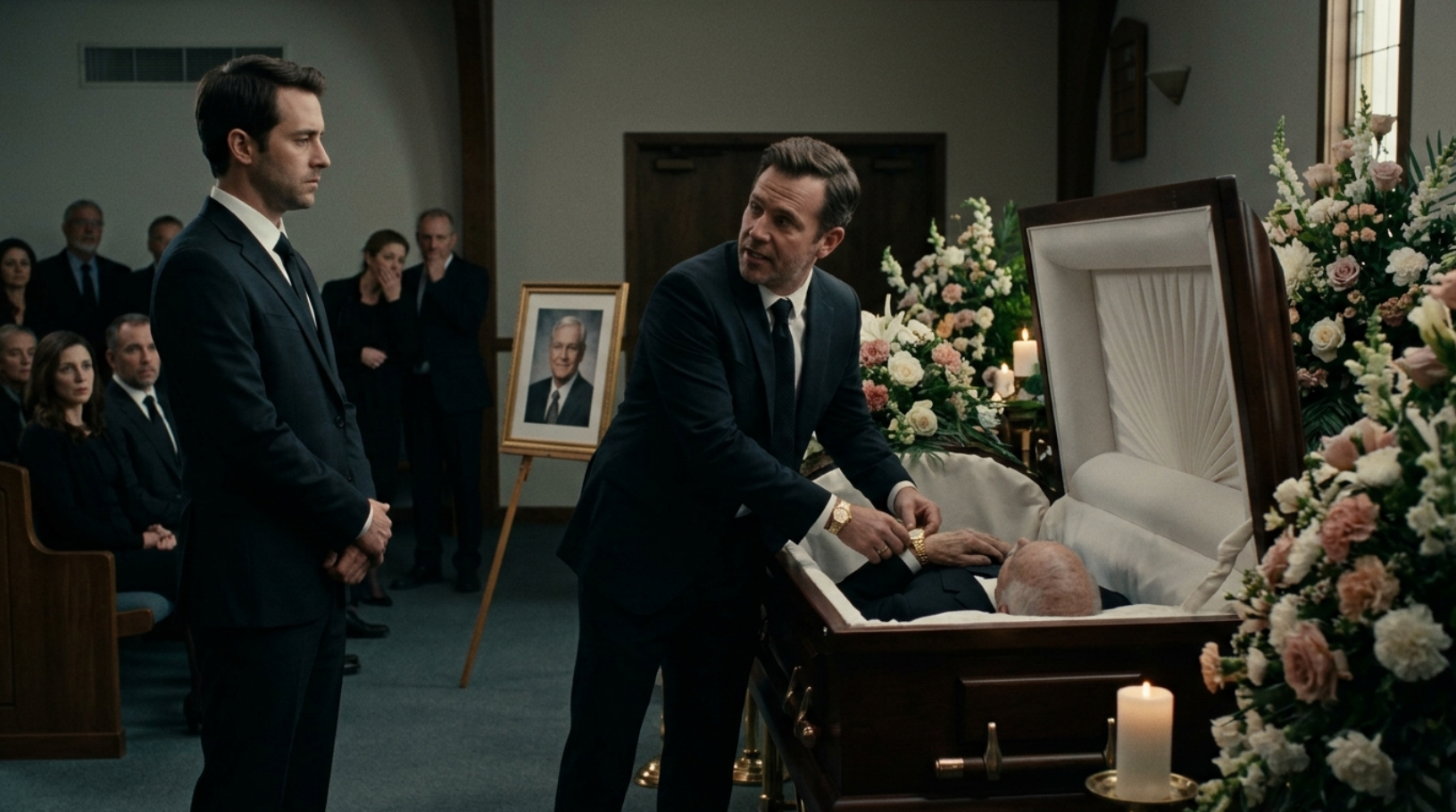
He looked nothing like the confident man who had stood beside the coffin three days earlier. His tie was loosened, his face was pale, and he kept rubbing his palms against his trousers.
“Where’s the letter?” he demanded.
I was standing beside the kitchen counter.
“Hello to you too.”
“Please. I’m serious.”
“So am I.”
He looked around the room as though Dad might suddenly appear from the hallway and explain everything.
Finally, he sat down.
“The jeweler showed me something inside the watch. There are two sets of numbers and a tiny inscription. He said the watch may be connected to an old railroad collection, and the ownership records might be complicated.”
I pulled out a chair opposite him.
“What did the second inscription say?”
Rick hesitated.
“‘For the man who brought them home.’”
I felt a chill run through me.
I had never seen that inscription, but I knew immediately that it mattered.
Dad had once told me about an accident on the railroad during his early years. He had been a young maintenance worker when a storm damaged part of a track. Several men had been caught in a dangerous situation, and Dad had helped bring them to safety.
He never spoke about himself as a hero.
When I asked him about it, he always said, “Everyone did what they could.”
I told Rick what I remembered.
He stared at me.
“Why didn’t he tell me any of this?”
“Maybe he did. You just weren’t listening.”
The words escaped before I could stop them.
Rick’s face hardened.
“There it is. The lecture. You always thought you were the better child because you lived nearby.”
“No,” I replied. “I never thought I was better. I just wanted Dad to have someone when he needed help.”
For once, Rick had no immediate answer.
I took a breath.
“Mr. Whitmore wants to meet us tomorrow.”
“Who’s that?”
“Someone Dad trusted.”
Rick rubbed his forehead.
“Fine. I’ll go.”
Then he looked at me with an expression I hadn’t seen since we were children.
Fear.
“Tell me something,” he whispered. “Did Dad leave you everything?”
I thought about the letter.
I thought about the key.
And I thought about the years Dad had spent trying to teach us that love was not a competition.
“I don’t know yet,” I answered honestly. “But I don’t think that’s the question we should be asking.”
Rick looked away.
For the first time, I wondered whether he was afraid of losing money—or of discovering that his father had understood him better than he understood himself.
Tomorrow, we would find out.
Part 4: The Meeting That Changed Everything
At nine the next morning, Rick and I entered a modest office above a small railroad museum.
Mr. Thomas Whitmore stood beside a filing cabinet, holding a photograph of Dad.
He was in his late seventies, with silver hair and the steady gaze of someone who had spent a lifetime observing people before deciding what to say.
When he saw Rick, he nodded politely.
“You must be Daniel’s son.”
Rick extended his hand.
“Yes. I believe you have some information about my father’s watch.”
“I do. But first, I would like you both to understand something about your father.”
He invited us to sit.
On the desk lay several documents, an old newspaper clipping, and a photograph of a steam locomotive.
Mr. Whitmore picked up the clipping.
“Forty years ago, the railroad company began documenting its history. Your father had kept meticulous records of an accident that occurred early in his career. His testimony helped establish what happened that night and ensured that several workers received recognition they had initially been denied.”
He placed the clipping in front of us.
The headline described a railroad worker who had helped rescue several men after a severe storm damaged the track.
The article mentioned Dad’s name.
I had never seen it before.
Rick leaned forward.
“Dad never told us he was in the newspaper.”
“He wasn’t interested in publicity,” Mr. Whitmore replied. “He was interested in making sure the truth was recorded.”
He opened another folder.
“The watch was presented to your father upon his retirement. But the railroad’s historical society later discovered that the piece had been specially commissioned as part of a limited collection. The original records were incomplete, and its full historical significance was not recognized until recently.”
Rick’s expression changed.
“So it’s valuable?”
“Potentially, yes. But not simply because it contains gold. Its value depends on its provenance, condition, and the historical records associated with it. No responsible appraiser should give you a definitive figure without completing that work.”
Rick looked disappointed.
Mr. Whitmore continued.
“Your father knew the watch might eventually be of interest to collectors. But he was concerned about something else.”
He reached into the folder and removed a handwritten letter.
“Several years ago, the historical society began a project to preserve the stories of retired railroad workers. Your father contributed his memories and photographs. He also made a commitment regarding the watch.”
“What commitment?” I asked.
Mr. Whitmore looked directly at me.
“He wanted it preserved with the railroad’s historical collection after his death, under an arrangement that would honor his service and allow future generations to learn about the people who built and maintained the railway.”
Rick sat back.
“He wanted to give away the watch?”
“Not exactly. The arrangement was still being finalized. Your father had discussed several options, including a temporary loan and a permanent donation. He had not completed the final transfer, so the legal ownership must be established through his estate documents.”
Rick’s face reddened.
“Then it’s mine. I took it from his body. He didn’t sign anything giving it to the museum.”
Mr. Whitmore didn’t argue.
“You are correct that a discussion alone does not transfer ownership. The will and applicable estate documents must be reviewed. That is why I advised you not to sell or alter the watch before speaking with an attorney.”
Rick looked at me.
“So you knew this was happening?”
“I knew Dad wanted me to contact Mr. Whitmore. I didn’t know all the details.”
Mr. Whitmore then asked me to show him the letter and the brass key.
He examined both carefully before opening a drawer.
From inside, he removed a small metal box.
The key fitted its lock.
Inside were railroad photographs, a certificate of service, several letters, and a sealed envelope marked with Dad’s handwriting.
Mr. Whitmore handed it to me.
I opened it.
To my children,
If you are reading this together, then I have been fortunate enough to leave you one final opportunity to understand each other.
My watch was never intended to prove which of you loved me more.
It was a reminder of the years I worked, the people who stood beside me, and the family I hoped would stand beside one another when I was gone.
I have arranged for my estate attorney to explain my legal wishes. Nothing in this letter should replace the instructions in my will.
But I want you both to know something.
I have never measured my children’s worth by the number of visits, the money they earned, or the things they could give me.
I measured it by the love I hoped they would show one another.
If the watch can help preserve the stories of the men who worked beside me, I hope you will consider allowing that to happen.
If you disagree, then discuss it honestly. Do not turn it into another reason to hate each other.
Your father,
Daniel.
By the time I reached the signature, my eyes were blurred with tears.
Rick stared at the paper.
“He could have told me all this.”
“Yes,” I whispered. “He could have.”
For several moments, neither of us spoke.
Then Rick said something I had never expected to hear.
“I didn’t take the watch because I needed the money.”
I looked up.
He swallowed.
“I took it because I was angry.”
“Angry at Dad?”
“At you. At myself. At everything.”
He rubbed his eyes.
“When I stood beside the coffin, I kept thinking about how you knew everything about his last years. You knew his doctors, his medication, his routines. You knew which stories made him laugh. I barely knew what he ate for breakfast.”
His voice cracked.
“And instead of admitting that I felt ashamed, I told everyone I was the son who mattered.”
I sat very still.
Rick looked down at his hands.
“I thought taking the watch would prove that I still had a place in his life.”
I wanted to tell him that he had hurt me.
I wanted to remind him of the nights I spent at the hospital, the cancelled plans, and the countless small responsibilities he had never seen.
But I could see that he was finally looking at the truth without trying to turn it into someone else’s fault.
“You always had a place in Dad’s life,” I said. “You didn’t have to take anything to prove it.”
Rick began to cry.
Not loudly. Not dramatically.
He simply covered his face and sat there, grieving the father he had lost and the relationship he had never taken enough time to understand.
Mr. Whitmore quietly left us alone.
After several minutes, Rick wiped his eyes.
“What happens now?”
“We speak with the estate attorney,” I said. “We find out what Dad legally arranged. Then we decide what to do based on the facts, not our anger.”
Rick nodded.
For the first time in years, we were making a decision together.
But we still had one final appointment to attend.
That afternoon, we would meet the lawyer who had prepared Dad’s will.
And there was something in that will that neither of us expected.
Part 5: What Dad Really Left Behind
Dad’s estate attorney, Margaret Ellis, welcomed us into her office that afternoon.
She had handled his affairs for more than a decade and had known him long enough to understand that he preferred careful planning to dramatic announcements.
After reviewing the relevant documents, she explained that Dad had left a clear will, a list of personal possessions, and instructions regarding the watch and his railroad memorabilia.
The gold watch was not automatically Rick’s simply because he had removed it from the coffin. Its ownership had to be determined according to the estate documents and applicable law.
Rick listened without interrupting.
Then Margaret opened a separate folder.
“Your father also made arrangements for the preservation of his railroad collection,” she explained. “The documents authorize discussions with the historical society, but the final transfer of the watch was not completed before his death. The estate will need to resolve that matter properly.”
Rick glanced at me.
For once, he didn’t ask how much the watch was worth.
Instead, he asked, “What did Dad want us to do?”
Margaret studied him for a moment before answering.
“He wanted you to consider the historical society’s proposal. He believed the watch belonged in a place where people could learn about the railroad workers who helped build the community. However, he also wanted his children to reach an informed decision without pressure.”
She handed us another letter.
It was shorter than the others.
My children,
I cannot choose your future for you.
I can only tell you what I hope you remember.
One day, you may inherit money, a house, a watch, or a box of photographs. Those things can be divided, sold, donated, or forgotten.
But the time you spend with the people you love cannot be returned once it is gone.
I hope you will remember that before you decide what anything is worth.
Love, Dad.
Rick lowered the letter.
“I don’t deserve to keep the watch,” he said quietly.
Margaret corrected him gently.
“This isn’t about whether you deserve it. It’s about what the documents say, what the estate permits, and what decision you and your sister can make in good faith.”
Rick nodded.
“I understand.”
He turned to me.
“If the watch can be preserved properly, I want to help make that happen. I don’t want to sell it.”
I studied my brother’s face.
“Are you sure?”
“Yes. But I want to be part of the decision. I don’t want to feel like I’m being pushed out of Dad’s life again.”
I understood what he meant.
For years, I had carried the responsibilities of caring for Dad, and sometimes I had allowed that sacrifice to become a wall between my brother and me.
Rick had been absent, but I had also stopped telling him how to return.
We had both allowed our relationship to become smaller than it needed to be.
“Then let’s do it together,” I said.
We agreed to work with the attorney and the historical society to determine the watch’s proper disposition. No one would sell it or make claims about its value until the legal and historical reviews were complete.
The following weeks were not magically perfect.
Rick still lived in Phoenix. I still lived fifteen minutes from Dad’s empty house.
We still disagreed about small things, and grief sometimes made ordinary conversations unexpectedly difficult.
But something had changed.
Rick began calling without needing a reason.
He asked me about Dad’s final months, and I told him stories I had never thought to share.
I told him about the time Dad accidentally put salt in his coffee and blamed the kitchen.
I told him how he insisted on wearing the same old slippers even after I bought him a new pair.
I told him how, during his final weeks, he sometimes asked whether Rick had called.
Rick listened to every word.
One evening, he said, “I wish I’d been there more.”
“So do I,” I answered.
He didn’t defend himself.
He simply said, “I’m sorry.”
And for the first time, I believed he meant it.
A few months later, after the estate and historical reviews were completed, the watch was placed in the railroad museum under an arrangement approved by the estate. Its display included Dad’s photograph, his service certificate, and a short account of the night he helped rescue his fellow workers.
The inscription on the display read:
Daniel Whitmore — A man remembered not only for the years he worked, but for the people he helped bring home.
Rick and I attended the small ceremony together.
When the museum director invited us to say a few words, Rick stepped forward.
“My father wore this watch for forty years,” he began. “I used to think it represented something I could inherit. Now I understand that it represented a life I should have taken more time to know.”
He paused, his eyes shining.
“I can’t change the time I lost with him. But I can change what I do with the time I have left.”
I reached for his hand.
He held it.
And for the first time since Dad’s funeral, I felt that we were grieving together rather than competing over the pieces he had left behind.
Final Part: The Time We Still Had
A year after Dad’s funeral, Rick came to visit me.
He arrived carrying two cups of coffee and a small cardboard box.
“I found something while cleaning out my garage,” he said.
Inside the box was an old photograph of the three of us.
I was about ten years old, Rick was twelve, and Dad stood behind us with one hand on each of our shoulders. His gold watch gleamed in the sunlight.
On the back, Dad had written:
The best things in life are the moments we don’t realize we will miss.
Rick sat beside me at the kitchen table.
“I used to think Dad loved you more,” he admitted. “You were always there. I thought that meant there was less room for me.”
I looked at the photograph.
“I used to think you didn’t care enough to come home.”
“Maybe we were both wrong.”
“Maybe.”
We sat quietly, remembering the man who had somehow managed to leave us a lesson even after he was gone.
Before Rick left, he asked if we could visit the museum together the next time he came to town.
“Of course,” I said.
He smiled faintly.
“And maybe afterward, we could come here and make Dad’s coffee the way he liked it.”
I laughed through my tears.
“You mean too strong and with far too much sugar?”
“Exactly.”
After he left, I placed the photograph beside the kitchen clock.
The gold watch was no longer in our family home, but it had found a place where Dad’s story could live on. Children would see it. Former railroad workers would recognize its history. Families would read about the man who had worn it for four decades.
And Rick and I had finally learned that Dad’s love was never something either of us needed to win.
The watch had measured forty years of his life.
But the lesson it left behind would last much longer.
Sometimes, the greatest inheritance isn’t what our parents leave in a will. It’s the wisdom that finally brings a family back together.
And if I could speak to Dad one more time, I would tell him that his watch had done exactly what he hoped it would do.
It had reminded us that time is precious.
That pride can steal years we can never recover.
And that while we cannot change the time we’ve already lost, we can still choose how we spend the time we have left.
The clock keeps moving.
The people we love will not be here forever.
So don’t wait until a funeral to tell someone they matter.
Don’t wait until a letter is opened to understand what someone tried to teach you.
And never mistake the value of an inheritance for the value of a life.
Because in the end, the most important thing Dad left us was not the gold watch. It was the chance to become a family again.