PART 3
Then Lauren made a sound I had never heard from her before. It was the sound of someone realizing that she had hurt the one person who had spent her entire life making sure she never had to hurt.
“Mom,” she whispered. “I didn’t think about it that way.” “I know.” “Mark said it was normal. He said everyone splits expenses now. He said you would appreciate knowing exactly what things cost.”
I closed my eyes. There it was. Mark. I had suspected his influence from the moment I read that email. My daughter had not always been someone who measured affection with spreadsheets.
When Lauren was little, she used to make me birthday cards from construction paper. She would cover them with crooked hearts and glitter, then write things like, “I love you more than all the stars.”
I still had those cards. They were in the same boxes as the receipts.
“Lauren,” I said carefully, “I don’t mind paying my share when someone invites me to dinner. I don’t mind contributing. I don’t even mind helping with the cleaning. But I do mind being treated like a customer after spending thirty-five years being your mother.”
“I know. I know, Mom.”
“And I certainly don’t need Mark explaining my financial situation to me.”
She went quiet.
Then she said something that made me sit up straighter.
“He told me you probably wouldn’t mind because you don’t have many expenses anymore.”
I stared at the wall.
“Does he?”
“Does he what?”
“Know what my expenses are?”
“No.”
“Then perhaps he should stop discussing them.”
Lauren began crying again.
“I’m sorry.”
I wanted to believe her.
I really did.
But an apology made at eleven o’clock at night was only the beginning. It was not the same thing as understanding.
“Go to bed, sweetheart,” I told her. “We can talk when we’re both rested.”
“Are you angry with me?”
I looked at the Christmas card sitting on my counter. It was the one she had given me this year.
On the front was a photograph of her and Mark standing in front of their new house.
Inside, she had written:
To Mom. Thank you for always being there. We love you.
I had placed it beside the photograph of her as a little girl.
“No,” I answered. “I’m disappointed. There’s a difference.”
She cried harder.
We said goodnight.
I did not sleep much.
Not because of the $212.14.
I had paid that money without hesitation.
It was the realization that somewhere along the way, my daughter had begun to see my presence as another expense to manage.
And I wondered when that had happened.
The following morning, I made coffee, opened my laptop, and reviewed the spreadsheet one more time.
I had not created it to punish her.
That was important.
Every figure was real. Every receipt was genuine. Every date had been checked.
But I knew something else.
If I had simply sent Lauren a message saying that she had hurt my feelings, she might have apologized, hugged me, and forgotten about it by February.
The invoice had forced her to stop.
It had made her look at the years she had never thought to count.
At 9:17 a.m., my phone rang.
It was Lauren again.
“Mom, can I come over?”
“Of course.”
“Can I come alone?”
I paused.
“That would be nice.”
She arrived forty minutes later.
I saw her car pull into the driveway. She sat behind the steering wheel for almost five minutes before getting out.
When she finally came through the front door, she looked exhausted.
Her eyes were swollen, her hair was pulled into a messy ponytail, and she was still wearing the oversized sweater she had worn the previous evening.
She held the manila envelope in both hands.
“I brought this back,” she said.
“You didn’t have to.”
“I couldn’t leave it at home.”
I pointed toward the kitchen.
“Coffee?”
She nodded.
We sat across from each other at the same table where I had paid her Christmas invoice.
For a moment, she looked at the table rather than at me.
Then she opened the envelope.
“I read it again this morning.”
“All eleven pages?”
“All eleven.”
She turned to the first page.
“Mom, I didn’t know you kept the receipt from the hospital when I swallowed that button.”
“I kept it because the doctor wrote that you were lucky.”
She swallowed.
“I don’t remember that.”
“You were three. You were more interested in the sticker they gave you afterward.”
A tiny smile appeared on her face.
Then it disappeared.
She turned to page four.
“The science fair volcano.”
I laughed softly.
“You were convinced the judges had something against you because your volcano erupted too quickly.”
“It did!”
“It covered the principal’s shoes.”
For the first time that morning, Lauren laughed.
Then she looked down at the page again.
“You rebuilt it at midnight.”
“Your father had already gone to bed. You were crying because you thought everyone would laugh at you.”
She pressed her fingers against the paper.
“I won second place.”
“You did.”
“And you told me I would have won first if the principal hadn’t been wearing such expensive shoes.”
We both laughed.
But the laughter did not last.
Lauren turned another page.
The wedding expenses.
The lost deposit.
The eleven months she had lived with me after her divorce.
She stopped there.
“Mom, you never told me about the money you lost when I canceled the first wedding.”
“Because it wasn’t something I wanted you to feel guilty about.”
“But it was thirty-one thousand dollars.”
“Not all of it was lost. Some vendors refunded portions.”
“Still.”
I reached for my coffee.
“Lauren, you were unhappy. I would rather lose money than watch you marry someone you didn’t want to spend your life with.”
She looked at me.
“Even after everything?”
“Especially after everything.”
She lowered her head.
For several seconds, she said nothing.
Then she asked, “Why didn’t you ever tell me how much you spent helping me after the divorce?”
“Because you were trying to put your life back together. You needed a place to sleep, not another bill.”
She began crying again.
And this time, I reached across the table and took her hand.
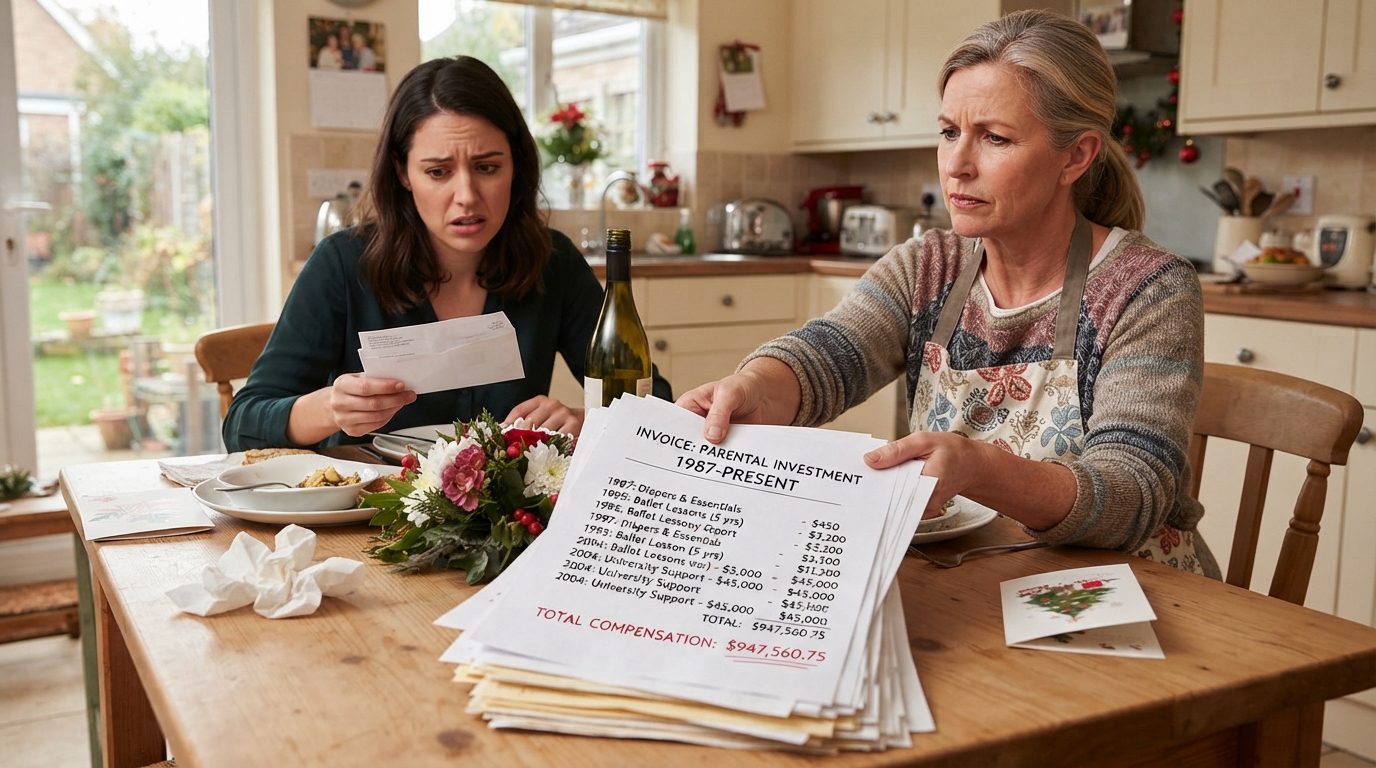
“Listen to me. I did not send you that invoice because I want you to pay me back. I don’t want $412,618. I don’t want interest. I don’t want installments.”
“Then what do you want?”
I looked directly at her.
“I want my daughter back.”
She covered her mouth.
I continued.
“I want the girl who used to call me just to tell me that she saw a pretty bird outside her office. I want the woman who invited me over because she wanted my company, not because she needed something. I want to be your mother, Lauren. Not another person on your household expense sheet.”
She stood up so suddenly that her chair scraped against the floor.
Then she came around the table and wrapped her arms around me.
“I’m sorry, Mom.”
I held her.
And for a moment, everything felt like it used to.
But then she whispered something that changed the conversation entirely.
“There’s something else you need to know.”
I pulled back slightly.
“What is it?”
She wiped her cheeks.
“Mark didn’t just suggest that I send you the invoice.”
I waited.
“He actually made the spreadsheet.”
I felt my expression change.
“What?”
“After Christmas dinner, he sat down with me and said we should calculate everyone’s share. He said it was only fair. I told him I thought it was strange to charge you because you brought food and presents, but he said those were your choices.”
I stared at her.
“And you agreed?”
She nodded, ashamed.
“He said his parents paid their share of the meal, so everyone should. Then he said you were probably used to being generous because you had always been a mother, but that didn’t mean we should take advantage of you.”
I leaned back.
“Interesting.”
“Mom, I know.”
“No, sweetheart. Let me understand this. His parents paid their share?”
“Yes.”
“And you charged me for the ham, pies, and shortbread I brought?”
Her face fell.
“Yes.”
“And the cleaning service?”
She nodded.
I took a slow breath.
“Did his parents bring anything?”
Lauren hesitated.
“His mother brought a bottle of wine.”
“And his father?”
“Nothing.”
I nodded.
I wasn’t angry that they had brought nothing. People contribute in different ways. Some cook, some clean, some bring gifts, and some simply show up.
That was never the problem.
The problem was the sudden appearance of a financial rule that somehow applied only after the dinner was over.
“Lauren, I want to ask you something.”
“Okay.”
“Did Mark’s parents receive an invoice?”
She looked down.
“No.”
“Did Mark receive one?”
“No.”
“Did you charge yourself?”
She shook her head.
I almost smiled.
“Then it wasn’t about fairness, was it?”
She didn’t answer.
At noon, Lauren left.
She hugged me twice at the door and promised to call the following evening.
I watched her drive away.
Then I returned to the kitchen, where the envelope still lay open.
I placed the eleven pages back inside.
For the first time since mailing it, I wondered whether I had done the right thing.
Perhaps I had been too sharp.
Perhaps I should have simply told her how I felt.
But then I remembered something.
On page ten, beneath the section about the eleven months she had lived with me, I had included a little note.
It wasn’t an expense.
It was a memory.
November 2017: Lauren came home from work crying. Made her favorite chicken soup. Sat with her until 2:30 a.m. No charge.
I had written that because I wanted her to remember.
Not the soup.
Not the money.
The fact that I had been there.
Three days later, Lauren called again.
This time, she sounded different.
“Mom, would you come over for dinner on Sunday?”
I hesitated.
“Is Mark cooking?”
She laughed nervously.
“No. I am.”
“That sounds nice.”
“And Mom?”
“Yes?”
“I want you to bring nothing.”
I smiled.
“Are you sure?”
“Absolutely nothing. Not even shortbread.”
“That’s going to be difficult.”
“I know. But I want to do this properly.”
I agreed.
Sunday evening arrived.
When I pulled into her driveway, I noticed something unusual.
There were two cars parked outside.
One belonged to Mark.
The other belonged to his parents.
I stood at the door for a moment, wondering whether Lauren had invited them because she wanted to repair the situation or because she wanted witnesses.
Then the door opened.
“Mom!”
She hugged me and took my coat.
Inside, Mark was standing near the kitchen island.
His parents were seated in the living room.
“Hello,” I said politely.
Mark nodded.
“Good to see you.”
His mother smiled.
“How lovely that you could come.”
I returned the smile.
Lauren led me into the dining room.
There was no spreadsheet.
No printed breakdown.
No envelopes.
Just a simple dinner.
Roast chicken, mashed potatoes, green beans, and a bowl of salad.
The table was set with the same new linens from Christmas.
I almost laughed.
Lauren noticed my expression.
“I know,” she whispered. “I thought about replacing them, but then I realized that would be ridiculous.”
I squeezed her hand.
Dinner began quietly.
Mark’s father discussed the weather. His mother mentioned a trip they were planning.
Then, halfway through the meal, Lauren put down her fork.
“I want to say something.”
Everyone looked at her.
She took a breath.
“After Christmas, I sent my mother an invoice for her share of dinner. I told myself I was being fair. But I wasn’t.”
Mark shifted in his chair.
Lauren continued.
“I charged her for food she had helped provide, for linens she didn’t damage, and for cleaning after a dinner she had already helped clean.”
Her voice trembled.
“And I did it without considering everything she had done for me throughout my life.”
Mark looked down.
His mother stopped chewing.
“I also need to apologize because I let someone else’s opinion change how I treated my own mother.”
“Lauren,” Mark interrupted quietly.
She raised her hand.
“Please let me finish.”
He went silent.
“I don’t expect anyone here to pay for my mother’s sacrifices. That’s not what this is about. But I never want her to feel like she has to pay for the privilege of being invited into my home.”
I looked at my daughter.
Her eyes were wet, but she kept speaking.
“Mom, I’m sorry. And I want you to know that from now on, you’re welcome here because you’re my mother. Not because you bring food, buy gifts, help with cleaning, or contribute financially.”
Nobody spoke.
Then Mark’s mother slowly placed her napkin beside her plate.
“Lauren,” she said, “I think there is something we should explain.”
Lauren turned toward her.
And I noticed Mark suddenly becoming very uncomfortable.
His mother looked at me.
“Actually, I was surprised when I heard about the invoice. Mark told us you had offered to pay for Christmas dinner.”
Lauren frowned.
“What?”
His mother continued.
“He said you had insisted on contributing because you didn’t want us covering your portion.”
I looked at Mark.
He avoided my eyes.
His father cleared his throat.
“And he also told us that the invoice was simply a way of helping you understand the cost of hosting.”
The room became very quiet.
Lauren slowly turned toward her husband.
“Mark?”
He rubbed his forehead.
“Can we not do this right now?”
But Lauren didn’t move.
“Did you tell your parents that Mom offered to pay?”
Mark remained silent.
“Did you?”
Finally, he answered.
“Yes.”
Lauren stared at him.
“Why?”
He looked at me, then at his parents.
“Because I didn’t want it to become a big issue.”
I almost admired the honesty.
Almost.
But Lauren wasn’t finished.
“Then why did you tell me that my mother should pay because she’s on a fixed income?”
Mark’s expression tightened.
“I was just trying to be practical.”
“No,” Lauren said quietly. “You were trying to make me believe that charging my mother was normal.”
“Lauren—”
“And you never suggested sending your parents an invoice.”
His mother looked deeply uncomfortable.
Mark pushed his chair back.
“This is getting ridiculous. It’s two hundred dollars.”
Lauren shook her head.
“Exactly. It was only two hundred dollars. And somehow, you convinced me to risk something worth more than money.”
She looked at me.
“Mom, I’m sorry.”
I reached for her hand.
But then Mark said something that made all of us freeze.
“Fine. If we’re going to talk about fairness, perhaps we should discuss the money your mother gave you for the condo.”
Lauren turned around.
“What?”
He gave a humorless laugh.
“She gave you money in 2015, didn’t she? A substantial amount. And now she’s acting like she’s never expected anything in return.”
I looked at him carefully.
“Mark, I never asked Lauren to repay that money.”
“Maybe not. But it was still a financial contribution.”
Lauren stood up.
“Stop.”
Mark looked at her.
“What’s wrong?”
She stared at him with an expression I had never seen before.
“Did you read the entire invoice?”
He said nothing.
“Because if you had, you would know that Mom specifically wrote that the condo money was a gift.”
She turned toward me.
“Mom, did you ever ask me for that money back?”
“Never.”
Lauren looked at Mark again.
“Then why are you bringing it up?”
He didn’t answer.
And that was when I realized something.
The invoice had not simply made my daughter reconsider Christmas.
It had exposed a much bigger problem in her marriage.
Because Mark wasn’t interested in fairness when it came to the people he loved. He was interested in fairness only when it benefited him.
And I had a feeling that the next conversation between husband and wife was going to be much more difficult than the one we had just finished.
PART 4: The Last Invoice Was Never About Money
For several seconds, nobody moved.
Mark stood beside his chair, his jaw tight, while Lauren stared at him as though she were seeing a stranger sitting across the dinner table.