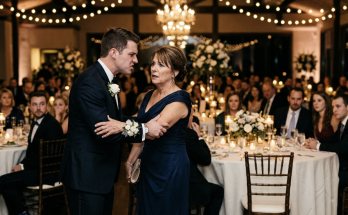
His mother slowly folded her napkin.
His father looked down at his plate.
And I sat quietly, holding my daughter’s hand.
I had spent thirty-nine years protecting Lauren from uncomfortable situations. I had defended her when she was wrong, encouraged her when she was frightened, and helped her rebuild her life when everything fell apart.
But I knew something important.
This time, I could not rescue her from the consequences of her own decisions.
She had to see them herself.
“Mark,” Lauren finally said, “I want you to answer one question.”
He sighed.
“What now?”
“Did you marry me because you wanted a partner, or because you wanted someone who would follow your rules?”
His expression changed.
“That’s an unfair question.”
“Is it?”
“Lauren, we’re talking about a dinner bill.”
“No. We’re talking about how you convinced me to charge my mother for Christmas dinner while telling your parents that she had volunteered to pay.”
Mark rubbed his face.
“I didn’t think it would become this dramatic.”
“Because you didn’t think she would ever question it?”
He didn’t answer.
Lauren continued.
“Do you know what my mother did after receiving my invoice?”
Mark shrugged.
“She paid it.”
“Exactly. She paid it without arguing. She didn’t call me names. She didn’t complain to anyone. She simply paid the $212.14.”
Lauren’s voice broke.
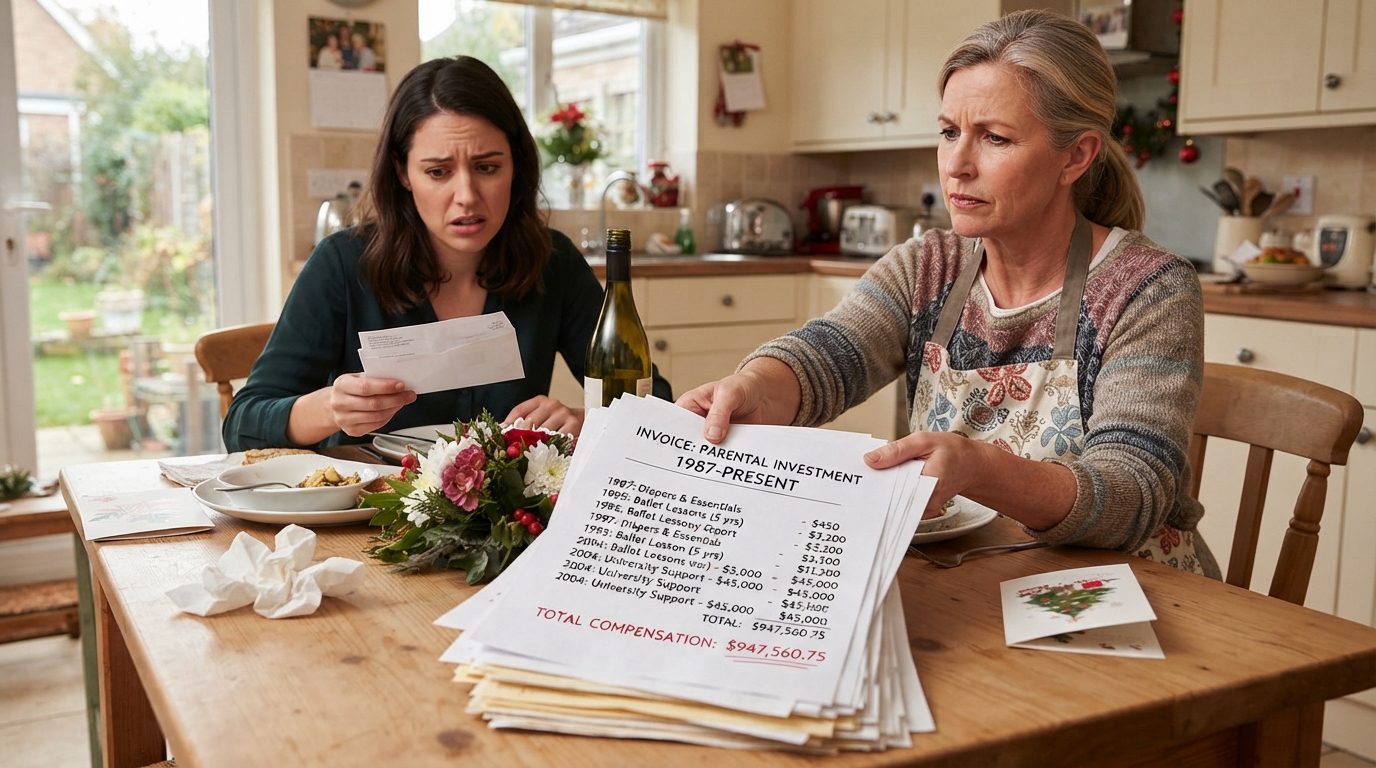
“And then she sent me eleven pages showing me everything she had given me without ever asking for a dollar.”
Mark looked toward me.
“Well, I think that was a little excessive.”
I finally spoke.
“Perhaps.”
He seemed surprised that I had agreed.
“But I have spent my entire life being told that mothers should give without expecting anything in return. I accepted that responsibility gladly. What I never agreed to was being treated like a stranger who needed to justify her place at the family table.”
His mother quietly said, “That’s a fair point.”
Mark turned toward her.
“Mom, please.”
She looked directly at him.
“No, Mark. I think it’s time someone said it.”
She turned toward Lauren.
“When my mother was alive, she never sent me an invoice for Christmas dinner. And I certainly never sent her one. I don’t know what has happened to family gatherings, but I don’t think this is what they were supposed to become.”
Mark’s father nodded.
“I agree.”
Mark pushed his chair away.
“Fine. Apparently, I’m the villain here.”
Lauren looked exhausted.
“I didn’t say that.”
“You don’t have to.”
He grabbed his jacket and walked into the hallway.
A moment later, the front door slammed.
His parents exchanged uncomfortable glances.
His mother stood.
“I’m sorry, Lauren. I think your father and I should leave.”
Lauren nodded.
“Thank you for coming.”
Before leaving, Mark’s mother approached me.
She took my hand.
“I’m sorry you were put in that position.”
“Thank you.”
She hesitated.
“And for what it’s worth, I think your daughter is lucky to have you.”
I smiled.
“She’s lucky to have people who love her enough to tell her when she’s making a mistake.”
The older woman nodded.
Then she left.
When the house finally became quiet, Lauren sat down and covered her face.
“I don’t know what to do, Mom.”
I pulled my chair closer.
“Then don’t decide tonight.”
She looked at me.
“What if this is how he’s always been?”
“Then you need to decide whether that’s the kind of marriage you want.”
She began crying again.
I held her hand.
“Sweetheart, don’t confuse keeping a marriage together with keeping yourself unhappy.”
She leaned against my shoulder.
And for the first time in a very long time, I saw my little girl again.
Not the successful professional with the new house and expensive furniture.
Not the married woman who worried about appearances.
Just Lauren.
My Lauren.
The following week, I didn’t hear from her.
I deliberately gave her space.
On Tuesday, she sent me a short message.
Mom, can I come over tomorrow? I need to talk.
I replied immediately.
The kettle will be on.
She arrived the next afternoon carrying a small cardboard box.
I recognized it immediately.
It was an old shoebox covered in faded pink paper.
“What is that?” I asked.
She placed it on the kitchen table.
“I found it in the storage room.”
I opened the lid.
Inside were birthday cards, childhood photographs, school certificates, and several little handwritten notes.
At the very bottom was a folded piece of construction paper.
I carefully opened it.
It was a drawing of a woman holding a little girl’s hand.
The writing was crooked, the letters uneven.
Dear Mommy, when I grow up I will buy you a big house and take care of you forever. I love you. Lauren.
I stared at it.
Then I laughed softly.
“You promised me a big house.”
Lauren smiled through her tears.
“I know.”
“You haven’t bought it yet.”
“I know, Mom.”
She sat down.
“I found this while looking for the Christmas decorations. I started reading everything. The birthday cards, the school notes, the little letters I used to leave in your purse.”
She opened another envelope.
“This one says you were the best mother in the whole world.”
I nodded.
“That was a good year.”
She laughed.
Then she became serious.
“Mom, I have been thinking about the invoice.”
I poured her some tea.
“All right.”
“I understand now that you weren’t asking me to pay you back.”
“No.”
“But I also realized something else. I have been keeping score in my marriage.”
I waited.
“Who paid for groceries. Who paid for the electricity. Who paid for dinner. Who bought the furniture. Who contributed more. Mark and I started dividing everything because he said it prevented resentment.”
She looked down at her hands.
“But somehow, we stopped doing things because we loved each other. Everything became a calculation.”
I listened.
“Do you remember when I first moved into my condo?”
“Of course.”
“You bought me a refrigerator.”
“I did.”
“You didn’t even let me pay you back.”
“You were just starting over.”
She smiled sadly.
“And when I got the job promotion, you made me that ridiculous chocolate cake.”
“It wasn’t ridiculous. It was delicious.”
“It was leaning to one side.”
“That was intentional.”
She laughed.
Then she wiped her eyes.
“That’s what I miss. Doing things because they make someone happy.”
I reached across the table.
“Then start doing that again.”
She nodded.
“There’s something else.”
“What is it?”
“I’m going to see a marriage counselor. Mark agreed to come.”
I didn’t react immediately.
“Do you want to go?”
“Yes. I want to understand whether we can fix this.”
“Then I support you.”
She squeezed my hand.
“But I need you to promise me something.”
“What?”
“Don’t ever let me treat you like that again. Even if I forget. Even if I get busy. Even if I become someone you don’t recognize.”
I smiled sadly.
“Lauren, I can forgive you. But I cannot live your life for you.”
She nodded.
“I understand.”
The counseling sessions lasted nearly three months.
I didn’t ask for details.
Lauren shared what she wanted to share, and I respected her privacy.
But I noticed changes.
She called more often.
Sometimes she asked about my day.
Sometimes she called just to tell me something funny that had happened at work.
One Saturday, she arrived at my house with groceries.
“What are you doing?” I asked.
“Making lunch.”
“You don’t have to.”
“I know.”
She placed the bags on the counter.
“I want to.”
We spent the afternoon cooking chicken soup and baking a pie.
At one point, she looked around my kitchen.
“Mom?”
“Yes?”
“Do you remember when you used to make this soup whenever I was sick?”
“Every time.”
“You always cut the carrots into little stars.”
I smiled.
“You refused to eat vegetables unless they looked interesting.”
She laughed.
Then she became quiet.
“I wish I had appreciated those things more.”
I put down the knife.
“Sweetheart, you were a child. You weren’t supposed to understand everything I did.”
“But I’m not a child anymore.”
“No. And now you have the opportunity to do things differently.”
She hugged me.
And that afternoon, we ate lunch without discussing invoices, expenses, or who owed whom.
It was one of the nicest days I had experienced in years.
In March, Lauren called me with news.
“Mom, Mark and I have made a decision.”
My stomach tightened.
“All right.”
“We’re going to separate.”
I sat down.
“Are you sure?”
“Yes.”
She explained that counseling had helped them understand their differences, but it had also revealed how unhappy they had become.
Mark wanted a marriage built around strict financial arrangements and separate responsibilities.
Lauren wanted a marriage where generosity, affection, and shared decisions were not treated as weaknesses.
Neither of them could agree on what a partnership should look like.
“We’ve been trying to force ourselves to become people we’re not,” she said.
I listened quietly.
“Are you okay?”
She took a breath.
“I’m sad. I’m frightened. But I’m also relieved.”
I closed my eyes.
That was the answer I needed to hear.
“Then take your time, sweetheart.”
“I will.”
A few weeks later, Lauren moved into a small apartment while they worked through the separation.
She didn’t ask me for money.
I didn’t offer unsolicited financial advice.
I simply helped her carry boxes, made her dinner, and listened when she needed to talk.
One evening, while unpacking her kitchen, she found the eleven-page invoice.
She had brought it with her.
“Why did you keep that?” I asked.
She smiled.
“Because I don’t ever want to forget it.”
I shook my head.
“Lauren, you don’t need to punish yourself forever.”
“I’m not.”
She folded the papers carefully.
“I’m keeping it because it reminds me that love isn’t something you should measure after someone has already given it.”
I didn’t know what to say.
So I hugged her.
By summer, Lauren had settled into her new apartment.
It wasn’t large, but it was bright.
There were flowers on the windowsill, photographs on the shelves, and a little dining table that seated four people.
One Saturday, she invited me for dinner.
When I arrived, she opened the door wearing an apron.
“Welcome!”
I stepped inside.
The smell of roasted chicken filled the apartment.
On the table were mashed potatoes, green beans, fresh bread, and a small vase of flowers.
I looked around.
“This is lovely.”
“Thank you.”
She took my coat.
Then she pointed toward the kitchen.
“And before you ask, no, you are not allowed to help.”
I laughed.
“I wasn’t going to.”
“Yes, you were.”
She was right.
We sat down.
Halfway through dinner, she disappeared into the kitchen and returned with a small envelope.
“What’s this?” I asked.
“Something I wanted to give you.”
I opened it.
Inside was a handwritten letter.
It began:
Dear Mom,
I used to think that because you had always been there, you would always be there in exactly the same way.
I thought I could call whenever I needed something. I thought you would understand when I was busy. I thought your generosity was something I could count on without ever having to acknowledge it.
I was wrong.
I am sorry I made you feel like an expense.
I am sorry I forgot that you were a person before you were my mother.
And I am sorry that I needed eleven pages to remind me of something I should have known all along.
I cannot repay you for the years you gave me. I don’t want to try. I just want to spend the years ahead showing you that your love was never wasted.
You are not a bill.
You are not an obligation.
You are my mother.
And I am grateful that I still get to call you.
Love, Lauren.
I folded the letter carefully.
My eyes were wet.
“Thank you, sweetheart.”
She reached across the table.
“There’s one more thing.”
She opened a drawer and brought out a little framed photograph.
It was the picture of us from her college graduation.
I was standing beside her in a simple blue dress, holding flowers.
She placed it on the table.
“I want this here.”
I smiled.
“Why that picture?”
“Because I remember looking at you that day and thinking I couldn’t have done anything without you.”
She paused.
“I want to remember that feeling.”
The following Christmas, Lauren invited me to dinner again.
This time, she didn’t send an invoice.
She didn’t divide the cost of the food.
She didn’t ask me to contribute to the cleaning service.
Instead, she called me two weeks beforehand.
“Mom, I’m hosting Christmas. Would you like to come?”
“I’d love to.”
“Wonderful. And please don’t bring anything.”
I laughed.
“You’re asking the impossible.”
“Then bring your shortbread. But only because I love it.”
Christmas Eve arrived.
When I entered her apartment, the table was already set.
There were candles, simple white plates, and a small vase of flowers.
The shortbread was placed in the center of the table.
Lauren had made a little handwritten card and placed it beside my seat.
It read:
Reserved for Mom. Always.
I picked it up and smiled.
Dinner was wonderful.
We talked about work, family, old memories, and the ridiculous things that had happened during the year.
At one point, Lauren raised her glass.
“I want to make a toast.”
Everyone looked at her.
She smiled at me.
“To the people who gave us things we can never repay. Not because we owe them, but because we were lucky enough to receive their love.”
She lifted her glass.
“And especially to my mother, who taught me that the most valuable things in life never come with a price tag.”
My throat tightened.
I raised my glass.
“To learning.”
We drank.
Later, while everyone was helping clear the table, Lauren approached me with a small envelope.
“Mom, one more thing.”
I opened it.
Inside was a single sheet of paper.
At the top, in bold letters, she had written:
CHRISTMAS DINNER — FAMILY ACCOUNT
Underneath were two columns.
The first read:
Things provided:
-
Food.
-
Warmth.
-
Laughter.
-
Memories.
-
A place at the table.
-
Love.
The second read:
Amount owed: $0.00.
At the bottom, she had written:
Payment accepted in hugs, phone calls, and as many Christmases together as life allows.
I laughed, but tears were already running down my face.
“You’re becoming quite the accountant,” I said.
She hugged me.
“I learned from the best.”
That night, after I returned home, I placed her little note beside the original eleven-page invoice.
I looked at both documents for a long time.
One represented everything I had given.
The other represented everything my daughter had finally understood.
I used to believe that the hardest part of motherhood was the giving.
The sleepless nights.
The school fees.
The hospital visits.
The sacrifices nobody noticed.
But I eventually learned that sometimes the hardest part is allowing your grown child to make mistakes without letting those mistakes destroy the love between you.
Lauren had hurt me.
I had hurt her pride.
We had both learned something.
And although I never received a dollar of that $412,618, I eventually received something far more valuable.
My daughter began calling me simply to talk.
She visited without needing anything.
She remembered my birthday.
She asked about my health, my friends, and the little things happening in my quiet life.
And whenever she invited me for dinner, I no longer wondered whether I was welcome because of what I could contribute.
I knew I was welcome because I belonged.
As for the original $212.14?
I never asked her to return it.
I never needed it.
But I did keep the Venmo receipt.
Not because I wanted to remember what she had charged me.
Because beneath the payment, there was a note I had written:
Thank you for a lovely dinner.
I smiled whenever I saw it.
Because I finally understood something.
The most expensive thing a family can lose isn’t money. It’s the feeling that you belong to one another.
And no spreadsheet, no matter how carefully prepared, can ever calculate the cost of losing that.