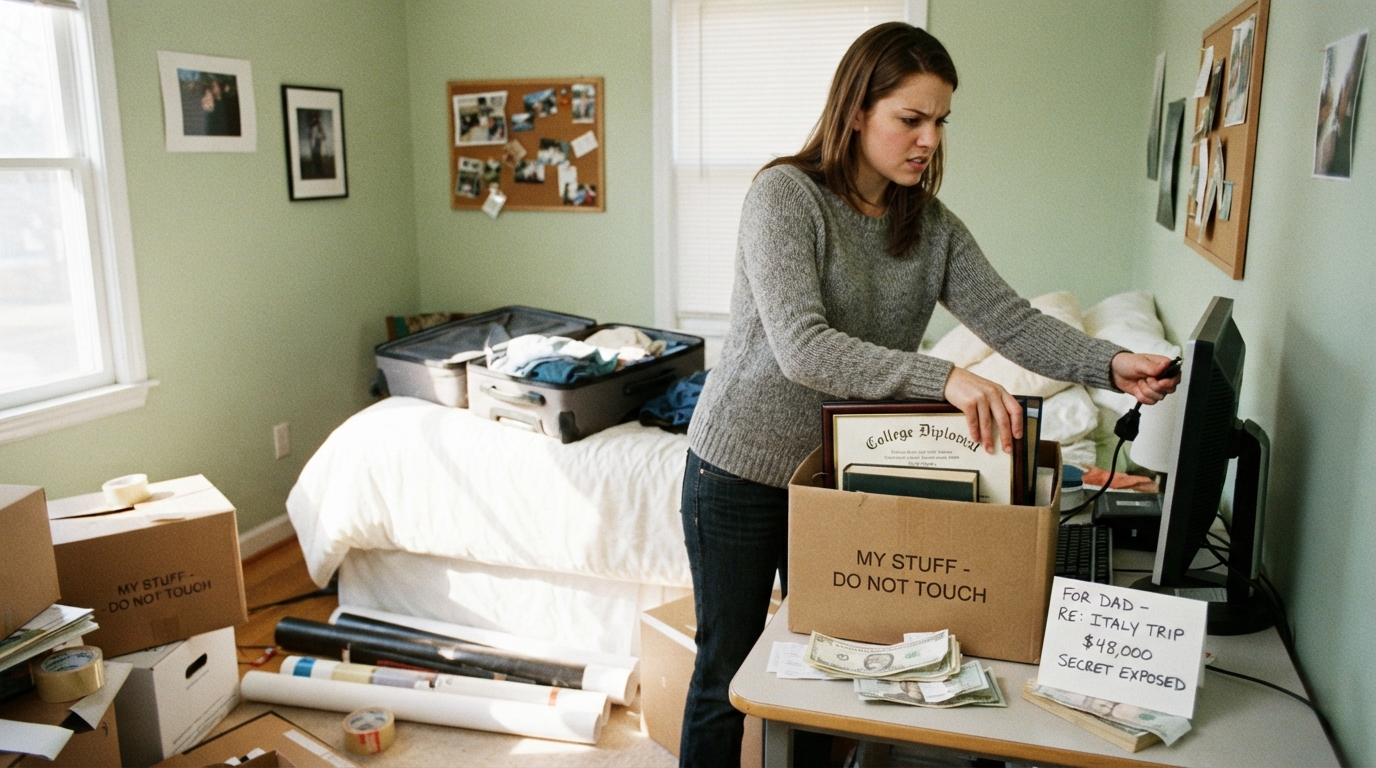
PART 3
I closed my eyes. Of course. Not a single word about the money I had spent. Not a single word about the years I had supported them.
Not a single word about the fact that I had carefully consulted an attorney before removing anything.
Just another attempt to make me responsible for everything that had gone wrong in their lives.
“What exactly did he tell them?” I asked. “My office received a call from the investigating officer this morning. Your father claims several expensive items disappeared from the property. He also says you had access to the house and that he never authorized you to remove anything.”
I let out a quiet, bitter laugh. “Never authorized me? I lived there for almost ten years. I paid for half the things in that house.”
“I understand,” my lawyer replied. “But we need to separate what you purchased from what you may have given to your parents. That distinction is important.”
“I have every receipt.” “I know. That’s why I want you to remain calm. Don’t contact your father directly. Don’t argue with your sister. Don’t post anything online. Send me the envelope you left at the house, along with the complete inventory of everything you removed.”
I looked toward the expandable folder sitting beside my laptop.
Reality. For the first time, I was grateful I had spent two weeks organizing every document instead of simply packing my belongings and disappearing.
“There’s something else,” my lawyer continued.
“What?” “Your father told the officer that you had been acting strangely before the trip. He suggested you might be experiencing some kind of emotional breakdown.”
I stared at the wall.
Then I laughed again, although there was nothing remotely funny about it.
“An emotional breakdown?”
“Yes.”
“My parents excluded me from their anniversary vacation after I spent ten years helping them financially. I moved out. That’s the breakdown?”
My lawyer remained quiet for a moment.
“Victoria, people sometimes create a story that makes their behavior easier to defend. We aren’t going to fight their version with emotion. We’re going to establish the facts.”
I nodded, even though he couldn’t see me.
“Tell me what to do.”
“Send me the documents. I’ll handle the communication with the police.”
After the call ended, I sat completely still.
Then I opened my laptop.
I began attaching bank statements, purchase receipts, delivery confirmations, credit card records, and the signed moving inventory.
There were hundreds of pages.
Ten years of my life reduced to digital files.
And as I uploaded them, I noticed something I hadn’t thought about since leaving.
My parents had never actually asked me to return.
They hadn’t asked me to come home and discuss the situation.
They hadn’t asked whether I was happy or whether I had somewhere comfortable to live.
They had gone straight to the police.
That told me more than any argument ever could.
By lunchtime, my lawyer had everything.
He called me again around two.
“Victoria, I reviewed the inventory. Your documentation is quite thorough.”
“Does that mean I’m safe?”
“It means you have a strong factual basis for explaining why you removed those items. I cannot promise what an investigation will conclude, but the receipts, ownership records, and moving company’s documentation are important.”
I exhaled.
Then he asked a question I hadn’t expected.
“Did you leave anything else at the property that belongs to you?”
I thought for a moment.
“My bedroom furniture. Some clothes I didn’t need. A few boxes of books. My old desk.”
“Anything valuable?”
“Nothing particularly expensive.”
“Good. Don’t go back to retrieve anything without discussing it with me first.”
“Okay.”
He paused.
“Victoria, I also want to ask you something about the financial assistance you provided your parents.”
“What about it?”
“You mentioned the mortgage refinance. Was that money documented as a loan?”
I looked down at my hands.
“No. I transferred it because they were struggling. My father said he would pay me back when things improved.”
“Did he ever?”
“No.”
“Do you have messages discussing repayment?”
I slowly opened my email.
“Yes. I might.”
“Send those to me as well. We need to understand which payments were loans, which were gifts, and which were ordinary household contributions.”
After we ended the call, I searched through old messages.
At first, I found nothing significant.
Then I discovered an email from my father dated four years earlier.
The subject line read:
Mortgage Situation — Please Help Us.
I opened it.
His message was short.
Victoria, your mother and I are in a difficult position. The bank has given us a final opportunity to refinance the mortgage. We need $8,000 to complete the process. I know you’ve been saving, but this is important. I promise we will make things right when we’re back on our feet. You’re our daughter, and family helps family.
I remembered that email.
I remembered transferring the money the following morning.
I also remembered eating instant noodles for nearly two months because I wanted to rebuild my savings as quickly as possible.
I forwarded it to my lawyer.
Then I found another message.
And another.
Some were from my mother.
Some were from Lily.
One from Lily read:
Vicki, please don’t be mad, but I missed another car payment. Dad says you can cover it this month and I’ll pay you back after I find another job. You’re literally the only person I can ask.
That message was dated eighteen months earlier.
Lily still hadn’t paid me back.
I kept searching.
By the time I finished, the mountain outside my window had disappeared behind an afternoon mist.
And I had discovered something much more disturbing than the money.
My parents had been telling relatives that I was financially irresponsible.
I found out through a family group email that my aunt had forwarded to me months earlier.
My mother had written:
Victoria makes decent money, but she never seems to have anything saved. We worry about her future. Lily is much better at managing her life, and we’re trying to help her become independent.
I read the paragraph three times.
Then I looked at the spreadsheet showing the $112,419 I had spent supporting that family.
I wasn’t the irresponsible one.
I was the reason everyone else could afford to pretend they were financially stable.
And apparently, even that wasn’t enough.
The next morning, my lawyer called.
“Victoria, the police officer would like to speak with you.”
My stomach tightened.
“Do I have to go to the station?”
“Not necessarily. I have arranged for us to meet with the officer. I’ll accompany you, and we’ll bring the documentation.”
“When?”
“Tomorrow morning.”
I looked around the cabin.
The small living room.
The secondhand bookshelf.
The kitchen I had barely finished organizing.
For the first time in my life, I was afraid that my parents might succeed in making me lose the peaceful life I had just started building.
But I agreed.
The following morning, I drove forty minutes to the town where my lawyer had his office.
He was waiting outside with a dark folder tucked beneath his arm.
“Ready?” he asked.
I nodded.
We entered the police station together.
A middle-aged officer introduced himself as Detective Harris. He had a calm expression and spoke in a professional tone.
“Ms. Victoria, thank you for coming in.”
“Of course.”
He opened a file.
“Your father reported that several household items were removed from the property while he and your mother were overseas. He estimates the value at approximately twenty-five thousand dollars.”
I almost choked.
Twenty-five thousand?
The items I had taken were worth far less than that.
My lawyer gently placed his folder on the desk.
“We have an itemized inventory, purchase receipts, and supporting documentation establishing ownership of the property our client removed.”
Detective Harris examined the papers.
He looked at the television receipt.
The furniture invoice.
The appliance purchases.
The moving company’s signed inventory.
He turned several pages.
Then he looked at me.
“Did your parents give you permission to remove these belongings?”
I took a breath.
“I didn’t ask them for permission because I had already established that the items belonged to me. However, I did not remove anything that I couldn’t reasonably document as my personal property.”
“Did you take anything from your sister’s bedroom?”
“No.”
“Did you remove your parents’ furniture?”
“No.”
“Did you remove any jointly owned property?”
“No. I deliberately left anything whose ownership was uncertain.”
He looked down at the paperwork again.
“Your father says you removed the refrigerator, television, washing machine, dryer, and living room furniture.”
“Yes. Those were my purchases. I have the receipts.”
Detective Harris studied the documents for another minute.
Then he asked something that made me uncomfortable.
“Why did you leave the property so suddenly?”
I looked at my lawyer.
He nodded slightly.
I answered honestly.
“My parents planned an anniversary trip to Italy. They told me they couldn’t afford to take both daughters, so they chose my younger sister. My father reminded me that I was twenty-nine and could take my own vacation. I realized I had spent most of my adult life supporting a household that didn’t consider me equally important. I decided to move out.”
Detective Harris looked at me.
“And you did this while they were away?”
“Yes.”
“Did you leave a note?”
“Yes. Explaining that I had moved out and taken only my legally documented personal belongings.”
My lawyer handed him a copy.
The detective read it silently.
When he reached the final sentence, he stopped.
“I am completely done being your second option, your backup plan, and your personal bank account.”
He placed the note back on the desk.
For several seconds, nobody spoke.
Then he closed the file.
“Ms. Victoria, based on the documentation you’ve provided, this matter appears to be more complicated than your father’s initial report suggested. We’ll need to verify some details, but I don’t see a reason to treat every item listed as missing property as stolen.”
I felt my shoulders relax.
“Thank you.”
He wasn’t finished.
“One other thing. Your father also mentioned that you might have removed some important documents from the property.”
My heart skipped.
“What documents?”
“He says some financial papers and household records are missing.”
I shook my head.
“I took my personal financial documents. Nothing belonging to my parents.”
“Did you have access to their filing cabinet?”
“No.”
He wrote something down.
Then he asked:
“Do you know whether anyone else had access to the house while your parents were away?”
I thought about it.
“The neighbors have a spare key for emergencies. And my sister has her own key.”
Detective Harris nodded.
“Thank you. That’s all for today.”
My lawyer and I stood.
But before we left, the detective said something that made me stop at the door.
“Ms. Victoria?”
I turned.
“Your father also submitted a separate statement claiming you owe your parents money for living in their home.”
I stared at him.
“What?”
“He says you lived there rent-free for several years and that the value of the household property you removed should be considered compensation for unpaid rent.”
My lawyer slowly turned around.
For the first time that morning, I saw his expression change.
Not anger.
Something closer to disbelief.
“Did he provide a rental agreement?” my lawyer asked.
“No.”
“Any written agreement establishing a debt?”
“Not that we’ve received.”
My lawyer nodded.
“Then we’ll address that separately if necessary.”
We walked outside.
I stood on the pavement, unable to believe what I had just heard.
Unpaid rent.
My father wanted to charge me rent.
The same father who had repeatedly asked me to cover his mortgage payments.
The same father whose credit card debt I had helped reduce.
The same father who had called me an adult when he wanted to exclude me from Italy.
I looked at my lawyer.
“Can they really do that?”
“Anyone can make a claim. That doesn’t mean the claim is legally valid. We need to review the facts and the applicable law before drawing conclusions.”
I nodded.
Then I asked the question that had been bothering me since the beginning.
“Why are they doing this?”
My lawyer adjusted his coat.
“Because you changed a financial arrangement that benefited them.”
I looked toward the road.
For years, I had believed my family needed me because they loved me.
Now I was beginning to understand that they had also become accustomed to depending on me.
And they weren’t prepared to lose that arrangement.
I thought the police interview would be the worst part.
I was wrong.
That evening, my phone rang.
The screen displayed an unfamiliar number.
I almost ignored it.
But something made me answer.
“Hello?”
A woman’s voice came through.
“Victoria? This is Aunt Margaret.”
I sat up.
My mother’s older sister.
We had always gotten along, although she lived several hours away and rarely involved herself in family matters.
“Hi, Aunt Margaret.”
“Oh, sweetheart. I’ve been trying to reach you.”
“Is everything okay?”
There was a long pause.
“I don’t know what to say. Your mother called me crying yesterday.”
I closed my eyes.
“I’m sorry she’s upset.”
“She said you emptied the house and left your parents with practically nothing.”
I rubbed my forehead.
“Aunt Margaret, I took my own belongings.”
“That’s what I thought. But your father is telling everyone you stole their furniture.”
“Did he tell you that I paid for most of it?”
Another silence.
“No.”
“Did he tell you that I spent ten years helping them with their bills?”
“No, Victoria.”
“Did he tell you that he and Mom went to Italy with Lily and left me behind because they couldn’t afford my ticket?”
Aunt Margaret sighed.
“He mentioned something about the trip, but he said you had chosen not to go.”
I laughed quietly.
“Of course he did.”
Then her voice became softer.
“Victoria, can I ask you something?”
“Sure.”
“Are you safe? Are you somewhere comfortable?”
That simple question nearly broke me.
For two weeks, I had received accusations, threats, and demands.
Not one person in my immediate family had asked that.
But my aunt had.
“Yes,” I whispered. “I’m safe. I have a little cabin in the mountains. It’s peaceful.”
“Good. That’s all I wanted to know.”
She paused.
Then she said something unexpected.
“Your mother told me something else. She said you had been acting strangely for months, and that she was worried you might be planning something against the family.”
I stared at the window.
“Did she tell you that she had been asking me for money during those same months?”
“No.”
“Did she tell you that I was paying Lily’s car loan?”
“No.”
I took a slow breath.
“Aunt Margaret, I don’t want to fight with anyone. I just want to live my own life.”
“I understand.”
Then she lowered her voice.
“There’s something I think you should know.”
“What?”
“Before they left for Italy, your father called your uncle and asked whether he could borrow some money.”
I frowned.
“Why?”
“He said there had been an unexpected financial problem. He needed several thousand dollars.”
My stomach tightened.
“What kind of financial problem?”
“I don’t know. He didn’t explain much. But he sounded desperate.”
I looked down at the table.
My parents had supposedly planned their anniversary trip months in advance.
They had paid for flights and hotels.
And now my father was asking relatives for money?
“Did Uncle David lend it to him?”
“No. He said he couldn’t afford to.”
I swallowed.
“Thank you for telling me.”
Aunt Margaret hesitated.
“Victoria, I don’t want to make things worse, but I think you should check your credit.”
My entire body went cold.
“Why?”
“I don’t know. Your father mentioned something about needing your information for a financial application. He said you had agreed to help him.”
I couldn’t breathe properly.
“What financial application?”
“I don’t know, sweetheart. Maybe I’m misunderstanding. But please check.”
After we hung up, I sat motionless.
Then I opened my laptop.
I checked my credit accounts.
Everything appeared normal at first.
No unfamiliar credit cards.
No unexpected loans.
No new accounts.
I was about to close the page when I remembered something.
Four months earlier, my father had asked me to send him a copy of my identification.
He said the bank needed it to update some household records because my name was still associated with the mortgage.
I had sent him a scanned copy without thinking twice.
At the time, it seemed harmless.
Now I wasn’t so sure.
I opened my email and searched for the conversation.
There it was.
A message from Dad.
Vicki, can you send me a copy of your ID? The bank needs to update the family file. Nothing serious. Just paperwork.
I stared at the message.
Then I noticed the attachment.
It was a document I had never opened.
The filename was:
Loan Application — Supporting Documents.
My hands began trembling.
I downloaded it.
And when I opened the first page, I saw my full legal name.
My date of birth.
My identification number.
And a signature.
A signature that looked disturbingly similar to mine.
But I had never signed that document.
I read the heading again.
Personal Loan Application.
The applicant was my father.
The supporting guarantor was listed as:
Victoria.
I slowly scrolled down.
There was a section containing the guarantor’s declared monthly income.
My salary was listed.
There was also a declaration stating that I had agreed to accept financial responsibility if the borrower failed to make payments.
At the bottom of the page was the signature.
My signature.
Or something designed to look like it.
I felt sick.
I immediately called my lawyer.
He answered after two rings.
“Victoria?”
“I found something.”
“What is it?”
“My father used my identification for a loan application.”
Silence.
“What do you mean?”
I emailed him the document while we were speaking.
“I never signed this. I never agreed to guarantee his loan.”
“Don’t touch anything else. I’m opening the document now.”
I heard his keyboard.
Then several seconds passed.
Finally, he spoke.
“Victoria, this is serious.”
My eyes filled with tears.
“Did he commit fraud?”
“I can’t determine that from one document. We need to establish whether this was submitted, whether the lender relied on it, and whether your signature was authorized or forged.”
“What should I do?”
“First, preserve the original email and attachment. Don’t alter anything. I’ll contact the lender through the appropriate channels and help you formally dispute the application.”
I pressed my fingers against my forehead.
“Why would he do this?”
My lawyer’s voice became firm.
“That’s a question we’ll need to investigate. But there’s one more thing I noticed.”
“What?”
“The application was submitted four months ago.”
“Yes.”
“And the loan amount is considerably larger than the amount your aunt mentioned.”
I looked at the screen.
My eyes moved to the figure printed near the top.
<PRIVATE_PERSON>.
I blinked.
Then I leaned closer.
$48,000.
Forty-eight thousand dollars.
My father had apparently attempted to borrow forty-eight thousand dollars using my identity as a guarantor.
I couldn’t speak.
Then my lawyer asked:
“Victoria, did your parents ever mention why they needed that much money?”
“No.”
“Did your father tell you about any major financial difficulties?”
“No. He said everything was fine.”
There was a long pause.
Then he said:
“I’m going to investigate this. But Victoria, I want you to understand something. This may be much bigger than the dispute over the furniture.”
I stared at the document.
For ten years, I had been helping my parents financially because I believed they were struggling.
I had sacrificed my savings.
I had paid their bills.
I had covered my sister’s mistakes.
And now I was looking at evidence that my father might have been using my personal information to obtain credit without my knowledge.
My phone suddenly vibrated.
A message appeared.
It was from Lily.
For the first time since the family returned from Italy, she wasn’t calling me names.
She wasn’t demanding that I return the television.
She wasn’t accusing me of ruining the house.
Instead, she wrote:
Vicki, please call me. I know what’s happening, and there’s something Mom and Dad haven’t told you. I didn’t know how bad it was until we got back from Italy.
I stared at the message.
Then another arrived.
Dad is going to blame me if you find out. But I swear I didn’t know he used your name.
My heart began beating faster.
I typed one question.
What did Dad do, Lily?
The three little dots appeared.
Disappeared.
Appeared again.
Then her reply came through.
The $48,000 wasn’t for the house, Vicki. It was supposed to pay off something Dad has been hiding for almost two years.
I stopped breathing.
Because whatever my father had been hiding, it had apparently been serious enough for him to use my identity.
And Lily knew exactly where the money had gone.
PART 4: THE $48,000 SECRET THAT DESTROYED MY FATHER’S LIES
I read Lily’s message so many times that the words began to blur.
The $48,000 wasn’t for the house, Vicki. It was supposed to pay off something Dad has been hiding for almost two years.
I wanted to call her immediately.
I wanted to demand answers.
But I remembered my lawyer’s instructions. Everything needed to be documented, especially now that my father’s financial decisions might have involved my identity.
So I typed one sentence.
Lily, tell me everything. I deserve to know the truth.
She didn’t respond for almost twenty minutes.
Then my phone rang.
I answered.
“Vicki?”
Her voice sounded different. Smaller. Almost frightened.
“I’m here.”
“Are you alone?”
“Yes.”
“Promise you won’t tell Dad I contacted you.”
I leaned back in my chair.
“Lily, I can’t promise to hide something illegal. But I will listen to you.”
She started crying.
“I didn’t know he used your name. I swear.”
“Then tell me what happened.”
There was a long silence.
Finally, she spoke.
“Dad has been gambling.”
I closed my eyes.
For a moment, I thought I had misunderstood her.
“What?”
“Online betting. Sports betting. At first, he said it was just something he did occasionally. He told Mom he was making extra money.”
I stared at the mountain outside my window.
My father had always been the person who lectured everyone about responsibility.
He criticized Lily whenever she spent too much.
He told me I needed to save more.
He reminded us that financial discipline was the foundation of a successful life.
And apparently, behind closed doors, he had been gambling.
“How much?” I whispered.
“I don’t know exactly. But I saw some statements in his office before we left for Italy.”
“How much, Lily?”
She began crying harder.
“I think it’s more than sixty thousand dollars.”
I gripped the edge of the table.
Sixty thousand.
My father had been asking me for money for years.
He had told me the mortgage was in danger.
He had told me the refrigerator needed replacing.
He had told me my mother needed help with medical expenses.
And I had believed him.
“Does Mom know?”
“Yes.”
That answer hurt more than I expected.
“Since when?”
“Almost a year.”
I couldn’t speak.
Lily continued.
“Mom found out when a collection agency called the house. Dad promised he would stop. He said he had lost control once, but it wouldn’t happen again.”
“And then?”
“He kept doing it.”
I looked down at the loan application on my laptop.
“Was the $48,000 supposed to pay his gambling debt?”
“I think so. He told Mom he had a plan to consolidate everything. He said if the bank approved the loan, he could pay off the people demanding money and start fresh.”
“Using me as the guarantor.”
Lily went quiet.
“Yes.”
I felt something inside me collapse.
“Did Mom know about that?”
“I think she knew he was trying to use your income. I don’t know if she knew he had copied your signature.”
I pressed my fingers against my forehead.
“Lily, listen to me. Did you see the application?”
“No. But I heard them arguing about it before we left.”
“What did they say?”
She took a shaky breath.
“Dad said you would never find out because the bank only needed the documents. Mom told him it was dangerous. He said you owed the family anyway because they had let you live in their house.”
I felt physically sick.
There it was again.
The house.
The same house I had helped keep financially afloat.
The same house where I had cooked their meals, purchased groceries, paid bills, and quietly repaired everything that broke.
Apparently, my parents believed those things gave them the right to use my identity.
“Why didn’t you tell me earlier?” I asked.
Lily didn’t answer immediately.
Then she whispered:
“Because I was afraid.”
“Afraid of what?”
“Dad told me if I said anything, he would stop paying my car insurance. He said I should be grateful because he and Mom were the reason I had everything.”
I almost laughed.
Even Lily was being controlled through money.
But then I remembered something.
“Lily, you said Dad had been hiding something for almost two years. Is there anything else?”
She hesitated.
“Yes.”
“What?”
“He sold Grandma’s old jewelry.”
I sat completely still.
Grandma had died six years earlier.
Her jewelry wasn’t particularly expensive, but my mother had kept it in a small wooden box. There were rings, a necklace, and a gold bracelet that had belonged to my grandmother for decades.
Mom had always said she would eventually give the necklace to one of us.
“Why would he sell that?”
“I don’t know. Mom said he told her he had put it somewhere safe. But when she asked to see it last year, he admitted he had sold it.”
I looked toward the window again.
“Lily, there’s something I need to ask you.”
“What?”
“Did you receive money from Dad recently?”
She went quiet.
Then she whispered:
“Yes.”
My stomach tightened.
“How much?”
“Twenty-five hundred dollars.”
“What for?”
“He said it was an anniversary gift. He told me to use it for clothes and shopping in Italy.”
I closed my eyes.
Twenty-five hundred dollars.
My parents had told me they couldn’t afford another plane ticket.
Yet they had given my sister $2,500 to spend on vacation.
And they had apparently been borrowing money, gambling, and attempting to use my identity to cover their debts.
I didn’t know whether to laugh or cry.
“Vicki?” Lily asked.
“I’m still here.”
“Are you angry with me?”
I looked at the phone.
I thought about the dinner table.
The way she had smiled and promised to send pictures.
The way she had watched our parents choose her without questioning anything.
“Yes,” I said honestly. “I’m hurt. But I’m not going to pretend I know everything you were dealing with.”
She started crying again.
“I miss you.”
For the first time, I didn’t immediately comfort her.
I didn’t tell her everything would be okay.
I didn’t promise to fix anything.
I simply said:
“I need time, Lily.”
And I ended the call.
The next morning, I sent my lawyer a written summary of everything Lily had told me.
He responded within an hour.
He wanted to meet.
When I arrived at his office, he already had several documents spread across his desk.
“Victoria, I contacted the lender through the appropriate fraud-dispute process. They confirmed that an application was submitted using your information.”
My stomach dropped.
“Was the loan approved?”
“No. The application was placed on hold because additional verification was required.”
I released a breath I hadn’t realized I was holding.
“So I don’t owe them anything?”
“Based on what we’ve established so far, you have not agreed to guarantee that loan. But we’ll need written confirmation that your information and signature were used without authorization.”
He handed me a printed document.
It was the lender’s acknowledgment of my dispute.
Then he continued.
“There’s something else. Your father submitted additional financial information with the application.”
“What information?”
“His declared debts and assets.”
I frowned.
“Why does that matter?”
“Because the information doesn’t appear consistent with what he told the bank about his financial position.”
He turned the document toward me.
The reported value of the family home was significantly higher than the amount my parents had originally disclosed to me.
But there was another figure.
A second loan.
An outstanding balance of approximately $31,000.
I stared at it.
“What is that?”
“It’s listed as an existing private loan.”
“From whom?”
“The documents don’t identify the lender clearly. We’re requesting clarification.”
I slowly sat back.
For years, I had believed my parents were struggling because their mortgage was too expensive.
Now I was discovering that there might be several layers of debt I knew nothing about.