My lawyer folded his hands.
“Victoria, I want to be very clear. You are not responsible for your father’s debts simply because you are his daughter. We need to examine every agreement and protect your identity.”
I nodded.
Then I asked:
“Can I recover any of the $112,419?”
He didn’t give me the answer I wanted.
“Not automatically. Some payments may have been gifts or voluntary household contributions. Others may have different legal implications if there was a clear agreement to repay them. We’ll examine the evidence individually.”
I understood.
I wasn’t going to get ten years of my life back.
But I could at least stop losing more of it.
Before I left, my lawyer gave me one final instruction.
“Change every password. Contact your bank. Freeze or place alerts on your credit where available. And do not give your parents any additional personal information.”
I agreed.
For the first time, I treated my financial identity as something that needed protection from the people who had raised me.
Three days later, my father called.
I watched his name flash across my phone.
For several seconds, I considered ignoring it.
Then I answered.
“What?”
“Victoria.”
His voice was cold.
Not angry.
Not emotional.
Cold.
“We need to discuss what you’ve done.”
“I think our lawyers can communicate about the property.”
“This has nothing to do with the property.”
I almost laughed.
“Then what does it have to do with?”
“You have been making accusations about me.”
“Who told you that?”
“Your mother. Lily. Apparently, you’re telling people I’m some kind of criminal.”
“I haven’t told anyone anything that isn’t supported by documents.”
He exhaled sharply.
“Listen to me. I don’t know what you’ve convinced yourself of, but you need to stop this nonsense.”
I looked at my laptop.
The fraudulent loan application was still open.
“Did you submit a loan application using my information?”
Silence.
Then he said:
“I was helping the family.”
“That wasn’t my question.”
“You have a good salary. The bank needed a guarantor. We were going to pay it back.”
“Did I agree?”
“You live in our house for years, Victoria. You benefited from everything we provided.”
I closed my eyes.
There it was.
His favorite argument.
“You let me live in your house.”
“Yes.”
“And I paid for the mortgage, groceries, utilities, appliances, and Lily’s car. I also helped you refinance the property.”
“That’s what families do.”
“Then why did you tell the police I stole my own furniture?”
His voice rose.
“Because you emptied the house!”
“I removed the belongings I purchased.”
“You took the television!”
“My television.”
“The washing machine!”
“My washing machine.”
“The refrigerator!”
“My refrigerator.”
“You left us with practically nothing!”
I sat silently for a moment.
Then I asked:
“Dad, did you ever intend to take me to Italy?”
He didn’t answer.
“Did you ever actually consider buying a ticket for me?”
“Victoria, this is ridiculous.”
“Just answer.”
He sighed.
“We couldn’t afford it.”
“Yet you gave Lily $2,500?”
“That was different.”
“Why?”
“She deserved something nice.”
I stared at the wall.
Then I said something I had wanted to say for years.
“And I deserved something, too.”
He went silent.
I continued.
“I deserved to be treated like a daughter, not an emergency fund.”
“Don’t start with that emotional nonsense.”
“I’m not starting anything. I’m finished.”
Then I ended the call.
My hands were shaking.
But I didn’t cry.
The following week brought the first major consequence.
My mother called.
Unlike Dad, she sounded exhausted.
“Victoria, sweetheart.”
I almost didn’t recognize her voice.
“Hi, Mom.”
“Can we please talk?”
“About what?”
“Your father is in a terrible state. He’s barely sleeping. The bank keeps calling, and now the police are asking questions.”
I looked out at the trees.
“Mom, I didn’t create this situation.”
“I know.”
Those two words surprised me.
“What?”
“I know you didn’t.”
For a moment, I couldn’t speak.
Then she continued.
“Your father has made mistakes. But he’s your father, Victoria. You can’t just abandon him.”
I closed my eyes.
“Mom, I didn’t abandon anyone. I moved out.”
“He says you are trying to destroy our family.”
“No. I’m trying to protect myself.”
She began crying.
“Please, sweetheart. We need your help.”
I waited.
Then she said:
“The bank wants someone to help us refinance the house. Your father says if you speak to them, you can explain that the loan application was just a misunderstanding.”
I felt my stomach tighten.
There it was.
Even after everything, they wanted me to fix it.
“Mom, I never signed that application.”
“I know.”
“Then why are you asking me to explain it away?”
“Because your father says everything can still be corrected.”
“By telling the bank I agreed to something I never agreed to?”
She started crying harder.
“Victoria, please. We could lose the house.”
I stared at the coffee mug in my hands.
For years, that sentence had been enough to make me reach for my banking app.
We could lose the house.
The mortgage is behind.
Your father needs help.
Your sister needs another chance.
But this time, I didn’t open my banking app.
I said:
“Mom, I am not signing anything. I am not guaranteeing anything. And I am not lying to the bank.”
She went quiet.
Then she whispered:
“Your father says you’re being selfish.”
I smiled sadly.
“Maybe I am finally being selfish enough to protect my own future.”
And I hung up.
A few days later, Lily came to visit.
I hadn’t invited her.
She simply texted me that she was driving to the mountains and wanted to talk.
I almost told her not to come.
But something made me agree.
When I opened the cabin door, she was standing on the porch holding a paper bag.
Her blonde hair was tied back.
She wasn’t wearing makeup.
She looked tired.
“Hi, Vicki.”
“Hi.”
She held out the bag.
“I brought groceries.”
I looked at it.
Then at her.
“You didn’t have to.”
“I know.”
I stepped aside.
She entered slowly, looking around the cabin.
“This is nice.”
“It’s small.”
“It’s peaceful.”
I nodded.
We sat at the kitchen table.
For several minutes, neither of us spoke.
Then Lily placed both hands on the table.
“I need to tell you something.”
“I’m listening.”
“Mom knew about Dad’s gambling. But I don’t think she knew everything.”
I waited.
“Dad had been borrowing money from people he knew. Friends, former coworkers, even someone from his old business.”
“Why?”
“To keep paying gambling debts. He kept believing he could win back what he’d lost.”
I felt a knot forming in my stomach.
“Did he ever win?”
“Sometimes. But he lost much more.”
She reached into her handbag and removed a folded piece of paper.
“There’s something else.”
I unfolded it.
It was a bank statement.
My father’s name appeared at the top.
The account showed multiple transfers to online betting platforms.
There were deposits.
Withdrawals.
And repeated transfers of several thousand dollars.
I stared at the dates.
Some were from the same months when my father had asked me for money.
I recognized one immediately.
The $800 he had told me was needed to repair the heating system.
The transfer had happened the same day.
Another payment was from the week I had transferred $2,000 to help with household expenses.
I looked at Lily.
“Where did you get this?”
“Mom found it in his office. She made copies before he could destroy anything.”
“Why are you showing me?”
“Because I don’t want him blaming you.”
Her eyes filled.
“And because I should have said something earlier.”
I folded the paper carefully.
“Lily, you knew he was gambling.”
“I knew something was wrong. But I didn’t know he was using your money to cover it.”
“You knew I was paying your car loan.”
She lowered her head.
“Yes.”
“You knew Mom and Dad kept asking me for money.”
“Yes.”
“Did you ever wonder why I was always the one paying?”
She began crying.
“I thought you could afford it.”
I looked at her.
“That doesn’t make it okay.”
“I know.”
For the first time, I saw her understand something I had been trying to explain for years.
Being the financially responsible person in a family doesn’t mean you have unlimited money.
It doesn’t mean your sacrifices are invisible.
And it certainly doesn’t mean everyone else gets to enjoy the benefits while you quietly carry the burden.
Lily wiped her eyes.
“I don’t expect you to forgive me.”
“Good.”
She looked up.
“But I want to start paying you back.”
I leaned back.
“Your car payments?”
“All of it. Whatever I can.”
I studied her face.
“How much do you actually earn?”
“I’m working full-time now. I got a job at a medical office two months ago.”
“That sounds good.”
“I can send you $200 every month.”
I shook my head.
“Lily, don’t promise me money you can’t afford. I don’t want another situation where you miss payments and someone else has to rescue you.”
She nodded.
“Then I’ll start with what I can manage.”
I didn’t hug her.
I didn’t suddenly forget everything.
But I believed that, for the first time, she was trying to take responsibility for her own life.
And that was a beginning.
PART 5: THE DAY MY FATHER FINALLY LOST CONTROL
Lily stayed for another hour.
Before she left, she stood near the front door and looked at me.
“Vicki, can I ask you something?”
“Of course.”
“Do you think we’ll ever be a normal family again?”
I looked at her for a long moment.
Then I answered honestly.
“I don’t know, Lily. But I know we can’t go back to the way things were.”
She nodded slowly.
“I understand.”
After she left, I stood on the porch watching her car disappear down the mountain road.
I wanted to believe things could improve.
I wanted to believe my parents might eventually understand what they had done.
But I had learned something important.
Forgiveness could be offered.
Trust had to be earned.
And I wasn’t going to confuse the two anymore.
Two weeks later, my lawyer called with an update.
“Victoria, we’ve received a response from the lender.”
I immediately sat down.
“What did they say?”
“They’ve completed their initial review. The loan application was submitted using your personal information, but the lender has placed the application on hold pending the fraud investigation. They’ve also confirmed that you are not listed as an approved guarantor.”
I released a long breath.
“So I’m not responsible for the $48,000?”
“Based on the current records, no. We’ll continue pursuing written confirmation and make sure your credit file is protected.”
I closed my eyes.
For months, my father had apparently been trying to borrow money using my identity.
And now, finally, there was an official record of my dispute.
But my lawyer wasn’t finished.
“There’s another development.”
“What?”
“Your father’s bank has also contacted him about several unusual transactions. Apparently, the financial information submitted with the application raised additional questions.”
I frowned.
“About the gambling?”
“Possibly. I don’t want to speculate. But your father will need to explain certain transfers.”
I looked down at my hands.
“Is he in trouble?”
“That depends on what the investigation establishes. Our priority is protecting you.”
I thanked him and ended the call.
For the first time, I felt that the truth was beginning to catch up with the people who had spent years hiding it.
The following Sunday, my aunt Margaret called again.
“Victoria, have you heard from your mother?”
“No. Why?”
“She and your father had a terrible argument.”
I sat down.
“What happened?”
“Your father apparently discovered that your mother had copied some of the bank statements and given them to Lily.”
I closed my eyes.
“Is Mom okay?”
“She is staying with me for a few days.”
That surprised me.
My mother had never left my father.
Not during financial difficulties.
Not during arguments.
Not even when she discovered the gambling.
She had always defended him.
“What did they argue about?”
“Your father accused her of betraying him. He said she had destroyed his reputation by allowing Lily to tell you the truth.”
I looked toward the kitchen.
“And what did Mom say?”
Margaret sighed.
“She told him he had been destroying the family himself.”
For a moment, I didn’t know what to say.
Then my aunt added:
“Victoria, there’s something else. Your mother finally admitted that she knew about the loan application.”
My stomach tightened.
“How much did she know?”
“She knew your father was using your financial information. She said he told her you had agreed to help.”
“But she never asked me.”
“No.”
I stared at the floor.
That hurt in a different way.
My father had apparently created the application.
But my mother had known something was happening.
She could have called me.
She could have asked whether I had agreed.
She could have warned me.
Instead, she had remained silent.
“Does she want to talk to me?” I asked.
“She does. But I think she’s afraid you’re going to hate her.”
I closed my eyes.
“I don’t hate her, Aunt Margaret. I’m just tired of being hurt by people who expect me to keep forgiving them.”
My aunt didn’t respond immediately.
Then she said:
“That’s understandable, sweetheart.”
Three days later, my mother arrived at the cabin.
I was working on my laptop when I heard a car pull into the driveway.
I looked through the window.
It was her.
She stepped out wearing the same beige coat she had worn during our last family Christmas.
For a moment, I considered pretending I wasn’t home.
But I decided to open the door.
“Hello, Mom.”
Her eyes immediately filled with tears.
“Hello, sweetheart.”
She looked thinner than I remembered.
There were dark circles beneath her eyes, and her hands were trembling slightly.
“Can I come in?”
I stepped aside.
She entered slowly.
When she saw the little living room, she looked around.
“You really moved everything here?”
“Not everything. Just what I needed.”
She nodded.
Then she noticed the coffee machine sitting on the counter.
“I remember when you bought that.”
“I bought it three years ago.”
“You always loved expensive coffee.”
I almost smiled.
“I like good coffee.”
For a few seconds, the conversation felt almost normal.
Then she sat down.
“Victoria, I came here because I owe you an apology.”
I remained standing.
She looked at her hands.
“Your father has made terrible mistakes. I know that now.”
“Mom, you knew about the gambling.”
“Yes.”
“You knew he was asking me for money while he was gambling.”
She began crying.
“I didn’t know how much he had lost.”
“But you knew something was wrong.”
“Yes.”
“And you let me continue paying for everything.”
She covered her mouth.
“I was afraid.”
“Of what?”
“Losing the house. Losing your father. Losing the life we had built.”
I looked at her.
“What about losing me?”
She raised her head.
I continued.
“Did you ever think about what would happen to me if I kept giving you everything I had?”
She couldn’t answer.
“Mom, I was twenty years old when I started helping you. I gave you my savings because you told me the mortgage was in danger. I paid Lily’s car payments. I bought appliances. I covered groceries. I worked extra hours because I didn’t want you to worry.”
My voice began trembling.
“And when I asked about going to Italy, you told me there wasn’t enough money for my ticket.”
She started sobbing.
“I know.”
“No, Mom. I don’t think you do.”
I sat opposite her.
“I wasn’t upset because I missed a vacation. I was upset because the vacation showed me exactly where I stood in this family.”
She looked at me through her tears.
“You were never second to us.”
I shook my head.
“Then why did you keep treating me like I was?”
She had no answer.
After several minutes, she reached into her handbag.
She removed a small envelope.
“I brought something.”
I opened it.
Inside was a photograph.
It showed me at about eight years old, sitting between my parents at a beach.
My father had one arm around me.
My mother was holding my hand.
All three of us were smiling.
On the back, my mother had written:
Our beautiful Victoria. The day we promised to always protect her.
I stared at the photograph.
For a moment, I was eight years old again.
I remembered believing my parents could solve every problem.
I remembered running to my father when I was frightened.
I remembered my mother brushing my hair before school.
I remembered thinking that being a good daughter meant never making their lives difficult.
Then I looked at the woman sitting in front of me.
“Mom, I miss the family I thought we were.”
She began crying again.
“So do I.”
I placed the photograph on the table.
“I need you to understand something. I can forgive you eventually. But I’m not moving back. I’m not paying your bills. I’m not guaranteeing another loan. And I’m not going to pretend this never happened.”
She nodded.
“I understand.”
“Do you?”
“Yes.”
I looked at her carefully.
“Then please don’t ask me for money again.”
She wiped her eyes.
“I won’t.”
We sat together for another twenty minutes.
Before leaving, she hugged me.
It was the first time in weeks that someone from my immediate family had hugged me without demanding something afterward.
I hugged her back.
But I didn’t promise everything would be okay.
Because I wasn’t sure it would be.
The biggest surprise came one month later.
My father contacted me through my lawyer.
He wanted a meeting.
My first reaction was to refuse.
But my lawyer suggested that a formal meeting might help clarify several outstanding issues, particularly the property dispute and the disputed loan application.
So I agreed.
We met in his office.
My father arrived wearing a dark suit.
He looked older.
His hair was less neatly combed, and he had deep lines beneath his eyes.
He didn’t greet me warmly.
He simply sat down.
My lawyer placed a folder on the table.
“Let’s keep this discussion focused on the documented matters,” he said.
My father nodded.
Then he looked at me.
“Victoria, I think this situation has gone far enough.”
I said nothing.
He continued.
“Your mother is miserable. Lily is barely speaking to me. The police keep asking questions. The bank has frozen the application. Everyone is treating me like a criminal.”
I looked at him.
“Did you use my identity?”
He looked away.
“I was trying to solve a financial problem.”
“Did you copy my signature?”
“I didn’t think it would become such a big issue.”
My lawyer interrupted.
“Mr. Mark, we need a clear answer. Did Victoria authorize you to sign that application on her behalf?”
He remained silent.
Then he said:
“No. But I intended to tell her.”
I stared at him.
“You intended to tell me after submitting it?”
He rubbed his forehead.
“I knew you would refuse.”
“Then you knew I hadn’t agreed.”
He didn’t respond.
I felt tears beginning to form, but I refused to let them fall.
“Dad, why?”
He looked at me.
For the first time, I saw something other than anger in his eyes.
Shame.
“I thought I could fix everything.”
“How?”
“By getting the loan. Paying off the debts. Starting again.”
“Did you think about what would happen to me if you couldn’t repay it?”
He lowered his head.
“I thought I would make the payments.”
“You told me the mortgage was in danger. You told me the refrigerator was broken. You told me you needed money for emergencies. I believed you.”
He looked up.
“I know.”
“No, Dad. You don’t know. I spent ten years believing I was helping my family survive. All that time, you were hiding debts and gambling.”
His eyes filled.
“I made mistakes.”
I shook my head.
“Mistakes are forgetting an anniversary. Mistakes are buying the wrong refrigerator. You made choices. Repeated choices. And then you tried to make me responsible for them.”
Nobody spoke.
Finally, he asked:
“What do you want from me?”
I took a breath.
“The truth.”
He looked at me.
“I want you to stop telling people I stole from you. I want you to cooperate with the investigation. I want you to acknowledge that the belongings I removed were mine. And I want you to stop using my personal information.”
He stared at the table.
“Fine.”
“And one more thing.”
“What?”
“Don’t ever threaten me with the police again because I refuse to give you money.”
His jaw tightened.
Then he nodded.
My lawyer began discussing the documentation and the steps needed to resolve the property complaint.
There were no dramatic apologies.
No sudden embrace.
No miraculous family reconciliation.
Just paperwork, uncomfortable admissions, and the beginning of accountability.
For now, that was enough.
Over the next several months, the situation slowly changed.
The lender completed its review and confirmed that I had no responsibility for the disputed $48,000 loan application.
My credit records were corrected where necessary, and I received written confirmation that I was not a guarantor.
The police investigation into the disputed property report also progressed.
After reviewing the receipts, moving inventory, and ownership documentation, the matter involving my personal belongings was closed without charges against me.
My father eventually stopped telling relatives that I had stolen the furniture.
He never made a public apology.
But he stopped making the accusation.
As for his gambling debts, they became a problem he finally had to confront himself.
He entered a financial counseling program and agreed to work with a debt adviser.
Some of the debts were negotiated.
Others remained.
My parents had to sell several expensive possessions and make significant changes to their spending.
They also had to reconsider whether they could continue affording their house.
I felt sorry for my mother.
But I didn’t offer to pay the difference.
For the first time, their financial decisions belonged to them.
Lily also began changing.
She continued working at the medical office.
Every month, she sent me a small payment toward the money she had borrowed for her car.
Sometimes it was $150.
Sometimes it was $200.
I never demanded that she sacrifice her basic needs to repay me.
What mattered was that she finally understood the responsibility belonged to her.
One afternoon, she sent me a message.
Vicki, I made my last car payment today. I did it myself.
I smiled.
Then I replied:
I’m proud of you.
And I meant it.
Six months after I left home, I received an unexpected invitation.
My mother was turning sixty.
Aunt Margaret was organizing a small birthday dinner.
She asked whether I would attend.
I hesitated.
“Will Dad be there?”
“Yes.”
“Will Lily?”
“Of course.”
I looked out the window.
The mountain cabin had become familiar.
I had planted flowers beside the porch.
I had bought a comfortable chair.
I had even started taking evening walks along a nearby trail.
My life was finally becoming my own.
“I’ll think about it,” I told her.
A few days later, I decided to go.
Not because everything had been forgiven.
Not because I wanted to return to the old family arrangement.
I went because I didn’t want the worst chapter of my life to determine every chapter afterward.
The dinner was held at a small restaurant.
My mother looked genuinely happy to see me.
She hugged me carefully.
“I’m glad you came.”
“Happy birthday, Mom.”
Lily stood nearby.
She smiled.
“Hey, Vicki.”
“Hey.”
Then my father approached.
For a moment, nobody spoke.
Finally, he said:
“Hello, Victoria.”
“Hello, Dad.”
He looked uncomfortable.
“I hope you’re doing well.”
“I am.”
He nodded.
Then, unexpectedly, he said:
“I owe you an apology.”
I looked at him.
He continued.
“I should never have used your information for that loan. I should never have told the police you stole from us when I knew you had receipts. And I should never have made you feel like your only purpose in this family was to help us financially.”
My throat tightened.
He looked down.
“I was ashamed of what I had done, and instead of admitting it, I blamed you.”
I didn’t respond immediately.
Then I said:
“Thank you for acknowledging it.”
He nodded.
“I don’t expect you to forget.”
“Good.”
He looked surprised.
I continued gently.
“Because I won’t forget. But I don’t want to spend the rest of my life being angry either.”
He swallowed.
“I understand.”
For the first time in a long time, we stood together without arguing.
It wasn’t the relationship I remembered from childhood.
But perhaps it was the beginning of something more honest.
That evening, when I returned to my cabin, I placed the old photograph my mother had given me on the bookshelf.
I stood looking at it for several minutes.
Then I noticed the expandable folder sitting inside my desk drawer.
Reality.
I opened it.
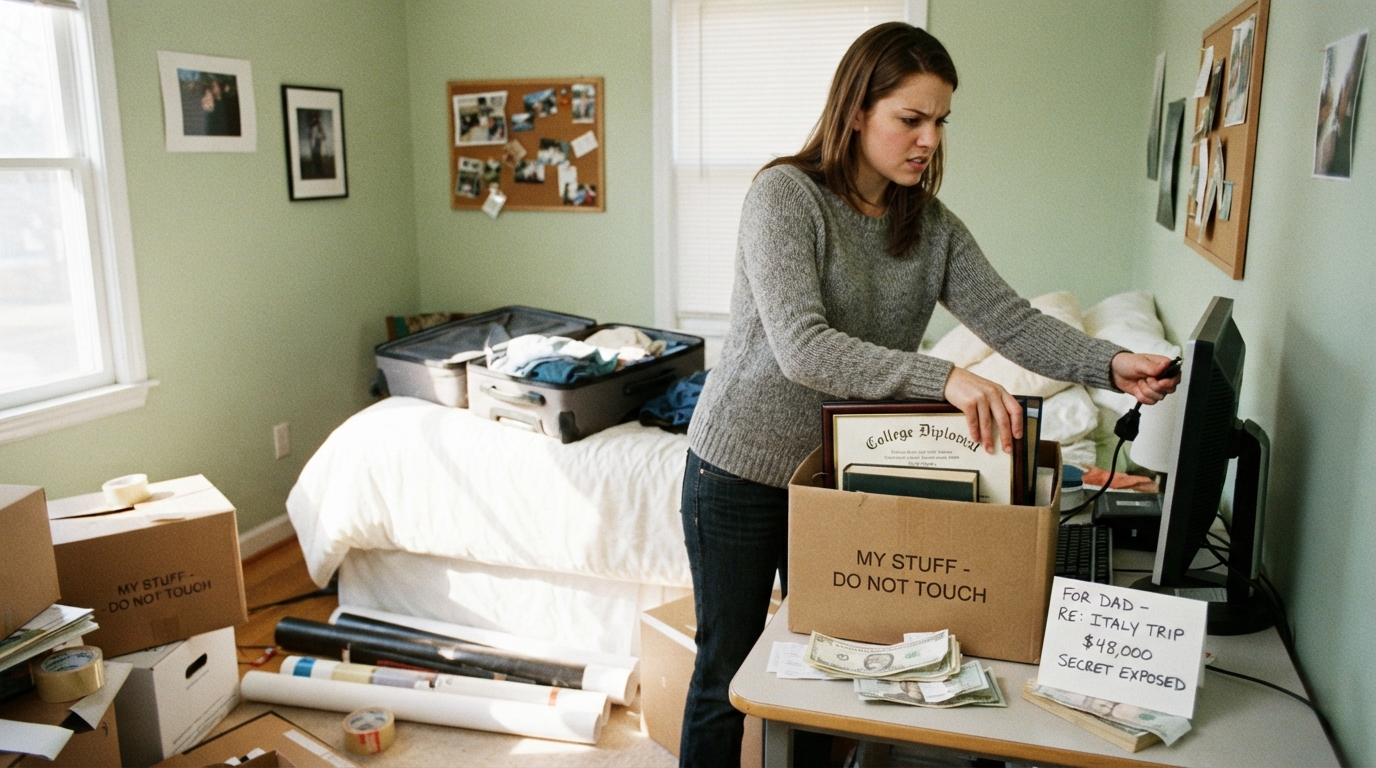
The first pages contained receipts for the refrigerator, television, furniture, and appliances.
Behind those were bank statements.
Ten years of financial records.
And on the final page was the spreadsheet showing the total.
$112,419.
I stared at the number.
For a long time, I had thought that figure represented everything I had lost.
But now I understood something.
It wasn’t simply money.
It represented the years I had spent believing that love meant making myself useful.
It represented every time I had said yes when I wanted to say no.
Every time I had ignored my own needs because someone else had a problem.
Every time I had been praised for being dependable when what I really needed was someone to ask whether I was okay.
I closed the folder.
Then I placed it on the shelf.
I wasn’t going to destroy it.
It was part of my history.
But it wasn’t going to control my future.
One year after the Italy trip, I finally booked a vacation.
Not an extravagant one.
Not a trip designed to impress anyone.
Just two weeks in Italy.
I had saved enough money through my own work.
I booked a flight to Rome.
I reserved a small hotel near a quiet street.
I planned to visit the Colosseum, walk through Florence, and spend a few days along the Amalfi Coast.
The morning I departed, I stood at the airport with my suitcase.
My phone buzzed.
It was a message from my mother.
Have a wonderful trip, sweetheart. Send me pictures if you can. I hope you enjoy every minute.
A second message arrived.
From Lily.
Don’t forget to buy yourself something beautiful. You deserve it.
I smiled.
Then I received one more message.
From my father.
Have a safe flight, Victoria.
I read it twice.
Then I put my phone away.
I boarded the plane.
As it lifted above the clouds, I looked through the window and felt something I hadn’t felt in years.
Freedom.
I wasn’t traveling to prove anything.
I wasn’t traveling because I had finally earned permission.
I wasn’t traveling to punish my parents or make my sister jealous.
I was traveling because I wanted to.
And that was enough.
On my third evening in Rome, I sat at an outdoor restaurant with a plate of pasta and a glass of sparkling water.
The streets were glowing under the warm lights.
People were laughing.
Music drifted from somewhere nearby.
I took a photograph and sent it to my mother.
Then I opened my camera and took another picture of the Colosseum.
For a moment, I thought about the dinner table where my mother had announced that there wasn’t enough money to take both daughters.
I remembered my father’s words.
You’re twenty-nine years old. You can easily take your own vacation anytime you want.
He had meant those words as a dismissal.
But eventually, they became something else.
He was right about one thing.
I was an adult.
I could build my own life.
I could travel without waiting for an invitation.
I could buy things without feeling guilty.
I could say no.
And I could love my family without sacrificing myself to keep them comfortable.
I put my phone down and looked at the beautiful city around me.
For the first time, I wasn’t the daughter standing in the kitchen preparing dinner while everyone else enjoyed life.
I was the woman sitting at her own table, enjoying the life she had worked so hard to build.
And I finally understood that I hadn’t lost my family when I walked away from that house.
I had simply stopped losing myself.