2,866 views
“Why didn’t anyone say anything?”
He sighed.
“Because Tara told everyone you were difficult about the property. She said you didn’t like family gatherings anymore.”
I closed my eyes.
That was the part that hurt most.
They hadn’t simply excluded me.
They had created a story about me that made excluding me easier.
Daniel continued.
“I should have called you.”
“Yes,” I said quietly. “You should have.”
There was a long pause.
Then he asked whether I would consider coming to the lake house that weekend.
I almost laughed.
“Why?”
“Because I think you should see something.”
“What?”
“Your grandmother’s room.”
I froze.
“What about it?”
“Tara had someone go through the old storage cabinets. They found a box with your name on it.”
I didn’t sleep much that night.
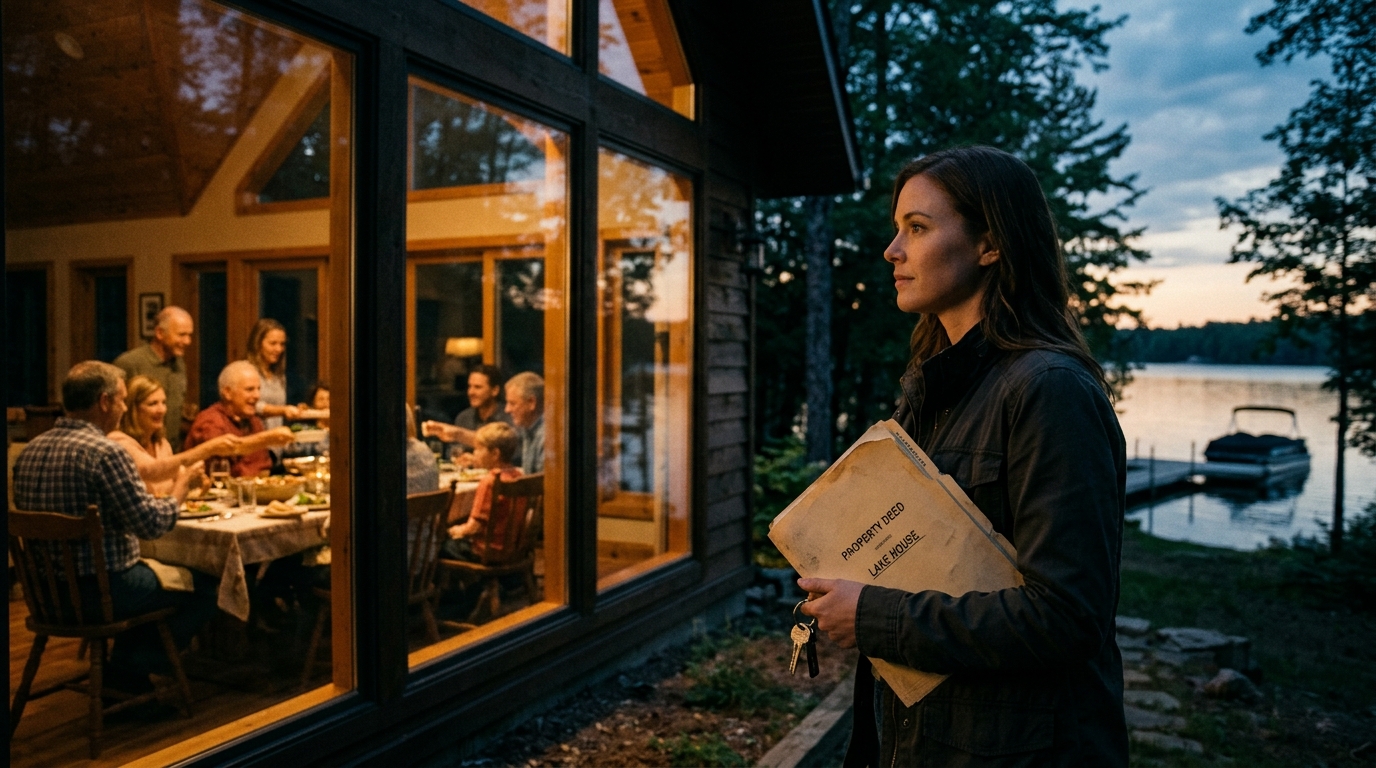
Saturday morning, I drove to the lake house.
This time, I didn’t park across the driveway.
I parked near the old oak tree where my grandmother used to hang bird feeders.
Daniel was waiting on the porch.
He hugged me.
Then he led me inside.
The house smelled exactly as I remembered.
Old wood.
Coffee.
The faint scent of the lavender soap Grandma used to keep in the upstairs bathroom.
Daniel took me to her bedroom.
On the bed sat a small wooden box.
My name was written across the lid.
I recognized the handwriting immediately.
I opened it.
Inside were photographs, old birthday cards, a pocket watch, and several letters.
At the very bottom was a sealed envelope.
To my Eli. Open when you need to remember who you are.
My hands trembled.
I opened it carefully.
The letter was short.
“My sweet boy,
I know you will grow up believing that being a good person means always being available.
It doesn’t.
Sometimes being a good person means saying no.
Sometimes it means walking away.
And sometimes it means allowing people to experience the consequences of their own choices.
I hope you never become bitter.
I hope you never stop loving people.
But please, never forget to love yourself too.
You were always enough.
Love, Grandma.”
I sat on the edge of the bed and cried.
Not because I wanted my family to feel guilty.
Not because I wanted the lake house.
I cried because I had spent so much of my adult life believing that if I gave enough, helped enough, and sacrificed enough, someone would eventually look at me and say:
We’re glad you’re here, Eli.
And my grandmother had been saying it all along.
When I came downstairs, my mother was waiting in the kitchen.
She looked older than I remembered.
“Did you find it?” she asked.
I nodded.
She glanced at the letter in my hand.
“Your grandmother loved you very much.”
“I know.”
My mother looked toward the window.
“She used to tell me you were the most generous person in the family.”
I put the letter inside my jacket.
“Then why did you treat me like I was disposable?”
She didn’t answer immediately.
Finally, she whispered, “Because I thought you would always forgive us.”
That sentence stayed with me.
Not because it excused anything.
But because it explained everything.
My family hadn’t necessarily believed I didn’t have feelings.
They had simply become comfortable believing my feelings would never change their access to me.
I nodded slowly.
“I probably would have forgiven you for a lot of things, Mom. But forgiveness doesn’t mean everything goes back to the way it was.”
She started crying.
“Can we start over?”
I looked around the kitchen.
The same kitchen where I had spent countless holidays washing dishes while everyone else sat outside.
“Maybe,” I said. “But this time, it has to be different.”
Then my phone vibrated.
It was a message from Rebecca.
Eli, I’ve reviewed the additional estate records. There’s one more document we need to discuss. It concerns a provision your grandmother included specifically for the lake property. Please call me before agreeing to any changes.
I stared at the message.
Another document?
I looked at my mother.
“Did Grandma leave anything else?”
Her expression changed.
For a moment, she looked almost frightened.
And that was when I realized there was still something about my grandmother’s estate that nobody had told me.
Something that might change everything.
PART 5
I called Rebecca before leaving the lake house.
She answered almost immediately.
“Eli, I want you to come to my office tomorrow. I’ve found something important in your grandmother’s original estate file.”
“What kind of something?”
“A provision that was never properly addressed when the property arrangements were updated. I don’t want to explain it over the phone until I’ve reviewed everything with you.”
I looked through the kitchen window.
My mother was still standing inside, holding a cup of coffee she hadn’t touched.
“Is it bad?”
“No,” Rebecca replied. “But it may explain why your grandmother was so particular about protecting your interests.”
The next morning, I arrived at her office at nine.
Rebecca had three folders waiting on her desk.
She opened the oldest one.
“Your grandmother established a separate fund connected to the maintenance and preservation of the lake property. It was intended to ensure that the house could remain available for family use without placing the financial burden on one person.”
I frowned.
“How much money?”
Rebecca turned a page.
“Approximately $185,000 remained in the account when the estate was settled.”
I stared at her.
“Where is that money now?”
“That’s what we’re investigating. The account records show several withdrawals over the years. Some appear to have been used for legitimate property expenses. Others require further explanation.”
She showed me the statements.
I recognized some of the transactions.
The new dock.
The roof repairs.
The plumbing.
But there were other withdrawals I had never seen before.
One was for $18,500.
Another was for $12,000.
A third was for nearly $9,000.
They had been made from the preservation account.
Rebecca explained that the records alone didn’t establish wrongdoing, but the withdrawals needed to be properly accounted for.
I sat quietly.
“Who managed the account?”
“Your mother and Tara were listed as authorized representatives at different times.”
I leaned back.
Suddenly, the email about selling the lake house made more sense.
They hadn’t simply been making plans without me.
There were financial matters they hadn’t wanted me to examine.
“What’s the next step?” I asked.
“We request a complete accounting and have the relevant transactions reviewed. You shouldn’t make accusations until we know exactly what happened.”
I nodded.
For once, I wasn’t interested in shouting.
I wanted the truth.
The accounting took several weeks.
During that time, Tara called me repeatedly.
At first, she was angry.
Then she became defensive.
Finally, she began leaving messages that sounded almost desperate.
“Eli, please call me. We need to talk about the paperwork.”
I didn’t respond.
My mother also called.
She told me she missed me.
She said the family was falling apart.
She said Memorial Day had always been special to everyone.
I listened.
But I didn’t immediately offer to fix anything.
Then Rebecca contacted me.
The review was complete.
The records showed that some withdrawals had been legitimate property expenses. Others had gone toward expenses that were not clearly connected to maintaining the lake house.
The people responsible were asked to provide supporting documentation and address the unexplained amounts through the appropriate estate process.
There was no dramatic courtroom scene.
No instant confession.
Just paperwork, uncomfortable conversations, and a series of decisions that could no longer be avoided.
And for the first time, my family had to deal with the consequences of financial arrangements they had previously expected me to overlook.
Three months later, I received an invitation.
It was from Daniel.
He was organizing a small family gathering at the lake house.
His message was simple.
No pressure. No expectations. I just thought it would be nice to see you.
I considered it for a long time.
Then I replied.
I’ll come for a few hours.
When I arrived, the driveway was open.
Nobody had reserved the master bedroom.
Nobody was arguing about who owned what.
The house looked the same, but the atmosphere felt different.
Daniel was grilling outside.
My uncle was repairing a loose fence board.
And Liam was sitting on the porch steps with a box of Lego pieces.
When he saw me, he jumped up.
“Uncle Eli!”
He ran toward me and wrapped his arms around my waist.
“I finished the spaceship!”
I smiled.
“You did?”
He nodded excitedly.
“Mom helped me with the wings.”
I looked over at my sister.
She was standing near the kitchen door.
For a moment, neither of us spoke.
Then she approached.
“Hi, Eli.”
“Hi.”
She looked down at her hands.
“I owe you an apology.”
I waited.
“I was cruel to you at Liam’s birthday. I knew you weren’t invited to the dinner, and I still made that comment. I told myself you were being too sensitive because it was easier than admitting I had hurt you.”
Her eyes filled.
“I also shouldn’t have treated your help like something I was entitled to.”
I nodded.
“Thank you for saying that.”
She seemed surprised that I didn’t immediately hug her.
But I wasn’t ready.
And for once, I wasn’t going to pretend I was.
“I hope we can have a better relationship,” I told her. “But it will take time.”
She nodded.
“I understand.”
Later, my mother approached me.
She looked at the lake for a while before speaking.
“Your grandmother would have wanted us together.”
I smiled faintly.
“I think she would have wanted us to treat each other properly too.”
My mother lowered her head.
“Yes. She would.”
Then she said something I hadn’t expected.
“I’ve started paying for the things I used to expect you to cover. It’s not easy, but I should have been doing it all along.”
I looked at her.
“I’m glad you’re taking responsibility.”
She reached for my hand.
I let her hold it.
But I didn’t make any promises about the future.
As the afternoon passed, Liam asked me to help him build his Lego spaceship.
We sat on the porch together.
He handed me a tiny piece.
“Uncle Eli, why weren’t you at the big dinner?”
I paused.
Children have a way of asking questions adults spend years avoiding.
“I wasn’t invited, buddy.”
He frowned.
“Why?”
“Sometimes grown-ups make bad decisions.”
He thought about that.
Then he handed me another Lego piece.
“Well, you’re invited to my next birthday.”
I smiled.
“I’d like that.”
He grinned.
“And you can sit next to me.”
I felt my throat tighten.
“That’s a deal.”
Across the yard, my family was laughing.
For the first time in a long while, I didn’t feel the need to prove anything to them.
I didn’t need to pay for the gathering.
I didn’t need to organize it.
I didn’t need to clean the kitchen afterward.
I could simply be there.
And if I didn’t feel welcome, I could leave.
That was a freedom I hadn’t understood before.
A few months later, I made one final decision about the lake house.
After consulting Rebecca and reviewing the ownership documents, I helped establish a formal written arrangement for its future use, expenses, and maintenance.
Everyone who wanted to use the property had to follow the same rules.
No secret arrangements.
No assumptions.
No one person carrying the financial burden while everyone else enjoyed the benefits.
I also established a small annual fund in my grandmother’s memory to help children from our community attend summer programs.
I called it the Margaret Lake Fund.
It had nothing to do with my family’s approval.
It was simply a way to honor the woman who had taught me what generosity was supposed to mean.
My grandmother had spent her life making people feel welcome.
I wanted to continue that part of her legacy.
But I also wanted to remember her other lesson.
Kindness should never require you to abandon yourself.
The following year, on Liam’s eighth birthday, I received an invitation in the mail.
This time, my name was written on the envelope.
Not as an afterthought.
Not through someone else’s message.
It was a proper invitation.
I arrived with a gift and a card.
My sister greeted me at the door.
“I’m glad you came.”
“Happy birthday to Liam.”
The party was smaller than the previous year.
There were balloons, pizza, children running through the backyard, and a cake decorated with little spaceships.
Nothing extravagant.
Nothing that needed to be photographed to prove how happy everyone was.
At one point, my mother came over and sat beside me.
“You know,” she said quietly, “I sometimes think about that dinner.”
“So do I.”
“I wish we had invited you.”
I looked at her.
“I wish you had too.”
She nodded.
Then she asked, “Do you think things will ever be like they used to be?”
I considered the question.
“No,” I answered honestly. “But maybe they can become something better.”
She smiled sadly.
Across the yard, Liam was waving at me.
“Uncle Eli! Come see!”
I stood up.
“Coming!”
As I walked toward him, I thought about the day I had parked my truck across the driveway.
I remembered Tara’s angry face.
My mother’s tears.
The documents.
The emails.
And the moment I finally understood that being related to someone didn’t automatically mean they would treat you with love.
For years, I had believed that if I stopped giving, I would lose my family.
What I eventually learned was that I had already been losing myself by giving without limits.
I didn’t destroy my family by saying no.
I simply stopped protecting everyone from the consequences of how they treated me.
Some relationships were repaired.
Some remained distant.
And some were never quite the same again.
But I was finally at peace.
That evening, after the birthday party, I drove to the lake house alone.
I walked down the wooden dock and sat where my grandmother and I used to watch the sunset.
The water was quiet.
The lights from the house reflected across the surface.
I took her old letter from my wallet and read the final sentence again.
You were always enough.
For the first time, I believed it completely.
I folded the letter, put it away, and watched the sun disappear behind the trees.
I hadn’t won because I owned part of a lake house.
I hadn’t won because my family finally understood what I had contributed.
I had won because I no longer needed their approval to know my worth.
And that was the one thing nobody could ever take away from me.