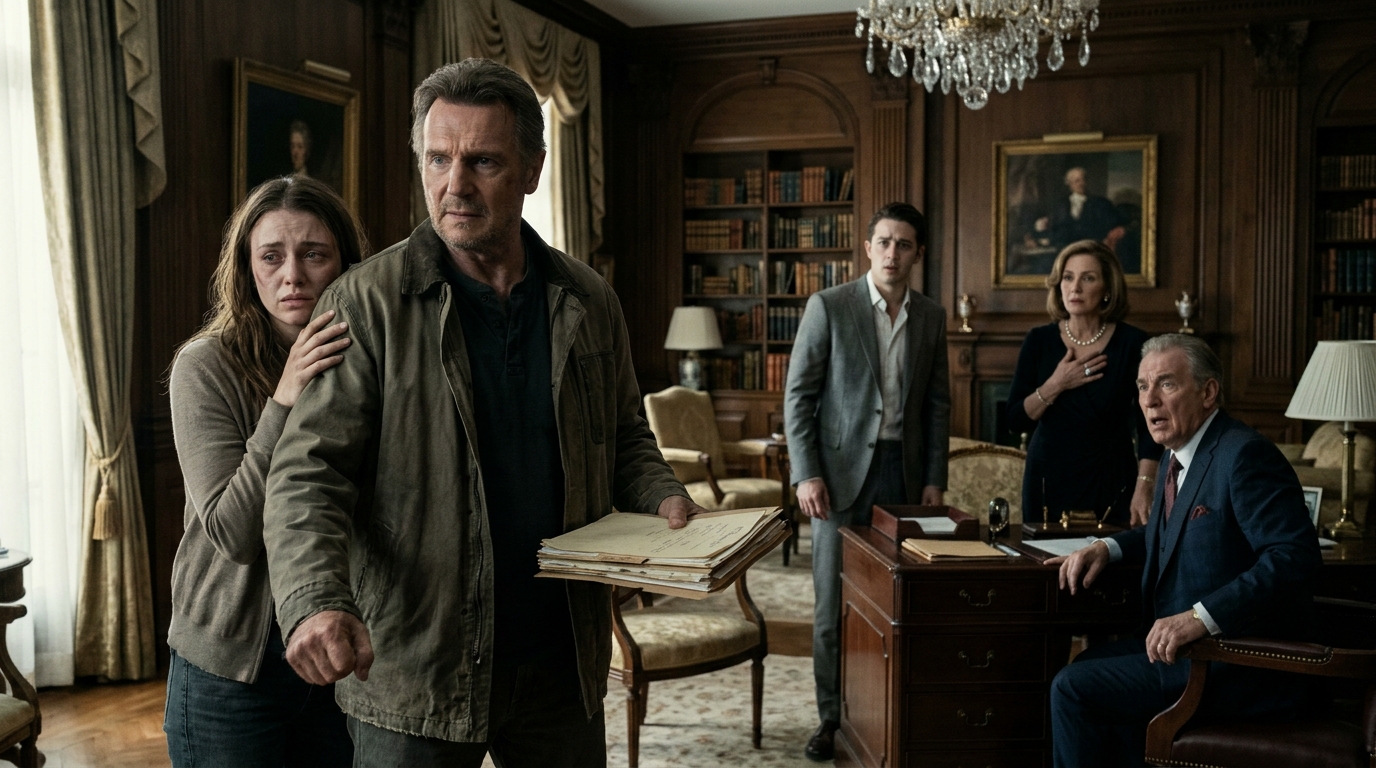
“I understand there’s been an unfortunate incident involving my son and your daughter.”
“Your daughter-in-law arrived at my home covered in blood.”
There was a pause.
“I understand emotions are running high. Daniel tells me Claire has been under considerable stress lately.”
Thomas wrote something on his notepad and slid it toward me.
Do not argue. Let him speak.
Warren continued.
“These things can be complicated between married couples. Sometimes a private disagreement becomes something larger when outsiders get involved.”
I looked through the glass panel in Claire’s hospital room door.
She was sitting upright in bed, listening.
“Are you suggesting my daughter should have stayed in the house?”
“I’m suggesting that everyone should be careful before making accusations that could permanently damage a family.”
“She has injuries documented by a doctor.”
“Doctors document what they see. They don’t necessarily know how those injuries occurred.”
Thomas’s expression tightened, but he remained silent.
Warren lowered his voice.
“Daniel is willing to discuss this privately. We can arrange a meeting. Perhaps we can resolve whatever misunderstanding has occurred without involving the sheriff or creating unnecessary publicity.”
I let the silence stretch.
Then I asked, “Does Daniel admit he struck my daughter?”
Warren did not answer immediately.
“Sam, I don’t think you understand the consequences of turning this into a public dispute.”
I almost laughed.
Not because anything was funny.
Because I finally understood how the Voss family had survived for so long.
They didn’t need everyone to believe their lies.
They only needed enough people to fear the consequences of questioning them.
“Let me make something clear,” I said. “My daughter is receiving medical care. Her injuries have been documented. She has received threatening messages from your son. And she is not going back to that house.”
“You’re making a serious mistake.”
“No, Warren. I made a mistake when I believed your son deserved my daughter’s trust.”
His voice became colder.
“You should think carefully about your position in this county, Mr. Reed. Your farm has certain outstanding matters that could become complicated if this situation escalates.”
Thomas looked up sharply.
There it was.
Not concern for Claire.
Not a question about her condition.
A threat.
I looked down at my rough hands.
For most of my life, I’d kept my head down because I had work to do. I didn’t care about social standing, expensive restaurants, or the approval of men who measured their worth by the number of people who answered their calls.
But Warren had just made a serious mistake.
He had threatened my livelihood while my daughter lay in a hospital bed.
“Are you threatening me?” I asked.
“I’m advising you to be sensible.”
“Then here’s my advice to you. If you have something legitimate to say about my farm, put it in writing. If you have something to say about my daughter, speak to her lawyer. And if your son has committed a crime, let the authorities investigate it.”
I ended the call.
For several seconds, nobody spoke.
Then Thomas slowly put down his pen.
“That was interesting.”
“What was?”
“Warren didn’t ask whether Claire was all right. He didn’t deny that Daniel had hurt her. He went straight to controlling the damage.”
I looked at the phone.
“He also mentioned my farm.”
Thomas nodded.
“Which means we should find out why.”
By noon, the hospital room had become the first place Claire felt safe enough to tell the whole story.
Not every detail.
Not yet.
But enough.
She explained how Daniel had gradually separated her from friends, criticized her clothes, questioned her spending, and insisted on reviewing every bank statement.
At first, he had presented it as responsibility.
We’re building a future, he would tell her.
I’m better with money.
You don’t need to worry about these things.
Then the rules changed.
He became angry when she visited me without asking his permission. He complained that my farm made him look bad. He told her that her friends were jealous of their marriage and that her family would never understand the pressures of his life.
When she questioned him, he would apologize.
Sometimes he cried.
Sometimes he bought her gifts.
Sometimes he promised to attend counseling.
And sometimes, when nobody else was watching, he hurt her.
“What happened last night?” Thomas asked gently.
Claire looked down at her hands.
“We argued about money. I found a statement for an account I didn’t recognize. There were transfers from our joint savings to another account.”
“Did you ask him about them?”
“Yes.”
“What did he say?”
“He told me it wasn’t my business. I said half the money belonged to me. Then he grabbed my phone.”
She swallowed.
“I tried to take it back. He shoved me into the table. When I tried to get up, he hit me.”
Her voice trembled.
“I remember falling. Then I remember him standing over me, telling me to stop pretending I was hurt.”
I felt my hands curl into fists.
Thomas noticed.
“Sam,” he said quietly, “take a breath.”
I did.
Claire continued.
“He dragged me toward the front door. I begged him to let me get my shoes and my coat, but he threw them outside. Then he said if I came back, he’d call the police and tell them I attacked him.”
She looked at me.
“He said nobody would believe me because you were nobody.”
I lowered my head.
For years, I had accepted being underestimated.
I had let people assume I was poor, unimportant, and content with a small life.
But hearing those words repeated by my own daughter made something painfully clear.
Daniel hadn’t simply insulted me.
He had used my reputation—or what he imagined my reputation to be—as a weapon against her.
He wanted her to believe that even her own father couldn’t protect her.
He wanted her to believe that the world belonged to people like him.
I looked at Thomas.
“What do we do now?”
He answered without hesitation.
“We document everything. We cooperate with the investigation. We protect Claire’s legal and financial interests. And we make sure nobody pressures her into silence.”
Claire looked frightened.
“What if he destroys everything?”
Thomas leaned forward.
“Then we’ll deal with what actually happens, not what he threatens might happen. You don’t have to solve the next ten years today. You only have to take the next step.”
She considered that for a long time.
Then she nodded.
It was a small movement.
But it was the first decision she had made that morning without looking over her shoulder to see whether Daniel would approve.
At 1:37 p.m., Emily arrived with a bag of clothes and a small paper sack containing Claire’s favorite muffins.
The moment she saw Claire, she burst into tears.
“Oh, Claire.”
She crossed the room and stopped beside the bed, afraid to touch her.
“Can I hug you?”
Claire nodded.
Emily embraced her carefully, crying into her shoulder.
“I’m sorry,” she whispered. “I’m so sorry I didn’t know.”
Claire closed her eyes.
“You couldn’t have known.”
“I should have asked more questions.”
“Emily, please.”
They held each other for a long time.
Then Emily pulled away and wiped her face.
“There’s something you need to know.”
Claire looked at her.
“What?”
Emily hesitated.
“Daniel called me this morning.”
The room went still.
“What did he say?” Thomas asked.
Emily looked uncomfortable.
“He said Claire had become unpredictable. He told me she’d been acting strangely for months and that he was worried she might hurt herself.”
Claire stared at her.
“That’s what he told you?”
Emily nodded.
“He said he wanted me to help convince you to come home before you did something you’d regret.”
Claire’s face crumpled.
“He was the one who hurt me.”
“I believe you,” Emily said immediately.
She reached into her bag and pulled out her phone.
“And there’s something else. He asked me whether you had ever talked about your father’s farm or any family property.”
I looked up.
“What exactly did he ask?”
Emily opened her messages.
“He wanted to know whether you had access to your father’s financial records. He said you might be confused about something involving an inheritance.”
I felt a chill move through me.
“An inheritance?”
Claire shook her head.
“I don’t know what he’s talking about.”
Neither did I.
My wife had left me the farm, a modest savings account, and a handful of personal belongings. There was no great fortune waiting to be discovered.
At least, that was what I had always believed.
Thomas asked Emily to forward the messages so they could be preserved.
Then he turned to me.
“Sam, do you have a will? Any trusts? Any property arrangements made before your wife died?”
“I have a will. The farm is mine. Claire is my only child.”
“And your wife?”
I hesitated.
“Margaret handled most of the paperwork when we bought the property. She was better at that sort of thing than I was.”
“Did she ever mention a trust or a separate account?”
I thought about it.
“No. Not that I remember.”
Thomas made a note.
“Then let’s not assume anything. We’ll review the documents when you’re ready.”
Claire looked from him to me.
“Daddy, why would Daniel care about your farm?”
I had no answer.
But for the first time in years, I remembered a conversation with Margaret that I had never fully understood.
It had happened about six months before she died.
We were sitting on the porch, watching a storm move across the fields. Margaret had been sorting through an old box of papers, and she had asked me whether I still kept the original deed to the property.
I told her it was in the safe.
She had looked at me for a long moment.
Then she said, “Sam, promise me something. If anyone ever comes asking about the land, don’t sign anything until you understand exactly what it means.”
I had laughed.
“Who would want our old farm?”
Margaret hadn’t laughed with me.
“Promise me.”
I had promised.
At the time, I thought she was simply being cautious.
Now, sitting in a hospital room while my daughter recovered from her husband’s violence, I wondered why she had sounded so frightened.
And why Daniel Voss had suddenly become interested in property he had spent years calling worthless.
At 3:05 p.m., Thomas and I returned to the farm to collect the documents Margaret had left behind.
Claire remained at the hospital with Emily.
Before we left, she caught my hand.
“Daddy, please don’t go looking for trouble.”
I brushed her hair back.
“I’m going to look for answers.”
“Promise me you won’t confront Daniel.”
I paused.
Then I nodded.
“I promise.”
It wasn’t an easy promise to make.
But it was one I intended to keep.
When we arrived at the farm, Thomas followed me into the small office where I kept the household accounts and property records.
The room smelled of old paper and cedar.
I opened the safe beneath the desk and removed the deed, my will, the farm’s tax records, and the folder containing Margaret’s estate documents.
Thomas examined them carefully.
For nearly twenty minutes, he said very little.
Then he stopped at a page near the back of the folder.
“Sam, do you remember signing this?”
I leaned over his shoulder.
It was a document dated nearly fifteen years earlier.
My signature appeared at the bottom.
“I remember signing something when Margaret refinanced the farm,” I said. “The bank needed paperwork. She explained it to me, but it was a long time ago.”
Thomas read the page again.
“This isn’t a standard mortgage document.”
“What is it?”
“An agreement relating to a conservation easement and development rights.”
I frowned.
“I don’t understand.”
He turned the page toward me and pointed to a paragraph.
“Your land was included in a regional conservation arrangement. Certain development rights were restricted, but the agreement also appears to have established conditions that could affect how the property is valued if the surrounding area is developed.”
I stared at him.
“What does that mean in plain English?”
“It means your farm may be more significant than you realize. But I need to review the full agreement before I can tell you exactly how.”
I sat down slowly.
For sixty-two years, I had thought of the land as a place where I worked, raised my daughter, and built a life with my wife.
It had never occurred to me that anyone might see it as something else.
Thomas continued reading.
Then he found another document.
A letter from a regional planning office.
It was dated four months before Margaret died.
The letter referenced a proposed development corridor near Hartwell County and requested confirmation of the ownership structure associated with several parcels of land.
One of the parcels was mine.
Thomas looked up.
“Has anyone approached you about selling?”
“Three times in the last two years. Different companies. I turned them all down.”
“Did any of them mention the Voss family?”
I thought carefully.
“One man said his company represented a group interested in assembling land for a future project. He didn’t give me a name.”
Thomas turned back to the paperwork.
“Do you remember the company?”
“No.”
He took a photograph of the letter.
“We’ll investigate this through the proper channels. Don’t sign anything, and don’t discuss the documents with Daniel or his father.”
I stared at Margaret’s signature on the page.
She had known something.
Maybe not everything.
But enough to make me promise never to sign away the land without understanding what I was doing.
I felt an ache in my chest that had nothing to do with anger.
Margaret had been gone for years, and yet here I was, discovering that she might have been trying to protect us from something I had never even thought to look for.
I carefully placed the documents back into the folder.
Then my phone buzzed.
An unknown number.
The message contained only one sentence.
You should ask your late wife what she knew about the Voss development deal.
I read it once.
Then again.
Thomas stepped closer.
“Who sent that?”
“I don’t know.”
“Don’t reply.”
I showed him the message, and he photographed it for the record.
For a long moment, neither of us spoke.
Then Thomas closed the folder.
“Sam, I think we have two separate problems now. One is protecting Claire from her husband. The other is finding out why someone believes your late wife was connected to the Voss family’s development plans.”
I looked toward the window.
Beyond it, the fields stretched toward the road, green and quiet beneath the afternoon sky.
I had spent my entire life believing that if I worked hard, paid my bills, and treated people honestly, I could keep my family safe.
Now my daughter was in a hospital bed, my son-in-law was threatening us, and someone was sending messages about a secret my wife had carried to her grave.
And I still hadn’t asked Daniel Voss the question I had driven to town intending to ask.
Not yet.
Because something told me that when I finally stood in front of him, the most important question would no longer be about what he had done to my daughter.
It would be about what he had been trying to take from our family all along.
And I had a feeling the answer was hidden somewhere in the papers Margaret had left behind.
PART 4
The next morning, I finally learned why Daniel Voss had been so interested in my farm.
Thomas spent hours reviewing Margaret’s documents and contacting the county planning office. By noon, he discovered that my land sat on a proposed development corridor worth millions to the companies hoping to build there.
And one of those companies had ties to Warren Voss.
Margaret had helped establish legal protections for our property years earlier. Those protections prevented developers from forcing a sale or quietly taking control of the land. Without my signature, the Voss family couldn’t get what they wanted.
Suddenly, Daniel’s threats made sense.
He hadn’t just underestimated me.
He had assumed he could frighten my daughter into helping him gain access to something that belonged to our family.
That afternoon, I drove to Daniel’s house with Thomas beside me. I left the baseball bat at home.
When Daniel opened the door, his confident smile vanished.
Behind him stood Warren, looking as though he’d already been warned about what we had discovered.
I looked Daniel straight in the eyes.
“Tell me something, son. Did you marry my daughter because you loved her, or because you thought her family would eventually give you what you wanted?”
His face turned pale.
“You’re crazy,” he muttered.
Thomas stepped forward. “We have the messages, the medical documentation, and evidence of your family’s interest in the property. The authorities are investigating the assault. Any further threats will also be documented.”
Warren attempted to interrupt, but Thomas handed him a copy of the relevant property records.
For the first time, Warren had nothing to say.
Daniel looked at me, desperately searching for the frightened old farmer he thought he knew.
“You can’t destroy my life over one argument!”
“One argument?” I asked quietly. “My daughter arrived at my house bleeding, barefoot, and terrified of her own husband. You didn’t just hurt her, Daniel. You made her believe she had nobody.”
I stepped closer.
“You were wrong about one thing. I may not have money like your family, and I may never wear an expensive suit. But I know the difference between a man who makes mistakes and a man who believes he has the right to hurt someone.”
Daniel lowered his eyes.
I waited for an apology.
It never came.
So I turned and walked away.
The legal consequences followed. Claire cooperated with the investigation, and the evidence helped support the case against Daniel. She filed for divorce, obtained protective measures, and began rebuilding her life away from him. Warren’s company’s involvement in the development proposal also came under scrutiny, and our family’s land remained protected.
Months later, Claire returned to the farm—not as a frightened woman fleeing in the middle of the night, but as someone beginning to believe in herself again.
One evening, we sat together on the porch, watching the sunset.
“Daddy,” she said, “I used to think leaving him meant I had failed.”
I took her hand.
“Leaving someone who hurts you isn’t failure, sweetheart. It’s choosing to live.”
She rested her head on my shoulder.
For the first time in years, I heard her laugh without fear.
I eventually put Margaret’s old baseball bat back in the closet. I never needed to use it. The strongest thing I had brought to Daniel’s doorstep wasn’t a weapon. It was the truth—and the determination to stand beside my daughter when she needed me most.
Daniel had called me a nobody.
Perhaps, to people who measured a man’s worth by his money, I was.
But when my daughter needed someone at two in the morning, she knew exactly where to go.
And that was worth more than everything the Voss family owned.
Because a man’s true worth isn’t measured by the power he holds over others, but by the people who know they are safe when he stands beside them.