PART 3
My mother closed her eyes. My father didn’t respond immediately. He simply stared at the papers as if the numbers might rearrange themselves into something that made sense.
Ranata shifted in her chair. “Fay, this isn’t the time to make everything about you.”
I turned toward her. “I’m not making anything about me. Dad asked me a question, and I answered it.”
“You know how difficult things have been for you,” she replied. “You know you’ve struggled.”
“No,” I said. “You know what you’ve told them I’ve struggled with.”
Her lips pressed together.
Desmond, her husband, looked from his wife to the papers.
“Ranata,” he said quietly, “maybe you should explain the transfers.”
She shot him a look so sharp that he immediately fell silent.
That was the first moment I realized Desmond might know something I didn’t.
My father leaned back in his chair.
“Your sister told us you were too proud to ask for help. She said the farm was falling behind on taxes. She said your tractor needed repairs you couldn’t afford. She said you had been struggling with the bank and were afraid you might lose the property.”
He swallowed.
“Every time she called, she sounded worried about you.”
I looked at the first page again.
There were payments labeled tractor repair, property tax assistance, emergency farm expenses, and temporary loan to Fay.
Some were a few thousand dollars.
Others were much larger.
One transfer was for $42,000.
Another was for $18,500.
Beside each transaction was a handwritten note in my mother’s familiar writing.
For Fay.
I felt something painful settle in my chest.
It wasn’t the money itself. I had never expected an inheritance from my parents, and I had never asked them to finance my life.
It was the thought of my mother sitting at this very table, worrying about me, perhaps lying awake wondering whether her daughter would lose everything, while believing she was doing something to save me.
I looked at her.
“Mom, why didn’t you call me?”
Her eyes filled with tears.
“Ranata said you didn’t want us to know how bad it was.”
“Did you ever ask her to let me speak to you directly?”
Mom hesitated.
That hesitation told me more than any answer could have.
Finally, she whispered, “She said you would be embarrassed.”
I nodded slowly.
For fifteen years, I had believed my family didn’t understand my life because they had never bothered to ask about it.
Now I was discovering something worse.
They had been given a story about me, and they had chosen to believe it without ever checking whether it was true.
My father pushed another sheet toward me.
“This is the most recent transfer. Thirty-two thousand dollars. Three weeks ago.”
I stared at the date.
Three weeks earlier, I had been paying the final property taxes on the farm before the sale closed.
I remembered that week clearly. I had been negotiating a final adjustment with the buyer’s attorneys, meeting with the survey team, and arranging the transfer of equipment that wasn’t included in the purchase agreement.
I had not been short of money.
I had not been in trouble.
I had certainly not asked Ranata for $32,000.
“Where did this money go?” I asked.
Nobody answered.
I turned toward my sister.
“Ranata, where did the money go?”
She folded her arms.
“I already explained this.”
“No, you haven’t.”
“I used some of it to help you.”
“Which part?”
Her expression hardened.
“What?”
“Which payment did you use to help me? Give me a date, an amount, and a bill that you paid on my behalf.”
She stared at me.
I continued, keeping my voice level.
“Tell me which tractor repair you covered. Tell me which tax bill you paid. Tell me which bank received the money you supposedly sent to save my farm.”
“You don’t need to interrogate me.”
“Then it should be easy to answer.”
My father raised his hand.
“Ranata, please.”
She looked at him, then at Mom, and finally at Desmond.
For the first time that evening, she looked genuinely frightened.
But she still wasn’t ready to tell the truth.
“You’re all acting like I’m some kind of criminal,” she said. “I was trying to help my sister. Nobody else was doing anything.”
I almost laughed at the absurdity of it.
“Help me? You have spent years telling people I couldn’t manage my own life. You made me sound like a burden, and now you’re telling our parents you were the only person keeping me afloat.”
“I never said that.”
Dad immediately lifted another page.
“You said it here.”
He read from a printed message.
“‘Fay would have lost the farm two years ago if I hadn’t stepped in. She doesn’t know how to handle money, and she refuses to listen to anyone.’”
Ranata’s face turned red.
Dad continued.
“‘Please don’t tell her about the payments. She would be too ashamed to accept help.’”
He put the paper down.
“Those are your words.”
The room fell silent.
I watched my sister’s expression change from indignation to calculation.
She was looking for an explanation that would make the evidence less damaging.
Then she found one.
“You’re taking everything out of context,” she said. “You don’t know what I’ve been dealing with.”
“Then tell us,” Mom whispered.
Ranata turned toward her.
“You wouldn’t understand.”
“Try me.”
For a few seconds, I thought my sister might finally confess.
Instead, she stood up so abruptly that her chair scraped across the floor.
“I can’t believe this. I’ve spent years being the one who holds this family together, and now everyone wants to attack me because I kept some money?”
Dad’s voice became sharp.
“Some money?”
She flinched.
He pointed at the total.
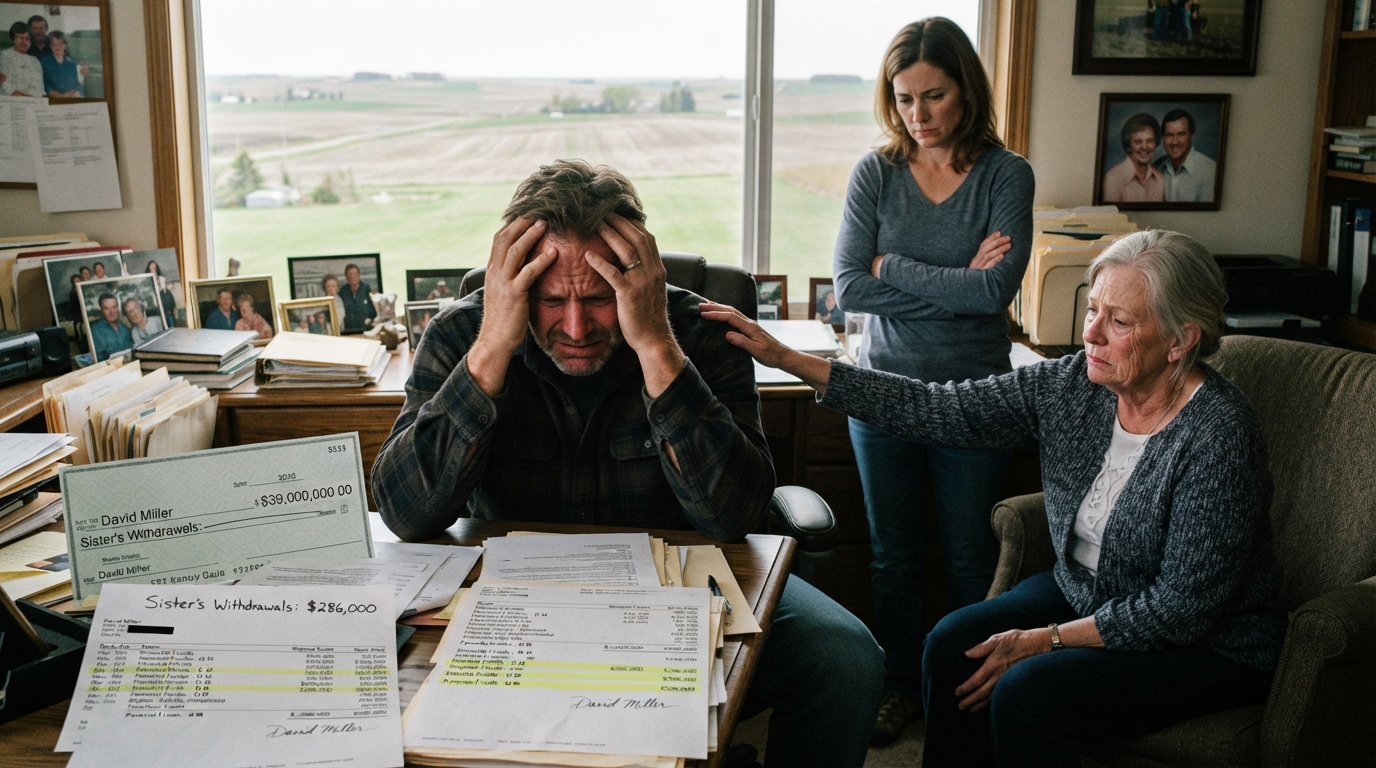
“Two hundred and eighty-six thousand dollars, Ranata. That is not some money.”
She grabbed her purse.
“I need to leave.”
Desmond didn’t move.
“Sit down,” he said.
The words were quiet, but they stopped her.
Ranata turned toward him slowly.
“What did you say?”
“I said sit down.”
She stared at him as if she had never heard him speak that way before.
Desmond looked exhausted.
“Your parents deserve an explanation. Fay deserves an explanation. And I think it’s time we stopped pretending this is just a misunderstanding.”
Ranata’s mouth opened, but no words came out.
I looked at Desmond.
“What do you know?”
He rubbed both hands over his face.
Then he looked at me.
“Fay, I need to tell you something. But before I do, I want you to understand that I should have spoken up sooner.”
My stomach tightened.
“What is it?”
He glanced at Ranata.
She shook her head almost imperceptibly.
He ignored her.
“About four years ago, Ranata told me your farm was in serious trouble. She said your parents were helping you, but you were still behind on several payments. She said you had asked her to manage some of your expenses because you couldn’t keep up with everything.”
“I never asked her to do that.”
“I know that now.”
He paused.
“She asked me to help her organize the transfers. I didn’t have access to your accounts, and I never claimed I did. But I saw the amounts your parents were sending her, and I believed the money was going toward your farm.”
“Did you ever see a bill in my name?”
“No.”
“A bank statement?”
“No.”
“A message from me asking for help?”
He lowered his eyes.
“No.”
“Then why did you believe her?”
His face tightened.
“Because she was my wife, and I didn’t think she would lie about something like that.”
I understood that answer more than I wanted to.
Sometimes betrayal didn’t begin with someone proving a lie was true.
Sometimes it began with someone deciding that asking a question would be uncomfortable.
Desmond took a breath.
“About eighteen months ago, I started noticing that our finances weren’t adding up. We were spending more than we seemed to earn. There were credit card balances I didn’t know about, withdrawals I couldn’t explain, and payments to accounts I didn’t recognize.”
Ranata shook her head.
“Desmond, don’t.”
He continued.
“I asked her about it. She said some of the money was going toward helping you. She told me your farm was in danger, and she couldn’t let you lose everything.”
I looked at him.
“And you believed her?”
“At first, yes.”
He swallowed.
“Then I found a transfer for $24,000 to a dealership. When I asked her about it, she said it was unrelated to your farm. She said it was money she’d saved from her own earnings.”
My father stared at him.
“What dealership?”
Desmond hesitated.
“A luxury vehicle dealership.”
Ranata’s face went completely still.
I remembered the black SUV sitting in my parents’ driveway that afternoon.
It was nearly new. Expensive. Immaculately maintained.
My sister had once joked that I could buy a better truck if I stopped being so attached to my old one.
I had assumed she was simply being herself.
Now I wondered how much of that vehicle had been purchased with money intended to help a sister who supposedly couldn’t afford to keep her property.
Desmond wasn’t finished.
“There were other things, too. A renovation. A vacation. Jewelry. Some money went toward paying off debts. I don’t know exactly how much came from your parents’ transfers, and I’m not saying every purchase was made with that money. But I started keeping records because I couldn’t get straight answers.”
He reached into a folder beside him and removed several printed statements.
“I brought these tonight because I thought your parents needed to see what I had found.”
Ranata stared at him.
“You went through my private information?”
“I reviewed the financial records for accounts we shared. I should have handled this differently, but I wasn’t going to sit here and let your parents believe Fay had taken their money.”
She looked around the table.
“You’re all against me.”
Mom started crying.
“No, sweetheart. We’re trying to understand what happened.”
“No!” Ranata snapped. “You’re trying to make me the villain because Fay suddenly wants everyone to think she’s better than us.”
I felt the familiar old anger rise in my chest.
For years, I had swallowed comments like that because I didn’t want every family gathering to turn into an argument.
I had let her call me stubborn.
I had let her call me unsuccessful.
I had even let her tell relatives that I was struggling, because I believed people who actually cared would eventually ask me about it themselves.
But I wasn’t going to let her turn this into another story about my supposed arrogance.
“I didn’t come here to compete with you,” I said.
She laughed bitterly.
“Of course you didn’t.”
“I came here to bring Mom her groceries.”
Nobody spoke.
I looked at the bags I had placed beside the door when I entered.
The milk was still inside. So was the bread, the coffee, and the cinnamon creamer she liked.
“I didn’t know you were telling them I was receiving money. I didn’t know Dad had been sending you transfers. I didn’t even know there was a conversation happening about my finances until I stood on the porch this afternoon.”
I looked directly at her.
“And I certainly didn’t come here to tell anyone about the farm sale.”
That last sentence made everyone look at me.
My father frowned.
“The farm sale?”
I hadn’t intended to say anything.
For three days, I had kept the news to myself because I wanted time to process what had happened. The farm had been part of my life for fifteen years. Selling it had been a business decision, not a sudden windfall I planned to announce at a family dinner.
But now the brown folder sat beside my chair, and my father was staring at it.
I took a breath.
“Yes. I sold the farm.”
Mom blinked.
“What do you mean, you sold it?”
“The sale closed three days ago.”
Dad looked confused.
“Why?”
“The buyer wanted the land for a major expansion project. The offer made financial sense, so I accepted.”
Ranata gave a disbelieving laugh.
“Wait. You’re telling us you sold that little farm?”
I turned toward her.
“Yes.”
“For how much?”
I hesitated.
I could have kept the number to myself. I could have said it was a private business matter and left it there.
But after everything I had heard that evening, I no longer felt the need to protect the false picture my family had built of me.
“Thirty-nine million dollars.”
The silence that followed was so complete that I could hear the refrigerator humming behind Mom.
Dad’s mouth opened slightly.
Mom slowly put down her mug.
Desmond stared at me.
Ranata looked as though someone had pulled the floor out from beneath her.
Finally, Dad spoke.
“Thirty-nine million?”
“Yes.”
He looked at the folder.
“Is that what those documents are?”
“The closing paperwork. I have the signed agreement, the valuation, and the final settlement statement.”
Mom shook her head.
“But we thought you were struggling.”
“I know.”
“We thought you were behind on your taxes.”
“I wasn’t.”
“We thought you might lose the property.”
“I sold it because I received an offer I was willing to accept. I wasn’t forced to sell.”
Dad lowered his face into his hands.
For a moment, I felt sorry for him.
Then I remembered the transfers.
I remembered the handwritten notes.
I remembered that he had been sending thousands of dollars away while believing his daughter was slowly losing everything.
His grief was real, but so was the damage that had been done.
Ranata found her voice first.
“You had thirty-nine million dollars coming to you, and you never told us?”
I looked at her.
“The sale had nothing to do with you.”
“I’m your sister!”
“And I am the sister you told everyone was broke.”
She stood there, breathing hard.
“You let us believe—”
“No,” I interrupted. “You let them believe.”
Her eyes narrowed.
“You could have told us.”
“About the sale? Yes, I could have. But I didn’t owe anyone an announcement before the closing was complete. And I certainly didn’t owe you access to my finances.”
“You’re acting like you don’t trust your own family.”
I looked at the papers on the table.
“Ranata, you told our parents they were helping me. You accepted money in my name. You allowed them to believe I was receiving it. And when I asked you where it went, you couldn’t give me one clear answer.”
I leaned forward.
“Trust isn’t something I can prove by handing you my bank statements. It’s something you were supposed to protect.”
She stared at me.
For the first time that night, she had nothing to say.
Then Dad slowly lifted his head.
“Fay, is the money really in your account?”
“Yes.”
“All of it?”
“The final proceeds were transferred according to the closing agreement. My accountant is helping me review the tax and investment implications.”
He looked stunned.
“Why didn’t you tell us?”
I thought about that question.
There were a dozen answers.
Because I wanted to know who I was without the farm.
Because I didn’t want money to change the way people treated me.
Because I had spent fifteen years being told that my choices were foolish, and I wanted to enjoy one major decision before anyone had an opinion about it.
But the deepest answer was simpler.
“I wanted to keep one thing in my life private until I was ready to talk about it.”
Mom reached across the table and took my hand.
“I’m sorry.”
Her fingers were trembling.
“I should have called you. I should have asked you directly. I kept believing Ranata because she always sounded so certain.”
I squeezed her hand gently.
“I wish you had called.”
Dad stared at the transfer records.
Then he asked a question I hadn’t expected.
“Fay, what do you want us to do now?”
I looked at him for a long moment.
“First, I want the truth. All of it. Every transfer, every message, every explanation Ranata gave you. I want to know exactly what you sent and when.”
He nodded slowly.
“Okay.”
“Second, I want everyone to stop discussing my finances as if I’m not capable of managing my own life.”
He nodded again.
“And third, I want you to understand that I’m not going to let the fact that I sold my farm for $39 million distract us from what happened here.”
Ranata scoffed.
“There it is. You’re going to use your money to make everyone feel small.”
I turned toward her.
“No. I’m going to use the facts to understand what happened to yours.”
Her expression changed.
Because now, finally, we were talking about the right thing.
Not the old truck.
Not the faded shirts.
Not whether I had bought new furniture or taken an expensive vacation.
We were talking about $286,000 that my parents believed had been given to me.
Money I had never seen.
Money they had sacrificed to provide.
Money that someone had accepted while claiming to be helping their daughter.
Dad gathered the pages into a neat stack.
“Tomorrow morning, I’m calling the bank. I want a complete record of every transfer.”
Ranata immediately protested.
“Dad, that’s ridiculous.”
“No,” he said. “What is ridiculous is that your mother and I have spent years believing we were helping Fay while neither of us ever spoke to her about it.”
He looked at her.
“If everything is innocent, the records will show it.”
She opened her mouth, then closed it.
Desmond quietly placed his folder on the table.
“I have copies of the records I mentioned. I’ll provide them if they’re needed.”
Ranata turned toward him.
“You said you were going to stay out of this.”
“I thought staying out of it would protect our marriage,” he said. “I was wrong.”
The words seemed to hit her harder than anything else that evening.
For the next hour, we went through the records.
Dad had transferred money to Ranata’s account on twenty-three separate occasions over six years. Some transfers were accompanied by messages from her explaining that I was facing another emergency.
One year, she had claimed my farm’s irrigation system had failed.
Another time, she said a storm had destroyed part of a barn.
She had told my parents that my lender was threatening foreclosure and that I was too ashamed to admit it.
Each story had been specific enough to sound believable.
Each had made my parents feel they needed to act quickly.
But none of those emergencies had happened.
I had repaired the irrigation system myself years earlier. The barn roof had been replaced using money from my own account. I had never been in foreclosure.
At one point, Dad found a message from Ranata saying that I had been so desperate that I had cried while asking her for help.
I read the sentence twice.
Then I pushed the page away.
“That never happened,” I said.
Mom started crying harder.
“I remember that message. I remember being so worried about you that I couldn’t sleep.”
I reached for her hand again.
“I’m sorry you were worried.”
She shook her head.
“No, sweetheart. You shouldn’t have to apologize for something you never did.”
For the first time that evening, I saw my mother begin to separate the daughter she had imagined from the daughter sitting in front of her.
It was a painful process.
But it was necessary.
Around nine o’clock, Desmond asked if he could speak to me privately.
We stepped out onto the back porch.
The night air was cool, and the yard looked exactly as it had when we were children. Dad had kept the old maple tree near the fence, and the small garden Mom tended every spring was beginning to fade with the season.
Desmond stood beside the railing, staring into the darkness.
“I don’t know how to apologize for this,” he said.
“You didn’t take the money.”
“No, but I believed her for too long. I knew there were things that didn’t make sense, and I kept accepting explanations because questioning them was easier than facing the possibility that something was wrong.”
I said nothing.
He looked at me.
“There’s something else I need you to know.”
I waited.
“About a month ago, Ranata told me your parents were planning to make another transfer. A much larger one.”
My stomach tightened.
“How much?”
“Eighty thousand dollars.”
I stared at him.
“For what?”
“She said you had an opportunity to buy additional land near the farm before the sale. She claimed you needed a short-term loan to secure it.”
I felt a cold wave move through me.
“That doesn’t make sense. I hadn’t been looking to buy more land.”
“I know.”
“How do you know?”
“Because when I asked her for the paperwork, she said you had sent it directly to her. She said you didn’t want your parents involved.”
He paused.
“I asked to see the documents. She became angry and said I didn’t trust her.”
“Did the transfer happen?”
“No. Your father delayed it because he said he wanted to discuss it with you first. That was when he called Ranata and asked for more details. She gave him another explanation, and eventually he asked to see the records of the previous payments.”
I leaned against the railing.
The $80,000 request had been stopped before the money left my parents’ hands.
If Dad hadn’t asked questions, the amount in those records might have been even larger.
“Why are you telling me this now?” I asked.
“Because I think she was going to keep asking for money. And because I don’t know whether she’s been honest with me about anything related to this.”
He looked ashamed.
“I love my wife. But I can’t keep confusing love with believing every word she says.”
I studied him for a moment.
“Do you think she knew about the farm sale?”
He shook his head.
“No. I don’t think she did. If she had known, I doubt she would have kept telling your parents you were desperate for money.”
That made sense.
The sale had been private. My attorney, accountant, and the buyer’s representatives had known about it, but I had deliberately kept the news away from my family until everything was finalized.
Ranata had built her story around the assumption that I was still the struggling younger sister who could be used to explain away almost any financial request.
She hadn’t known that the story was about to collapse.
Desmond lowered his voice.
“Fay, I need to ask you something. If my wife asks you for money now, please don’t give it to her without understanding exactly what it’s for.”
I looked at him.
“I wasn’t planning to.”
“Good.”
He hesitated.
“And if she tells you that I knew everything, please don’t automatically believe that either. I knew some things didn’t add up. I didn’t know the full picture, and I didn’t have all these records until recently. But I should have done more.”
I appreciated that he didn’t try to make himself completely innocent.
People who were genuinely sorry didn’t always have perfect explanations.
Sometimes they simply admitted where they had failed.
When we returned to the kitchen, Ranata was standing beside the window, looking at her phone.
Dad had put the documents into a folder.
Mom was wiping her eyes.
I picked up my coat.
“I think I’m going home.”
Mom stood.
“Already?”
“It’s been a long day.”
She looked as though she wanted to ask me to stay, but she stopped herself.
Then she said, “Can I call you tomorrow?”
“Of course.”
“And can we have lunch sometime next week? Just the two of us?”
I nodded.
“I’d like that.”
Dad rose from his chair.
“Fay, I want you to know something. Whatever happens with this money, I don’t want you to think that we believe you did anything wrong.”
“I appreciate that.”
He glanced toward Ranata.
“I also don’t want you to think that we are going to ignore what happened.”
I looked at him.
“Good.”
As I walked toward the door, Ranata finally spoke.
“So that’s it? You’re just going to walk away and leave everyone thinking I’m a terrible person?”
I turned around.
“No, Ranata. I’m walking away because I don’t want another argument tonight.”
“You could at least help explain things.”
“Explain what?”
She hesitated.
“You know what.”
“No. I don’t.”
She looked toward our parents.
For one brief moment, I saw the same expression I had seen on her face as a child whenever she was caught doing something she knew was wrong. It was the look of someone who wanted the consequences to disappear before she had to admit what had happened.
I opened the door.
“Tomorrow, the records will still be here. So will the questions. If you have an explanation, you can give it then.”
Then I left.
On the drive home, I kept thinking about the $39 million in my account.
Three days earlier, that money had represented freedom.
Freedom from the farm’s daily demands. Freedom to decide what I wanted to do next. Freedom to take a breath after fifteen years of hard work.
Now it felt almost irrelevant.
I had thought the sale would be the biggest change in my life.
Instead, it had exposed a problem that had been growing for years.
When I arrived home, I walked into my office and sat at my desk.
The brown folder lay beside my laptop.
I opened it and looked at the closing statement again.
The numbers were still there.
The money was still mine.
But I no longer felt the urge to look at the account balance.
Instead, I opened a new document and wrote down everything I remembered from the evening.
The dates on the transfers.
The false explanations.
The unanswered questions.
The request for another $80,000.
I wasn’t trying to build a case against my sister out of anger.
I was trying to protect myself and help my parents understand what had happened to their money.
Before going to bed, I sent a message to my accountant.
I asked him to review my financial records and confirm that there had never been any payments from my parents or Ranata connected to the farm.
Then I contacted my attorney and requested a meeting.
I didn’t tell him everything over text.
I simply said there was a family financial matter involving money that had apparently been collected in my name, and I wanted advice on how to preserve the relevant records and determine what steps might be appropriate.
His reply came the next morning.
I can meet with you at ten. Bring whatever documents you have, and don’t make any financial commitments until we’ve reviewed the situation.
I read the message twice.
Then I made coffee and went outside.
For fifteen years, the farm had taught me patience.
There were seasons when the work was exhausting and the results were uncertain. There were days when equipment broke, weather ruined plans, or a problem took weeks to solve.
I had learned that panic rarely improved anything.
You identified the problem.
You gathered the facts.
Then you decided what to do.
I intended to handle this the same way.
But I had no idea that by the end of the following week, the truth would become even more complicated than the records suggested.
Because at 8:16 that morning, while I was preparing to leave for my attorney’s office, my phone rang.
It was Desmond.
He sounded as though he hadn’t slept.
“Fay, I’m sorry to call so early.”
“What’s wrong?”
“I found another account.”
I stopped walking.
“What account?”
“It’s an account I didn’t know existed until last night. I was reviewing the statements and checking some of the old transactions. There were transfers connected to a separate savings account.”
“Whose account?”
He hesitated.
“Ranata’s.”
I leaned against the kitchen counter.
“How much is in it?”
“I don’t know the current balance. I only found the records of deposits. But there are several transactions that appear to match the dates your parents sent money.”
I closed my eyes.
“Can you send me copies?”
“Yes. I’m putting everything together now.”