Stephanie had always been the child who wanted everything to look perfect. Her house was immaculate, her children’s clothes were expensive, and her social media pages were filled with photographs of family vacations and holiday dinners.
But behind the polished pictures, she had always been terrified of falling behind.
“Mark and I have been having financial problems,” she admitted. “We’ve been spending more than we earn. I thought Dad might have left something that could help us.” There it was.
The truth she had never wanted to say aloud.
“How much do you owe?” I asked.
She hesitated.
“Mom, I don’t want you to think I’m asking for money.”
“Then don’t ask. Tell me what’s happening.”
She finally explained.
Their mortgage payments had increased. They had accumulated credit card debt. Mark’s business had suffered a difficult year, and Stephanie had been trying to maintain their lifestyle rather than admit they were struggling.
“I thought if Dad had left us something, everything would be fine,” she whispered.
“And if he hadn’t?”
“I don’t know.”
I looked out the window at the street below.
“Stephanie, your father and I worked for decades to build our savings. We didn’t do it so our children could spend money they hadn’t earned. We did it so we could grow old without becoming a burden to anyone.”
“I understand.”
“Do you? Because when I called you and told you I had nowhere to live, you suggested a shelter.”
She began crying harder.
“I know. I know, Mom. I hate myself for it.”
“Don’t hate yourself. Learn from it.”
She was quiet.
Then she asked, “Can I come see you?”
“Of course.”
When Stephanie arrived that evening, she didn’t wear her expensive coat. She came in an ordinary sweater, carrying a small bag of groceries.
She sat beside me and took my hand.
“I brought some things for dinner.”
I smiled.
“That’s very kind.”
She looked around Danny’s little apartment.
“I never realized how little space they had.”
“They never complained.”
“I complained about everything,” she whispered.
I didn’t argue.
Sometimes, people need to hear their own words without someone rushing to soften them.
Stephanie stayed for dinner. She helped Kayla wash the dishes, then sat on the floor with her nephews while they showed her their drawings.
Before she left, she hugged Danny.
“I’m sorry,” she told him.
Danny looked surprised.
“For what?”
“For thinking I was more important than you.”
He was silent for a moment.
Then he embraced her.
“You’re my sister, Steph. I never wanted you to be less important. I just wanted you to notice me.”
She cried against his shoulder.
And for the first time in years, I saw my three children begin to look at one another not as competitors, but as family.
It wasn’t a miracle.
It was a beginning.
Three weeks later, I made a decision of my own.
I had spent three months pretending I had lost everything, and although the truth had finally come out, I realized I no longer wanted to return to the life I had lived before Walt died.
I didn’t want to sit alone in our old house, surrounded by furniture that reminded me of the man I had lost.
I wanted a home filled with life.
So I purchased a modest, comfortable house not far from Danny’s apartment.
It had three bedrooms, a sunny kitchen, a little garden, and a porch where I could sit in the mornings with my coffee.
It wasn’t a mansion.
It wasn’t supposed to be.
I hired a lawyer to ensure that my finances, my estate, and my future wishes were properly documented. I also established a charitable fund in Walt’s name to help elderly people facing housing insecurity.
The fund would assist with emergency rent, temporary accommodation, and basic living expenses.
I had one condition.
Every application would be assessed according to need, not family connections.
When Michael heard about it, he asked why I didn’t simply give the money to my children.
“Because your father and I already spent our lives helping you,” I explained. “Now I want to help people who have nobody to call.”
He nodded slowly.
“I understand.”
And this time, I believed he was beginning to.
Danny’s trust changed his family’s future, but it didn’t change Danny overnight.
He continued working at the repair shop for several months.
He paid off his debts, helped Kayla clear her student loan, and bought a small house with enough space for their boys to have separate bedrooms.
He also kept his old car.
When I asked him why he didn’t buy something newer, he laughed.
“Mom, this thing still runs perfectly. Why would I replace it?”
Walt would have laughed at that, too.
Eventually, Danny opened his own auto repair shop.
He named it Walt’s Garage.
On opening day, I stood beside him as he unlocked the doors for the first time.
His hands trembled slightly.
“You okay, honey?”
He smiled.
“I just wish Dad could see this.”
I slipped my arm through his.
“He can see what matters, Danny. He can see the kind of man you became.”
He looked away, blinking back tears.
Above the garage entrance hung a small wooden sign.
Honest work. Fair prices. Every customer deserves respect.
Danny told me his father had taught him those principles when he was sixteen, after a customer accused Walt of overcharging for a repair.
Walt had refunded the money even though he knew he was right.
“Sometimes,” Walt had told him, “being right isn’t worth losing your integrity.”
Danny never forgot it.
Within a year, his garage became successful. He hired two young mechanics who had struggled to find steady employment and began teaching them the trade.
He didn’t become a millionaire businessman overnight.
He became something better.
A man who built a successful business without sacrificing the values that had made his father proud.
Michael’s transformation took longer.
He returned to work and continued living in his large house, but he began making different choices.
He stopped working late every evening.
He started taking his children to school himself.
He called me on Sundays, not to discuss money or ask questions about the estate, but simply to hear my voice.
Sometimes, he visited Danny’s garage and helped with paperwork. Danny never asked him to, but Michael seemed relieved to have something useful to do.
One afternoon, I visited Michael’s house for the first time since Walt’s funeral.
I noticed the guest bedroom had been converted back into a bedroom.
“Jenna’s office is upstairs now,” he explained.
I smiled.
“That’s nice.”
He looked embarrassed.
“I keep thinking about what I told you when you called me.”
I sat down.
“What part?”
“That there wasn’t room for you.”
He looked around the spacious living room.
“There’s room for everything in this house. Furniture. Decorations. Guests we want to impress. I just didn’t make room for my own mother.”
His eyes filled.
“I can’t change that day.”
“No,” I said. “You can’t.”
“But I can make sure I never treat you that way again.”
I reached for his hand.
“Then do that, Michael.”
He squeezed my fingers.
For the first time, I saw my eldest son without the armor of success he had worn for so many years.
I saw a frightened boy who had grown into a man who believed love had to be earned through achievement.
I wished Walt had lived long enough to witness this moment.
But perhaps the lesson had arrived when it was supposed to.
Stephanie’s road was less straightforward.
She and Mark eventually sold their expensive house and moved into a smaller one. They worked with a financial counselor, reduced their spending, and began rebuilding their savings.
Stephanie struggled with the change.
At first, she was embarrassed when friends asked why they had moved.
Then one day, she called me laughing.
“Mom, my daughter asked why our new house doesn’t have a swimming pool.”
“What did you tell her?”
“I told her that a swimming pool doesn’t make a family happy.”
I smiled.
“And what did she say?”
Stephanie laughed again.
“She asked if we could buy a dog instead.”
For the first time in years, Stephanie sounded genuinely happy.
She began volunteering with the charitable fund I had established in Walt’s name, helping elderly people complete applications for housing assistance.
One afternoon, she visited a woman who had been sleeping in her car after losing her apartment.
When Stephanie returned, she called me.
“Mom, I met a woman today who had worked her entire life. She raised two children, paid her bills, and never asked anyone for anything. Then she got sick, missed several months of work, and lost her home.”
Her voice trembled.
“I kept thinking about what I said to you. I suggested a shelter as if it were nothing.”
I listened quietly.
“Now I understand,” she continued. “I wasn’t just refusing to give you a room. I was refusing to see you.”
I closed my eyes.
“That’s a painful thing to understand, sweetheart.”
“I know. But I don’t want to be that person anymore.”
“Then don’t be.”
And slowly, she wasn’t.
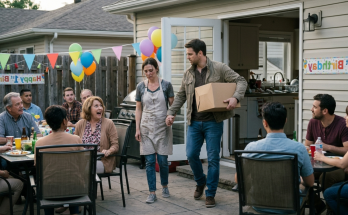
Almost a year after Walt died, I invited all three of my children to my new home for Thanksgiving.
This time, there were no envelopes waiting on the table.
There were no secrets.
There was only food, laughter, and the familiar sound of my grandchildren running through the house.
Michael arrived early and helped Danny carry chairs from the garage.
Stephanie brought a homemade apple pie and immediately began arguing with Danny about whether it needed more cinnamon.
Kayla was in the kitchen preparing Walt’s favorite roast, while the boys set the table.
For a moment, I stood in the doorway and watched them.
This was what I had wanted all along.
Not obedience.
Not repayment.
Not even apologies.
Just my family, together.
After dinner, Michael raised his glass.
“I’d like to say something.”
Danny groaned playfully.
“Here comes the executive speech.”
Everyone laughed.
Michael smiled, then looked at me.
“Mom, last year, I thought Dad’s letters were about money. I thought the trust was a judgment about which child deserved more.”
He paused.
“But I’ve come to understand that Dad wasn’t trying to tell us who was worth more. He was trying to show us what we had forgotten.”
He looked at Danny.
“You taught me that showing up matters more than talking about how busy you are.”
Then he turned to Stephanie.
“And you reminded me that admitting you’ve made mistakes is better than spending your life pretending you haven’t.”
Stephanie wiped her eyes.
Michael finally faced me.
“Mom, I can’t give you back the day you called me. I can’t erase the way I made you feel. But I can promise to spend the rest of my life making sure you never have to wonder whether I love you.”
I felt tears slipping down my cheeks.
“I don’t need you to spend your life making up for one day, Michael. I need you to spend it being my son.”
He nodded.
Then Danny stood.
“I want to say something, too.”
He reached into his pocket and pulled out a small photograph.
It was the same picture from his envelope: him at seventeen beside Walt and the old blue pickup truck.
“I had this framed,” he said.
He handed it to me.
On the back, beneath Walt’s original words, Danny had written a new sentence.
The greatest inheritance was knowing that Dad saw me.
I pressed the photograph against my chest.
For a moment, I couldn’t speak.
Then I looked at my children.
“Your father would have loved this evening.”
Danny smiled.
“He would’ve complained about how much the food cost.”
Michael laughed.
“And then he would’ve eaten three servings.”
Stephanie raised her glass.
“To Dad.”
We all raised ours.
“To Dad.”
And in that little house, with its crowded dining room and imperfect furniture, I felt Walt’s presence more strongly than I ever had in our old home.
Not because of the money he had left.
But because the truth he had planted in our family was finally growing into something good.
A few months later, I visited Walt’s grave alone.
I brought flowers from my garden and sat beside his headstone.
The morning was quiet. The wind moved gently through the trees.
“Well, Walt,” I whispered, “you certainly knew how to make an impression.”
I told him about Danny’s garage, Michael’s Sunday calls, and Stephanie’s work with the housing fund.
I told him about the grandchildren, who were growing taller every month.
Then I told him something I had not said aloud before.
“I was angry with you at first.”
I brushed a fallen leaf away from the stone.
“I wondered why you made me carry that secret. Why you wanted me to discover how our children would behave when they thought I had nothing.”
I paused.
“But I understand now.”
The money had not made my children selfish.
It had not made Danny generous.
It had simply revealed the habits, fears, and values that had already been there.
And once those truths were exposed, each of them had been given a choice.
They could defend themselves.
Or they could change.
Michael and Stephanie had chosen to change, slowly and imperfectly.
Danny had continued being the man he had always been.
And I had learned that loving my children did not mean protecting them from the consequences of their choices.
I could forgive them without pretending nothing had happened.
I could love them without allowing money to become the price of that love.
I placed my hand against Walt’s headstone.
“You were right about one thing, my love. Money does show you who people are.”
I smiled through my tears.
“But sometimes, when people see who they’ve become, they decide to become someone better.”
Then I stood, brushed the dirt from my skirt, and walked back toward my car.
I had a family dinner to prepare.
On the second anniversary of Walt’s death, my children gathered at my house once more.
After dinner, Danny’s oldest boy climbed onto my lap.
“Grandma, Dad says Grandpa left us a lot of money. Is that why we have a nice house now?”
I smiled and brushed his hair away from his forehead.
“Your grandfather did leave your family some money, sweetheart.”
“Then money makes people happy?”
I considered the question carefully.
“No, darling. Money can help people feel safe. It can buy a home, food, medicine, and opportunities. Those things matter very much.”
He nodded solemnly.
“But money can’t make somebody love you. And it can’t make you love somebody else.”
He thought about that for a moment.
“Then what makes people happy?”
I looked toward the kitchen, where Danny and Michael were arguing cheerfully about a football game while Stephanie and Kayla laughed over a spilled cup of coffee.
“People who love you,” I told him. “People who show up when you need them. People who make room for you even when their own lives are crowded.”
He rested his head against my chest.
“Like Dad giving you his bed?”
I kissed the top of his head.
“Exactly like that.”
And I realized that my husband had left our family something far more valuable than $3.8 million.
He had left us a lesson that no bank account could measure.
Love is not proven by what you inherit. It is proven by what you are willing to give when you believe there is nothing to gain.
I had called my three children believing I had lost everything.
In truth, I had discovered what each of them carried inside.
One had to learn humility.
One had to learn compassion.
And one had already learned that a home is not a place with enough bedrooms.
It is a place where someone will move over, give you their pillow, and tell you that you belong.
My husband had been gone for two years, but every time my children gathered around my table, I felt that his most important work was still alive.
And as I looked around at the family we were slowly rebuilding, I knew something with absolute certainty.
I had never been poor.
Not when I lost my husband.
Not when I believed I had lost my home.
And certainly not when my children discovered the truth.
Because the greatest wealth I possessed was never hidden in a bank account.
It was sitting around my dinner table.
And this time, there was room for everyone.