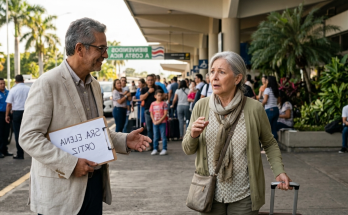
My 80-year-old mother went away for a week to reconnect with a childhood friend. Seven days later, when I picked her up at the train station, she looked frighteningly thin and exhausted, and she was carrying a large black suitcase I had never seen before.
I almost walked past her. Her cardigan hung loose on her shoulders, and she seemed to be concentrating just to stand comfortably. The suitcase beside her was nearly twice the size of the small blue travel bag she had taken.
“Mom?” I hurried over. “What happened? Are you feeling all right?”
She gave me a tired smile. “I’m fine, sweetheart. Just had a little trouble with my stomach.”
“You look exhausted. I think we should have a doctor examine you.”
“Please, Laura. I just want to go home and rest.”
I looked at the suitcase. “Where’s your blue bag?”
Her fingers tightened around the handle. “It broke during the trip. Margaret gave me this one.”
“Margaret gave you a suitcase?”
“Can we go now, dear?”
I could hear that she didn’t want to talk. I didn’t push her at the station. I told myself she was eighty, tired from traveling, and entitled to a little privacy. I also knew how quickly concern could sound like an accusation when I was worried.
At home, she insisted on taking the suitcase straight to her bedroom. Then she shut the door and locked it. I had never known her to lock that door.
I waited until evening, when she was resting upstairs, and called the number she had given me for Margaret. A man answered.
“Hello?”
“Good evening. May I speak to Margaret, please?”
There was a pause. “I’m sorry, but Margaret hasn’t lived here for eight years.”
“Eight years? Are you certain?”
“Absolutely. I’ve had this number for a long time.”
I checked the contact information after we hung up. I had copied it correctly. The number was exactly the one Mom had given me.
I stood with my phone in my hand, trying to make the details fit. Margaret lived about three hours away, Mom had said. The two women had known each other since childhood but hadn’t seen each other in twenty years. Now the number led to a man who said Margaret had been gone for eight.
The following morning, I found Mom asleep in her favorite armchair, still wearing yesterday’s cardigan. A train ticket sat on the table beside her. Its date was three days earlier than the day she had told me she was returning.
Under the ticket was a luggage tag attached to the black suitcase. The printed name was Ellen.
I looked at my mother, still asleep. I knew the suitcase was upstairs, behind her locked bedroom door. I also knew I had no right to search her belongings. I stood there for a while, caught between the fear that something was wrong and the fear that I would find out something I couldn’t take back.
Then I thought of how she had looked at the station.
I went into her room and opened the suitcase.
Inside were neatly arranged clothes, much larger than anything my mother wore. There was an unopened brown envelope and an old digital camera. I pressed the camera’s power button. The battery was nearly empty, and there were only four photographs.
In the first, Mom stood outside an unfamiliar brick house. In the second, she sat beside a frail elderly woman. The third showed them in the same room, but from farther away. In the fourth, I saw the narrow front steps and the old iron railing of a house I had known as a child.
It was the house where my mother had once taken me, nearly fifty years earlier. I remembered the brick front, though I couldn’t have said why that picture had stopped me. Then I remembered the address. I had not thought about it in years.
I took my keys and drove there.
The house looked smaller than it did in my memory. The iron railing was still there. I stood at the door long enough to consider going back, then knocked.
An elderly woman opened it. She was the woman in the second photograph.
“Is Evelyn here?” I asked.
The woman looked at me, then past me toward the street, as if checking whether someone else had come. “No. She went home.”
“Who are you?”
She held the door but didn’t invite me in. “I’m Ellen.”
The name on the suitcase tag.
I had a lot of questions. The one that came out was, “Why did my mother come here?”
Ellen lowered her eyes. “She told you she was visiting Margaret?”
“Yes.”
“She didn’t want you to know about me.”
Behind her, I could see the brown envelope and the camera on a small table. The same items I had found in the suitcase.
“Are you her friend?” I asked.
Ellen shook her head. “I’m her daughter.”
The words were plain. I still needed a moment to understand them.
She told me she had been born before me, when Mom was young. Mom had given her up, and another family had raised her in that house. The woman in the photograph was the person who had brought Ellen up. The address was familiar because Mom had taken me there when I was small, though I had never known why.
“Did she know where you were all these years?” I asked.
“She knew where I lived. We wrote sometimes. We saw each other now and then.” Ellen paused. “The last time was twenty years ago.”
That fit the story Mom had given me, almost exactly. The childhood friend she said she was visiting was the daughter she had not told me about. Margaret was the name she used to cover it.
“Why now?” I asked.
“She wanted to come. I wanted her to.” Ellen glanced at the suitcase. “She was going to bring those things back. They’re mine. I told her she could take them, but she shouldn’t have had to lie to you.”
I wanted the details to be simpler than they were. Instead, I asked what the photographs were for.
“Just the camera,” Ellen said. “She wanted pictures of the house and of us together.”
The fourth photograph showed why Mom had carried it home. It wasn’t evidence of a crime or a mistake. It was a record of the place where her first daughter had grown up, a place she had kept just outside my knowledge.
Ellen let me take the brown envelope with me. It had not been opened. Inside were old letters between her and Mom, along with a recent note from Ellen asking Mom to visit again. I read enough to understand that this wasn’t a sudden meeting. It was a relationship my mother had managed privately for years, sometimes close and sometimes distant.
I drove home with the envelope on the passenger seat. Mom was awake when I came in.
She looked at it. “You went there.”
“I did.”
“You shouldn’t have opened the suitcase.”
“I know.” I set the envelope on the table. “But I did. And I met Ellen.”
Mom stared at the envelope. “I was going to tell you.”
“When?”
She drew her cardigan closer around herself. “I don’t know.”
“Was Margaret ever part of this?”
“No.” Her answer came quickly, then she looked away. “Not this trip.”
“You told me you were going to see a childhood friend.”
“I couldn’t say it was Ellen.”
“You could have said there was someone you wanted to visit and you weren’t ready to explain.”
“I thought you’d ask questions.”
“I did ask questions. You gave me a false name and an old phone number.”
She pressed her lips together. “I didn’t know what you’d do.”
That was the part I had been trying not to hear. She had imagined my questions before I asked them and chosen the lie she thought would keep them away.
“Were you afraid I’d be angry?” I asked.
“I was afraid you’d think less of me.”
I looked at her. “You let me spend the night thinking you might be sick, and then I found out I didn’t know where you’d been.”
“I didn’t mean to frighten you.”
“But you did.”
She was quiet. Then she asked, “Did Ellen tell you everything?”
“She told me she’s your daughter. She said you’ve been in touch, and that you last saw each other twenty years ago.”
Mom nodded once.
“Why didn’t you tell me?”
Her answer came in fragments. She said she had been young when Ellen was born, and that the decision had been made for her. She had let Ellen be raised by another family. Later, she had stayed in contact but never found a way to bring that history into the life she had built with me.
“I kept thinking I’d tell you when it felt easier,” she said. “Then years went by.”
“Did you tell anyone else?”
“A few people knew.” She rubbed her thumb against the edge of her sleeve. “I didn’t know how to tell you.”
I wanted to say that other people knowing made it worse. I also knew the secret wasn’t mine to expose carelessly. But she had brought the lie into my life, and she had made me worry about her health while she hid the person she had gone to see.
“You could have told me the truth without telling me every detail,” I said. “You didn’t have to make me believe Margaret was waiting for you.”
“I know.”
“Do you?”
She looked up then. “I was ashamed. I thought if I kept it separate, I could keep all of us from being hurt.”
I had a sentence in my head that I was nervous to say aloud: I had trusted you, and now I didn’t know what else in our family had been arranged around what you couldn’t bear to tell me.
Instead, I said, “I don’t know what I’m supposed to do with this.”
“You don’t have to do anything today.”
“That’s what you’ve been doing for years.”
She flinched, and I wished I had put it more gently. I didn’t take it back.
The envelope stayed on the table between us. I told her I had read the recent note and the old letters, but not every page. She said the letters weren’t meant for me. I said I understood that, but the lie about the trip was meant for me.
“I should have told you there was someone important I wanted to see,” she said.
“Yes.”
“I didn’t want to lose what we have.”
“I’m still here. But I can’t pretend the trip was what you told me.”
She nodded, then asked me not to call the rest of the family yet.
“I’m not going to announce your private history to everyone,” I said. “But I won’t help you keep calling Ellen Margaret.”
That evening, I called Ellen from the number she gave me. I put the phone on speaker and asked Mom if she wanted to talk to her.
For a few seconds, neither woman spoke.
Then Ellen said, “You got home?”
“I did,” Mom replied.
“You could have told Laura.”
“I know.”
“You told me you were going to tell her.”
“I thought I could. I’m sorry.”
Ellen let out a small breath. “I don’t want to be the reason you fight.”
“You’re not,” I said. “The lie is.”
Mom looked at me, but didn’t argue.
Ellen said she wasn’t asking me to call her anything in particular or to make up for lost time. She wanted to keep seeing Mom. She also wanted me to know the truth. I told her I needed time, but I wanted to meet again when we could do it without pretending she was a friend.
“Whenever you’re ready,” Ellen said.
Mom asked if she could speak to Ellen alone. I handed her the phone. I went into the next room, but I could hear the low, uneven shape of their conversation. They talked about the visit, the suitcase, and whether Ellen had eaten. It sounded like two people who knew each other and had missed more than one chance to be honest.
The next Sunday, Mom came to our usual family dinner. I told the relatives who were there that she had a daughter named Ellen and that I had met her. I did not read the letters or explain the circumstances around Ellen’s birth. That was Mom’s story to tell, if she chose to tell it.
Mom sat through the first few minutes without speaking. One relative asked why she had kept it secret. Mom started to say she had meant to explain, then stopped.
“I was ashamed,” she said. “And then I let the silence go on too long.”
Nobody rushed to excuse her. Nobody told her she was a terrible person, either. There were questions, and Mom answered the ones she could. When she tried to say she had only been protecting us, I told her that protection was not what it had felt like from my side.
“I know,” she said. This time, she didn’t add anything.
After dinner, I called Ellen again. Mom sat beside me while I did. Ellen answered, and I said I wanted to see her. I didn’t call her Aunt or try to make the relationship sound settled. I told her I was glad she had agreed to meet.
“Your mother said you might,” Ellen replied.
Mom closed her eyes at the words, but she didn’t interrupt.
The suitcase stayed with Mom for a while. Then, with her agreement, I returned it to Ellen. The clothes belonged to her, and so did the camera. I kept no letters and made no copies. The photographs were Ellen’s to decide what to do with.
Mom and I still had to talk about the years she had kept this from me. I didn’t promise we could fix that in one conversation. I did tell her I would come with her to see Ellen again, as long as she stopped asking me to pretend she was someone else.
She agreed.
I had gone to the station expecting to bring my mother home. I came home with the truth about the daughter she had left out of my life.